
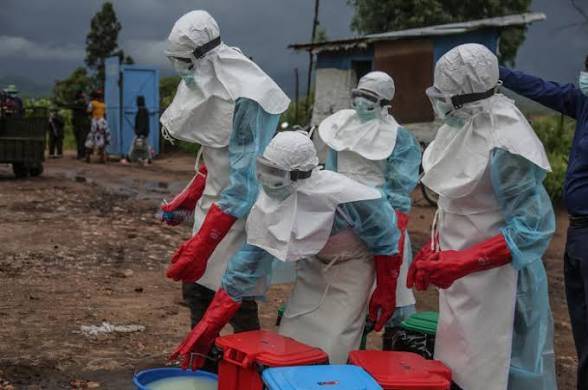

From the day the Democratic Republic of the Congo announced a fresh outbreak of Ebola, fears have spread far beyond its borders. Currently, health officials in the DRC are racing to contain the deadly virus. Countries across Africa, including Nigeria, are once again on alert over the potential for cross-border transmission. For a continent already burdened by fragile healthcare systems, insecurity, and poverty, the return of Ebola revives memories of one of the world’s most feared diseases.
The latest outbreak is once again exposing the difficult intersection of public health, insecurity, and survival in Africa. Sunday Vanguard examines how prepared Nigeria is to confront any possible outbreak
When Ebola entered Lagos
Twelve years ago, an infected traveler walked quietly into Lagos from Liberia carrying the Ebola virus into Nigeria, triggering one of the country’s gravest public health emergencies.
Within days, fear spread across Africa’s most populous nation.
Hospitals went on alert.
Health authorities scrambled into emergency contact tracing.
Airports tightened surveillance.
Ordinary citizens watched as uncertainty and panic took hold of Lagos, before spreading to Port Harcourt.
At the centre of that unfolding crisis stood a small group of Nigerian health workers who suddenly found themselves confronting a disease few had ever managed at close range.
Among them was the late Dr. Stella Adadevoh, whose firm decision to detain the index patient, despite intense pressure, is widely credited with preventing a far wider national catastrophe.
Her action set in motion a chain of emergency containment measures that would define Nigeria’s response in the weeks that followed.
Thanks to the Lagos State government for its prompt response.
Isolation protocols were activated, contact tracing was intensified, and health authorities worked against time to contain what many feared could spiral beyond control.
By the time the outbreak was declared over, Nigeria had recorded 20 confirmed cases and eight deaths before the World Health Organization officially declared the country Ebola-free on October 20, 2014, after 42 days without a new infection.
Lingering memories
At a major isolation ward in Lagos, a senior nurse who worked during the 2014 response still remembers the silence that followed suspected cases.
“We were afraid, not just of the patients, but of what we did not know,” she told Sunday Vanguard.
“Every movement felt like a risk. We wore protective gear for hours. Some of us went home and avoided our families for weeks.”
She described how training was suddenly compressed into emergency survival.
Her words: “We were learning infection control while already on the battlefield. There was no luxury of preparation.”
Her reflection is echoed years later by a journalist who was admitted into a COVID-19 isolation facility after testing positive during the pandemic.
She said the experience reshaped her understanding of outbreak fear and hospital environments.
“Fears gripped me while in isolation,” she recalled.
“You would see health workers moving in protective gear, and from my ward, I often saw bodies being moved out at intervals. It was a very frightening experience, not just because of the illness, but because of the environment itself.”
She added that what unsettled her most was not only the disease, but the atmosphere of uncertainty.
“You are alone, cut off, and everything happening around you feels like a reminder of how fragile life is in an outbreak situation.”
Today, she says, what worries her most is how quickly such memories fade from public consciousness.
“It feels like society has moved on completely. But those of us who were inside those wards know how fast things can escalate.”
New threat emerges
But 12 years later, investigations suggest that many of the lessons from Ebola and even the painful experience of COVID-19 may have faded faster than the memories of the crisis itself.
Today, the threat is once again drawing dangerously close.
On May 15, 2026, the Democratic Republic of the Congo officially declared a fresh Ebola outbreak after laboratory confirmation of the deadly Bundibugyo strain in Ituri Province.
Days later, the World Health Organisation classified the outbreak as a Public Health Emergency of International Concern (PHEIC), raising fears of possible regional spread through Africa’s highly mobile population.
Although Nigeria has no confirmed Ebola case as of press time, findings by Sunday Vanguard reveal growing concerns over whether the country can still mount a response as coordinated and rapid as it did in 2014.
Fading vigilance and system decay
Visits to several public places, transport hubs, and entry points showed that many of the preventive structures hurriedly installed during COVID-19 have collapsed, been abandoned, or become ineffective.
Temperature screening devices once mounted at airports and border posts are no longer functional in several locations.
Hand-washing stations that became common in banks, churches, shopping centres, and government offices during the pandemic have largely disappeared.
In crowded motor parks, compliance with basic hygiene protocols has almost completely faded.
More troubling is what experts describe as “silent system decay.”
Several states still lack fully equipped infectious disease laboratories.
Emergency response teams exist in name but struggle with logistics, funding, and manpower. Surveillance reporting remains inconsistent across regions.
Government response
However, officials at the Federal Ministry of Health and Social Welfare insist Nigeria is not unprepared.
According to a statement from the ministry, the Nigeria Centre for Disease Control and Prevention, NCDC, has activated enhanced surveillance at airports, seaports, and land borders following the outbreak in Central Africa.
Rapid response teams have been placed on alert, and states have been directed to intensify reporting of suspected viral haemorrhagic fever cases.
But health experts, who spoke to Sunday Vanguard, argued that Nigeria is not ready for another pandemic. They argued that even with structures, the question is how quickly it can respond if something slips through.
They added that the gap between structure and speed remains a fear. Infectious experts speak.
Preparedness is not memory, it is action —Prof Tomori
In a chat with Sunday Vanguard, a renowned virologist, Prof. Oyewale Tomori, warned that Nigeria risks confusing past success with present safety.
“We must stop behaving as though because we defeated Ebola in 2014, we are automatically safe today. That is not how infectious diseases work. One infected traveler and a delayed response can change everything. We survived because we were ready before we knew we needed to be.”
Tomori said the 2014 success was built on urgency, not infrastructure maturity.
“What worked then were speed, leadership, and coordination. People acted as if every hour mattered, because it did.”
He warned that many of those advantages have weakened.
“Surveillance is uneven. Laboratory systems are not strong enough in all states. Funding is inconsistent. These are not minor issues.”
He added that urban density increases national risk.
“In Lagos, movement is constant. If Ebola enters and is not detected quickly, transmission can escalate before the system even fully responds.”
For Tomori, the biggest danger is psychological.
“The moment people believe the threat is over forever, that is when vulnerability increases”, the virologist said.
“First, Nigeria should not live on past glory. The fact that you did it in 2014 doesn’t mean you’re doing it now.
“You passed last time, but that doesn’t mean you’ll pass this time. The only way to pass this time is to prepare not to panic, but to prepare.
“How do you prepare? Get all your surveillance systems in place. You have awareness of the doctors and other health workers.
“You man your borders just to be sure you are monitoring people who are coming in. I’m not saying we should close our borders.
“But most importantly, you get your labs ready. If you know what happened, even though DR Congo has had 16 episodes of Ebola, they failed woefully this time.
“So, within two days of hearing about it, the number of cases has gone from 300, now it’s 500, now it’s 600. Which means it’s been there before, and we didn’t know. Their system did not detect this.
“In fact, when you look at the report, the first so-called indicator was around April 24. Wow. The formal diagnosis did not come until May 13.
“That’s almost three weeks or more.
“The lab facility they have in that area is not up to par, because they are already taking a sample about a week from the first onset to the lab, the lab didn’t detect it.
“It took a week for the lab to send it to Kinshasa, where it was finally diagnosed. “So, the lab system is not up to par. It appears that maybe it’s only the lab in Kinshasa that has the capacity to do proper diagnosis, which is wrong.
“If you don’t decentralise your diagnostic, then forget it. This is what will happen to you. That’s what is happening today. So, in terms of preparedness, they may shout from the rooftop that they are prepared. But this one has shown us that DRC was not prepared.
“You can relate it to Nigeria because for the last six years or so, we have not learned anything. And that’s why everybody has seen an annual event. We need to run around and set up a task force. We have been doing that for the last 60 years. So, we are not prepared. Therefore, if Ebola comes in from outside, we will not know. We will not be prepared because we are not prepared for this one.”
According to him, Nigeria needs a multi-diagnostic lab and reagents that can detect all infectious diseases, not just specific.
“When your labs were set up, they were set up as a COVID laboratory. So, when COVID finished, they finished. Our labs should be built to diagnose any disease, not specific to COVID or Lassa, or whatever lab. That’s the error we are making”, Tomori explained.
“So, what you need, you need to provide them with the basic resources, the reagents, and stuff. The techniques are the same. But if you don’t have the reagent for diagnosis, you won’t be able to do anything.
“So, we should equip all these labs with the common reagents that we have. Diagnosis for Lassa, for Ebola, for Marburg, for whatever, hantavirus, anything. They should be able to make any diagnosis of any disease.
“That’s the error we are making. Our labs should be versatile.
“Annually, we talk about 10,000. All these 15 years, you may have been asking the question, the remaining 9,000 that look like Lassa, what is it? If it is negative for Lassa, is it not positive for something?
“For the last 15 years, we have been saying 10% diagnosis of Lassa. The remaining 9,000 cases, that are making our people sick. What is it? So if Ebola comes into this country now, I can assure you that NCDC is not going to be able to do that because they will need the reagent. Our labs should be multidimensional.
“They need to diagnose as many things as possible. Not just the COVID lab, Lassa lab, or whatever lab. Not disease-specific labs”.
He noted that part of the problem that DR Congo had was that they had the facility that diagnosed Ebola Zaire, but not Ebola Bundibugyo.
“And that’s where the problem is”, he continued.
“Bundibugyo has been around for more than 10 years. It has had two or three outbreaks before. But the lab in the area where they were has a facility to do Ebola Zaire. That’s why they were getting negative. If it was negative for Ebola Zaire, then the same was negative for the others, or negative for Ebola Bundibugyo. That’s why I say, equip your lab with all the facilities to make a diagnosis.
“That’s the first step, then you can actually nip the cases and you can treat the ones that, you know, the few cases you have, and you don’t have an epidemic in your hand.
Discover more
Public policy analysis
Press release distribution
Print newspaper delivery
“We are concentrating so much on control and so much on the vaccine and all that.
“The most important thing for us is surveillance, diagnosis, and detection. And once you detect one case, you do contact tracing immediately.
“You can actually nip that thing in the bud, just like we did in 2014.”
According to him, there was a need for African to build on their strength.
“So why is Africa making noise about its weakness? There’s no part of the continent, in any country, that is as experienced as Africa in looking at disease outbreaks”, Tomori said.
“Why don’t governments provide resources for people to improve on surveillance and the lab, rather than say ‘we’re waiting for a vaccine, or we’re waiting for whatever, drugs?’”
He said the surveillance is there for the government to improve upon: “How much is it going to cost us to improve surveillance? There’s no protective coat.
There’s no mask. How much are we talking about with all those things? Again, with one tire of a senator’s car, we’ll pay for all those things for a hospital.
“The media should stop covering these things up.
Uganda case
“The only country that I can point out that has done well is Uganda. Within two days, they found the case. There was supposed to be a mass religious rally, last weekend. They cancelled it immediately.
“Those are sensible countries. Try that in Nigeria. It’s Easter, and you say, ‘Don’t go to the Easter rally’. Christians call the curse of God on you. Or tell the Muslims not to go to the mosque. All those factors contribute to the spread”.
We are building fire stations after fire —Ashiru
To the founding President of the Academy of Medical Sciences, Prof. Oladapo Ashiru, Nigeria continues to repeat the same cycle of reactive health management instead of sustaining long-term epidemic preparedness.
According to him, the country often mobilises aggressively during outbreaks, only to abandon critical structures once the immediate danger fades.
“We are still building fire stations after the fire has already happened,” Ashiru said.
He warned that despite lessons from Ebola and COVID-19, Nigeria has failed to institutionalise permanent emergency response systems.
“There is no continuity. After every outbreak, there is momentum. Then it fades. That is one of our greatest weaknesses”, he said.
Ashiru stressed that the fresh Ebola outbreak in parts of East and Central Africa demands “extreme vigilance” from Nigerian authorities, particularly at airports and other entry points.
“What is important now is extreme vigilance on the part of the government. We were able to do this during COVID-19, although even then it was still not enough”, he stated.
According to him, flights originating from or connecting through East African hubs such as Ethiopia and Kenya should receive closer monitoring because of passenger movement from affected countries.
“Somebody may travel from Uganda or Congo and then connect back into Nigeria. Authorities must document such passengers properly and monitor them.”
He advised that travelers arriving from outbreak-prone areas should receive health warnings and be monitored for possible symptoms.
“They should reduce unnecessary close contact for some days, just in case they may have had exposure during travel.”
Ashiru also called for the return of visible hygiene measures at ports, hospitals, and public places.
“All ports of entry should have sanitizers and hygiene stations again. People should sanitize their hands and even their luggage because somebody else may have touched those surfaces.” He urged Nigerians to revive some of the preventive habits adopted during COVID-19.
“People should begin to keep sanitizers around them again. Immediately you get home, wash your hands properly. Those are simple but important preventive measures.”
The professor stressed that hospitals must maintain a high level of alertness, recalling how the late Dr. Stella Adadevoh identified the first Ebola case in Nigeria in 2014.
“She recognised that the patient was not suffering from ordinary malaria but Ebola. That level of vigilance is extremely important”, Ashiru said.
According to him, suspected cases must be isolated immediately to prevent wider transmission.
He also urged the media to intensify public awareness of Ebola symptoms and prevention.
“There is a major role for the press in educating people about warning signs such as fever, vomiting, fatigue, and unusual bleeding”, the professor said.
He noted that many of the infection prevention measures used during COVID-19 remain relevant.
“People must avoid contact with body fluids from sick persons, contaminated clothes, beddings, and medical equipment.”
He warned against the unsafe handling of wildlife and poorly cooked meat.
“Contact with bats, infected animals, and raw meat is dangerous. Meat must be properly cooked.”
For healthcare workers, Ashiru emphasised strict use of protective equipment.
“Medical workers handling suspected cases must use proper protective gear and double gloves because infection can occur even during removal of protective coverings.”
He further advised that travelers returning from outbreak zones should be monitored for up to 21 days.
“Ebola incubation can last three weeks, so people returning from affected areas should be closely monitored.”
Ashiru lamented Nigeria’s declining vaccine production capacity, recalling that the country once produced yellow fever vaccines locally in Yaba.
“Years ago, Nigeria produced yellow fever vaccines for Africa. Today, we are waiting for foreign countries to help us with Ebola vaccines. That should not be our reality.”
According to him, Nigeria already has the scientific expertise required to strengthen vaccine research and development.
“We have the scientists and the brainpower. What is needed is proper support and funding for research institutions.”
He urged the government to invest more seriously in local biomedical research and vaccine production capacity to reduce dependence on foreign intervention during health emergencies.
Nigeria is at high risk of Ebola – Ifeanyi
Reacting to why Nigeria should be concerned, a Public Health Analyst and the National President of the Association of Medical Laboratory Scientists of Nigeria, Dr. Casmir Ifeanyi, told Sunday Vanguard that infectious disease outbreaks are won or lost at the point of timing.
According to him, Nigeria has genuine reasons to be worried because of the country’s high vulnerability to imported infections through regional and international travel.
“Though we do not currently have an outbreak in Nigeria, we are at serious risk of importing the disease. Africa is highly interconnected through air and land travel, and Nigeria has very porous and vulnerable entry points”, Ifeanyi said.
He stressed that diseases themselves do not move across borders independently.
“Diseases do not travel by themselves; it is people who travel. Nigerians are highly mobile people, and there is massive regional movement across Africa every day”, the professional said.
“Somebody can travel from Uganda or Congo, connect through Ethiopia or Kenya, and arrive in Nigeria within hours.”
Referring to the outbreak in the Democratic Republic of the Congo and Uganda, Ifeanyi warned that the mortality figures already being reported should not be ignored.
“As we speak, hundreds of people have reportedly been affected and mortality is already approaching 50 percent in some reports.
“In one sample analysis, 13 suspected specimens were tested and eight turned positive. Once you begin to see positivity rates like that, the concern becomes extremely serious.”
He explained that Ebola remains especially dangerous because infected individuals may appear healthy during the incubation period while still moving freely within communities.
“Ebola has an incubation window of up to 21 days. Somebody may look perfectly healthy today and suddenly develop fever, vomiting, weakness, and complications tomorrow. Once symptoms begin, transmission risk becomes very high because the virus is already shedding.”
According to him, delayed diagnosis remains one of Nigeria’s greatest vulnerabilities.
“Everything breaks at the point of delay. If you detect early, you contain. If you delay, you escalate. That delay alone can determine the eventual size of an outbreak.”
Ifeanyi noted that Nigeria’s 2014 Ebola response succeeded largely because of aggressive surveillance and rapid contact tracing.
“Contact tracing during the 2014 outbreak was intense and disciplined. That level of coordinated response must be sustained and not assumed simply because we succeeded once before”, he said.
The expert, however, lamented that many of the preventive structures and behavioural practices introduced during Ebola and COVID-19 have largely disappeared.
“A whole lot of resources were invested in isolation centres, temperature monitoring systems, hand sanitizers, and public awareness campaigns. Today, most of those structures have either collapsed or been abandoned.”
He compared Nigeria’s situation with some African countries that maintained strict hygiene culture long after previous outbreaks subsided.
“In countries like Rwanda, hand hygiene culture and some preventive measures remained part of public life even after the outbreaks reduced. But in Nigeria, we abandoned virtually everything immediately the crisis faded.”
Ifeanyi expressed deep concern over Nigeria’s laboratory and diagnostic capacity, describing it as one of the weakest aspects of the country’s preparedness system.
“My greatest worry is diagnosis. Laboratory capacities for Ebola and other viral haemorrhagic diseases remain grossly inadequate in many parts of the country. Outside the NCDC structure, several hospitals still lack the ability for rapid diagnosis and confirmation.”
According to him, delays in laboratory confirmation could prove disastrous in densely populated urban areas.
“If there is an Ebola outbreak in Lagos today and samples still have to move across facilities before confirmation, imagine what could happen during that waiting period.”
He attributed the challenge to years of underinvestment in medical laboratory infrastructure and personnel.
“We have weak laboratory systems, inadequate facilities, and insufficiently trained manpower. Preparedness is not just about equipment. It involves training, logistics, funding, and functional systems.”
The infectious disease specialist also warned that healthcare workers remain highly exposed during outbreaks if proper protective measures are not in place.
“In the DRC now, there are already reports of healthcare-associated infections, meaning health workers themselves are becoming infected while attending to patients.”
He therefore called for immediate retraining of health workers across public and private hospitals.
“It is time for workshops, retraining, and renewed infection prevention protocols. Personal protective equipment must be available because healthcare workers are often among the first casualties during outbreaks.”
Ifeanyi criticised what he described as Nigeria’s weak hygiene culture, warning that poor public health habits could accelerate transmission if Ebola enters the country.
“Our hand hygiene culture is extremely poor. People leave toilets without washing their hands, touch surfaces carelessly, and move around freely without basic hygiene consciousness. For a highly contagious disease like Ebola, that is dangerous.”
He also cautioned against unsafe contact with wildlife and bushmeat, noting that bats and primates remain major reservoirs of the Ebola virus.
“Nigerians consume a lot of bushmeat delicacies, and that increases risk because Ebola is a zoonotic disease linked to animal reservoirs.”
While acknowledging efforts by the NCDC, to issue alerts and advisories following the outbreak in Central Africa, Ifeanyi insisted that public warnings alone are insufficient.
“It is good to call for calm, but calm alone is not enough. What we need now is preparedness — real preparedness across hospitals, laboratories, and surveillance systems.”
According to him, Nigeria’s vulnerabilities extend beyond a single agency and reflect broader weaknesses in the healthcare system.
“If someone develops symptoms today, the person will first go to a hospital, not the NCDC headquarters. The real question is: how prepared are our hospitals? What is the level of awareness and readiness among healthcare workers?”
He warned that unless Nigeria urgently strengthens laboratory systems, healthcare preparedness, and outbreak response coordination, the country could struggle severely if another imported Ebola case occurs.
“If one infected traveler enters Nigeria today, we may run helter-skelter. That is the reality.”
Memory and preparedness
For many experts, the fear is not merely hypothetical.
Nigeria’s 2014 Ebola experience demonstrated how quickly a single imported case can escalate into a national emergency if surveillance systems fail.
That outbreak was contained only through aggressive contact tracing, rapid isolation, and the extraordinary sacrifice of health workers who operated under extreme risk.
But experts warned that success built on urgency can fade if not institutionalised.
Across Africa, new outbreaks and persistent mobility patterns continue to increase cross-border disease risk.
For Nigeria, a large, densely populated, and highly mobile country, the challenge is not history. It is readiness.
The experts insisted the lesson is not about remembering 2014, but about rebuilding the systems that made survival possible, adding that in public health, memory does not stop transmission. But only systems do.
In a chat with Sunday Vanguard, a renowned virologist, Prof. Oyewale Tomori, warned that Nigeria risks confusing past success with present safety.
“We must stop behaving as though because we defeated Ebola in 2014, we are automatically safe today. That is not how infectious diseases work. One infected traveler and a delayed response can change everything. We survived because we were ready before we knew we needed to be.”
Tomori said the 2014 success was built on urgency, not infrastructure maturity.
“What worked then were speed, leadership, and coordination. People acted as if every hour mattered, because it did.”
He warned that many of those advantages have weakened.
“Surveillance is uneven. Laboratory systems are not strong enough in all states. Funding is inconsistent. These are not minor issues.”
He added that urban density increases national risk.
“In Lagos, movement is constant. If Ebola enters and is not detected quickly, transmission can escalate before the system even fully responds.”
For Tomori, the biggest danger is psychological.
“The moment people believe the threat is over forever, that is when vulnerability increases”, the virologist said.
“First, Nigeria should not live on past glory. The fact that you did it in 2014 doesn’t mean you’re doing it now.
“You passed last time, but that doesn’t mean you’ll pass this time. The only way to pass this time is to prepare not to panic, but to prepare.
“How do you prepare? Get all your surveillance systems in place. You have awareness of the doctors and other health workers.
“You man your borders just to be sure you are monitoring people who are coming in. I’m not saying we should close our borders.
“But most importantly, you get your labs ready. If you know what happened, even though DR Congo has had 16 episodes of Ebola, they failed woefully this time.
“So, within two days of hearing about it, the number of cases has gone from 300, now it’s 500, now it’s 600. Which means it’s been there before, and we didn’t know. Their system did not detect this.
“In fact, when you look at the report, the first so-called indicator was around April 24. Wow. The formal diagnosis did not come until May 13.
“That’s almost three weeks or more.
“The lab facility they have in that area is not up to par, because they are already taking a sample about a week from the first onset to the lab, the lab didn’t detect it.
“It took a week for the lab to send it to Kinshasa, where it was finally diagnosed. “So, the lab system is not up to par. It appears that maybe it’s only the lab in Kinshasa that has the capacity to do proper diagnosis, which is wrong.
“If you don’t decentralise your diagnostic, then forget it. This is what will happen to you. That’s what is happening today. So, in terms of preparedness, they may shout from the rooftop that they are prepared. But this one has shown us that DRC was not prepared.
“You can relate it to Nigeria because for the last six years or so, we have not learned anything. And that’s why everybody has seen an annual event. We need to run around and set up a task force. We have been doing that for the last 60 years. So, we are not prepared. Therefore, if Ebola comes in from outside, we will not know. We will not be prepared because we are not prepared for this one.”
According to him, Nigeria needs a multi-diagnostic lab and reagents that can detect all infectious diseases, not just specific.
“When your labs were set up, they were set up as a COVID laboratory. So, when COVID finished, they finished. Our labs should be built to diagnose any disease, not specific to COVID or Lassa, or whatever lab. That’s the error we are making”, Tomori explained.
“So, what you need, you need to provide them with the basic resources, the reagents, and stuff. The techniques are the same. But if you don’t have the reagent for diagnosis, you won’t be able to do anything.
“So, we should equip all these labs with the common reagents that we have. Diagnosis for Lassa, for Ebola, for Marburg, for whatever, hantavirus, anything. They should be able to make any diagnosis of any disease.
“That’s the error we are making. Our labs should be versatile.
“Annually, we talk about 10,000. All these 15 years, you may have been asking the question, the remaining 9,000 that look like Lassa, what is it? If it is negative for Lassa, is it not positive for something?
“For the last 15 years, we have been saying 10% diagnosis of Lassa. The remaining 9,000 cases, that are making our people sick. What is it? So if Ebola comes into this country now, I can assure you that NCDC is not going to be able to do that because they will need the reagent. Our labs should be multidimensional.
“They need to diagnose as many things as possible. Not just the COVID lab, Lassa lab, or whatever lab. Not disease-specific labs”.
He noted that part of the problem that DR Congo had was that they had the facility that diagnosed Ebola Zaire, but not Ebola Bundibugyo.
“And that’s where the problem is”, he continued.
“Bundibugyo has been around for more than 10 years. It has had two or three outbreaks before. But the lab in the area where they were has a facility to do Ebola Zaire. That’s why they were getting negative. If it was negative for Ebola Zaire, then the same was negative for the others, or negative for Ebola Bundibugyo. That’s why I say, equip your lab with all the facilities to make a diagnosis.
“That’s the first step, then you can actually nip the cases and you can treat the ones that, you know, the few cases you have, and you don’t have an epidemic in your hand.
“We are concentrating so much on control and so much on the vaccine and all that.
“The most important thing for us is surveillance, diagnosis, and detection. And once you detect one case, you do contact tracing immediately.
“You can actually nip that thing in the bud, just like we did in 2014.”
According to him, there was a need for African to build on their strength.
“So why is Africa making noise about its weakness? There’s no part of the continent, in any country, that is as experienced as Africa in looking at disease outbreaks”, Tomori said.
“Why don’t governments provide resources for people to improve on surveillance and the lab, rather than say ‘we’re waiting for a vaccine, or we’re waiting for whatever, drugs?’”
He said the surveillance is there for the government to improve upon: “How much is it going to cost us to improve surveillance? There’s no protective coat.
There’s no mask. How much are we talking about with all those things? Again, with one tire of a senator’s car, we’ll pay for all those things for a hospital.
“The media should stop covering these things up.
Uganda case
“The only country that I can point out that has done well is Uganda. Within two days, they found the case. There was supposed to be a mass religious rally, last weekend. They cancelled it immediately.
“Those are sensible countries. Try that in Nigeria. It’s Easter, and you say, ‘Don’t go to the Easter rally’. Christians call the curse of God on you. Or tell the Muslims not to go to the mosque. All those factors contribute to the spread”.
We are building fire stations after fire —Ashiru
To the founding President of the Academy of Medical Sciences, Prof. Oladapo Ashiru, Nigeria continues to repeat the same cycle of reactive health management instead of sustaining long-term epidemic preparedness.
According to him, the country often mobilises aggressively during outbreaks, only to abandon critical structures once the immediate danger fades.
“We are still building fire stations after the fire has already happened,” Ashiru said.
He warned that despite lessons from Ebola and COVID-19, Nigeria has failed to institutionalise permanent emergency response systems.
“There is no continuity. After every outbreak, there is momentum. Then it fades. That is one of our greatest weaknesses”, he said.
Ashiru stressed that the fresh Ebola outbreak in parts of East and Central Africa demands “extreme vigilance” from Nigerian authorities, particularly at airports and other entry points.
“What is important now is extreme vigilance on the part of the government. We were able to do this during COVID-19, although even then it was still not enough”, he stated.
According to him, flights originating from or connecting through East African hubs such as Ethiopia and Kenya should receive closer monitoring because of passenger movement from affected countries.
“Somebody may travel from Uganda or Congo and then connect back into Nigeria. Authorities must document such passengers properly and monitor them.”
He advised that travelers arriving from outbreak-prone areas should receive health warnings and be monitored for possible symptoms.
“They should reduce unnecessary close contact for some days, just in case they may have had exposure during travel.”
Ashiru also called for the return of visible hygiene measures at ports, hospitals, and public places.
“All ports of entry should have sanitizers and hygiene stations again. People should sanitize their hands and even their luggage because somebody else may have touched those surfaces.” He urged Nigerians to revive some of the preventive habits adopted during COVID-19.
“People should begin to keep sanitizers around them again. Immediately you get home, wash your hands properly. Those are simple but important preventive measures.”
The professor stressed that hospitals must maintain a high level of alertness, recalling how the late Dr. Stella Adadevoh identified the first Ebola case in Nigeria in 2014.
“She recognised that the patient was not suffering from ordinary malaria but Ebola. That level of vigilance is extremely important”, Ashiru said.
According to him, suspected cases must be isolated immediately to prevent wider transmission.
He also urged the media to intensify public awareness of Ebola symptoms and prevention.
“There is a major role for the press in educating people about warning signs such as fever, vomiting, fatigue, and unusual bleeding”, the professor said.
He noted that many of the infection prevention measures used during COVID-19 remain relevant.
“People must avoid contact with body fluids from sick persons, contaminated clothes, beddings, and medical equipment.”
He warned against the unsafe handling of wildlife and poorly cooked meat.
“Contact with bats, infected animals, and raw meat is dangerous. Meat must be properly cooked.”
For healthcare workers, Ashiru emphasised strict use of protective equipment.
“Medical workers handling suspected cases must use proper protective gear and double gloves because infection can occur even during removal of protective coverings.”
He further advised that travelers returning from outbreak zones should be monitored for up to 21 days.
“Ebola incubation can last three weeks, so people returning from affected areas should be closely monitored.”
Ashiru lamented Nigeria’s declining vaccine production capacity, recalling that the country once produced yellow fever vaccines locally in Yaba.
“Years ago, Nigeria produced yellow fever vaccines for Africa. Today, we are waiting for foreign countries to help us with Ebola vaccines. That should not be our reality.”
According to him, Nigeria already has the scientific expertise required to strengthen vaccine research and development.
“We have the scientists and the brainpower. What is needed is proper support and funding for research institutions.”
He urged the government to invest more seriously in local biomedical research and vaccine production capacity to reduce dependence on foreign intervention during health emergencies.
Nigeria is at high risk of Ebola – Ifeanyi
Reacting to why Nigeria should be concerned, a Public Health Analyst and the National President of the Association of Medical Laboratory Scientists of Nigeria, Dr. Casmir Ifeanyi, told Sunday Vanguard that infectious disease outbreaks are won or lost at the point of timing.
According to him, Nigeria has genuine reasons to be worried because of the country’s high vulnerability to imported infections through regional and international travel.
“Though we do not currently have an outbreak in Nigeria, we are at serious risk of importing the disease. Africa is highly interconnected through air and land travel, and Nigeria has very porous and vulnerable entry points”, Ifeanyi said.
He stressed that diseases themselves do not move across borders independently.
“Diseases do not travel by themselves; it is people who travel. Nigerians are highly mobile people, and there is massive regional movement across Africa every day”, the professional said.
“Somebody can travel from Uganda or Congo, connect through Ethiopia or Kenya, and arrive in Nigeria within hours.”
Referring to the outbreak in the Democratic Republic of the Congo and Uganda, Ifeanyi warned that the mortality figures already being reported should not be ignored.
“As we speak, hundreds of people have reportedly been affected and mortality is already approaching 50 percent in some reports.
“In one sample analysis, 13 suspected specimens were tested and eight turned positive. Once you begin to see positivity rates like that, the concern becomes extremely serious.”
He explained that Ebola remains especially dangerous because infected individuals may appear healthy during the incubation period while still moving freely within communities.
“Ebola has an incubation window of up to 21 days. Somebody may look perfectly healthy today and suddenly develop fever, vomiting, weakness, and complications tomorrow. Once symptoms begin, transmission risk becomes very high because the virus is already shedding.”
According to him, delayed diagnosis remains one of Nigeria’s greatest vulnerabilities.
“Everything breaks at the point of delay. If you detect early, you contain. If you delay, you escalate. That delay alone can determine the eventual size of an outbreak.”
Ifeanyi noted that Nigeria’s 2014 Ebola response succeeded largely because of aggressive surveillance and rapid contact tracing.
“Contact tracing during the 2014 outbreak was intense and disciplined. That level of coordinated response must be sustained and not assumed simply because we succeeded once before”, he said.
The expert, however, lamented that many of the preventive structures and behavioural practices introduced during Ebola and COVID-19 have largely disappeared.
“A whole lot of resources were invested in isolation centres, temperature monitoring systems, hand sanitizers, and public awareness campaigns. Today, most of those structures have either collapsed or been abandoned.”
He compared Nigeria’s situation with some African countries that maintained strict hygiene culture long after previous outbreaks subsided.
“In countries like Rwanda, hand hygiene culture and some preventive measures remained part of public life even after the outbreaks reduced. But in Nigeria, we abandoned virtually everything immediately the crisis faded.”
Ifeanyi expressed deep concern over Nigeria’s laboratory and diagnostic capacity, describing it as one of the weakest aspects of the country’s preparedness system.
“My greatest worry is diagnosis. Laboratory capacities for Ebola and other viral haemorrhagic diseases remain grossly inadequate in many parts of the country. Outside the NCDC structure, several hospitals still lack the ability for rapid diagnosis and confirmation.”
According to him, delays in laboratory confirmation could prove disastrous in densely populated urban areas.
“If there is an Ebola outbreak in Lagos today and samples still have to move across facilities before confirmation, imagine what could happen during that waiting period.”
He attributed the challenge to years of underinvestment in medical laboratory infrastructure and personnel.
“We have weak laboratory systems, inadequate facilities, and insufficiently trained manpower. Preparedness is not just about equipment. It involves training, logistics, funding, and functional systems.”
The infectious disease specialist also warned that healthcare workers remain highly exposed during outbreaks if proper protective measures are not in place.
“In the DRC now, there are already reports of healthcare-associated infections, meaning health workers themselves are becoming infected while attending to patients.”
He therefore called for immediate retraining of health workers across public and private hospitals.
“It is time for workshops, retraining, and renewed infection prevention protocols. Personal protective equipment must be available because healthcare workers are often among the first casualties during outbreaks.”
Ifeanyi criticised what he described as Nigeria’s weak hygiene culture, warning that poor public health habits could accelerate transmission if Ebola enters the country.
“Our hand hygiene culture is extremely poor. People leave toilets without washing their hands, touch surfaces carelessly, and move around freely without basic hygiene consciousness. For a highly contagious disease like Ebola, that is dangerous.”
He also cautioned against unsafe contact with wildlife and bushmeat, noting that bats and primates remain major reservoirs of the Ebola virus.
“Nigerians consume a lot of bushmeat delicacies, and that increases risk because Ebola is a zoonotic disease linked to animal reservoirs.”
While acknowledging efforts by the NCDC, to issue alerts and advisories following the outbreak in Central Africa, Ifeanyi insisted that public warnings alone are insufficient.
“It is good to call for calm, but calm alone is not enough. What we need now is preparedness — real preparedness across hospitals, laboratories, and surveillance systems.”
According to him, Nigeria’s vulnerabilities extend beyond a single agency and reflect broader weaknesses in the healthcare system.
“If someone develops symptoms today, the person will first go to a hospital, not the NCDC headquarters. The real question is: how prepared are our hospitals? What is the level of awareness and readiness among healthcare workers?”
He warned that unless Nigeria urgently strengthens laboratory systems, healthcare preparedness, and outbreak response coordination, the country could struggle severely if another imported Ebola case occurs.
“If one infected traveler enters Nigeria today, we may run helter-skelter. That is the reality.”
Memory and preparedness
For many experts, the fear is not merely hypothetical.
Nigeria’s 2014 Ebola experience demonstrated how quickly a single imported case can escalate into a national emergency if surveillance systems fail.
That outbreak was contained only through aggressive contact tracing, rapid isolation, and the extraordinary sacrifice of health workers who operated under extreme risk.
But experts warned that success built on urgency can fade if not institutionalised.
Across Africa, new outbreaks and persistent mobility patterns continue to increase cross-border disease risk.
For Nigeria, a large, densely populated, and highly mobile country, the challenge is not history. It is readiness.
The experts insisted the lesson is not about remembering 2014, but about rebuilding the systems that made survival possible, adding that in public health, memory does not stop transmission. But only systems do.
Credit: Vanguard