
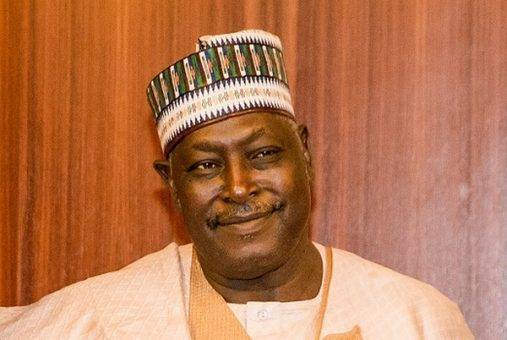

Life has been full of ups and downs for Babachir Lawal, an engineer and former chieftain of the All Progressives Congress (APC), who dumped the ruling party for the Labour Party (LP) before defecting to the African Democratic Congress (ADC), which he repudiated last week after its controversial presidential primary. EMMANUEL OLADESU dissects the politics of the eminent politician and serial defector, who has, in the interim, announced plans to cut ties with active partisan engagement.
He exudes a magnetic charisma. Bold, brave and confident, the boisterous actor from Adamawa always retains a cosmopolitan disposition.
He also knows his onions. Never lost in the crowd, he is particularly fond of domineering actions that tend to make him the centre of attraction.
He is a good mixer, with strong verbal skills, analytical ability, and persuasive skills.
These days, he consistently calls attention to himself through his television appearances, fighting perceived foes left, right and centre. The live interviews reveal an electrifying figure harbouring hostility towards former co-travellers on the ever-slippery political field.
The display of courage and candour amuses Nigerians. But they may also be weary of the air of self-importance, display of ego and occasional regression to self-pity.
Babachir David Lawal, a reputable engineer, is always hilarious; sometimes full of logical reasoning, but at times, off the point.
That contrasting personality is now before the mirror. What is discernible? A loyal, hardworking, and principled politician, and a combative, confused, controversial, inconsistent, serial defector; a partisan complainant seeking attention, and an impatient actor driven by a sense of entitlement.
Traversing three major parties in the space of three years, the eminent politician may be losing relevance. The challenge is pulling him back from the brink of a critical, self-destructive step to political oblivion.
Lawal came into national limelight through political involvement, although he was already a self-made man and a colossal success as a technocrat. The crowning of his career as a Muhammadu Buhari ally was his appointment as the Secretary to the Government of the Federation, which made him a power broker, confidant of the former president and a household name in Nigeria.
But the beat suddenly stopped. Hit by the blow of fate, he lost his commission through a hasty sack. Although his image was later redeemed and his honour restored, he never bounced back.
The media reports about the grass-cutting controversy were sensationalised, leading to his initial suspension before he was eventually kicked out.
The Senate Ad Hoc Committee on Mounting Humanitarian Crisis in the Northeast, headed by Senator Shehu Sani, indicted Lawal for mismanagement and recommended prosecution for allegedly awarding contracts worth N500m through the Presidential Initiative on North-East, a rehabilitation programme under his office, to a company in which he held an interest.
According to the panel, “all resources that have been misapplied or stolen by public officials should be retrieved, and anybody found culpable of contravening any of the provisions of the Public Procurement Act 2007 and the Federal Government Financial Rules and Regulations, about the award of these contracts, should be duly prosecuted by the relevant authorities.”
When the former SGF was summoned to appear before the committee on two occasions, the big man refused to show up, to the consternation of the lawmakers.
After surviving the ordeals, Lawal remained in the ruling All Progressives Congress (APC), held in esteem by some party faithful and sympathisers who recalled his involvement in the struggle to catapult the party to power.
Much later, he disagreed with the party over its adopted winning strategy, left the platform and sought refuge in a strange land. By the party, his party retained power, he was still left in the cold. As a pastime, he joined other foes in firing salvos at his former friend, President Bola Ahmed Tinubu, and the progressive administration he presided over.
Is BD Lawal, as fondly called by admirers, a factor in Nigerian politics? Opinion is now divided.
His contributions to the victory of Buhari in the Adamawa axis and as a member of the legacy parties’ merger committee were widely acknowledged.
Even when he was kicked out as the Federal Government’s secretary, he maintained an uncanny fidelity to the ruling party. Outside power, he was also among the first set of actors associated with the ‘Asiwaju Bola Ahmed Tinubu for President’ crusade.
At a press briefing in Kenny Martins’ Ikeja office, Lagos, he disclosed to reporters how he discussed his plan to support Asiwaju for President as a matter of principle.
Yet, he later became a shifting political “factor” on the eve of victory, moving from being a respected stalwart to a highly vocal opposition figure and a disillusioned internal critic within the party.
To analysts, Lawal’s political capital during the electioneering was largely defined by his religious inclination, which, initially, he nevertheless lacked the capacity to exploit as a divisive and destabilising tool.
As the first northern Christian to serve as SGF, he held considerable influence in bridging ethno-religious divides in the North. But the tempo was not sustained in a country where politics is often shaped by a combination of ethnicity and religion.
That Lawal failed to fully comprehend the strategy and motivation for the 2023 Muslim/Muslim presidential ticket was confounding. Analysts had argued that if a Muslim from the North was not paired with the Muslim presidential candidate from the South, victory would be difficult. In implementing the strategy, only the criterion for ethnic balancing could be fully satisfied.
Those challenging moments in the APC called for understanding, extreme sacrifice and abnegation, which Lawal ignored.
Lawal, like other minority Christians in the North, including former House of Representatives Speaker Yakubu Dogara, who has since retraced his steps, cried foul, obviously because ambition was at stake. A number of them targeted the vice presidential slot, which they qualified for, but which could have been disastrous for the party, as it would have led to the exclusion of the larger Muslim population in the vast Northern region.
Lawal stuck to his guns in vehemently opposing the APC’s same-faith presidential ticket. He inadvertently tried to pull down the house he collaborated in building, resigned from APC and eventually aligned with Peter Obi of the Labour Party (LP) to champion northern Christian interests.
On getting to LP, he met a different party, a ‘structureless’ forum dominated by the Obedient Movement, a noisy group bent on harvesting skewed ethnic votes that could not earn their principal the coveted Aso Villa. In that wilderness, retracing steps could not be easily contemplated.
President Tinubu had hardly been inaugurated when calls for the realignment of forces to unseat him were championed by the scattered opposition leaders. Babachir acted as a vocal mobiliser in efforts to forge a formidable northern-anchored coalition aimed at challenging the administration. It was ironic. The politician mooted the idea of undoing what he had done, which he had never waited to complete in his former party.
Predictably, cracks appeared on the opposition wall. Peeping into the future, Obi, who had left LP for ADC, hurriedly left when reality dawned on him that the party dominated by gerontocrats from the crumbling PDP only regrouped for the purpose of making former Vice President Abubakar Atiku the presidential candidate.
As the former Anambra governor bade the coalition farewell, it also marked the parting of ways. Lawal stayed on, but with an agenda to pull the rug off Atiku’s feet at the primary. In the face of Atiku’s formidable structure, the agenda to displace Atiku and tilt support towards Mohammed Hayatu-Deen’s direction collapsed like a pack of cards.
In a shocking move, Lawal suddenly resigned from ADC, following alleged internal manipulation allegations. He said his primary metric for the 2027 political landscape had shifted as he navigated the complex, often volatile nature of Nigerian alliances. His next point of call is unknown.
Lawal’s allegations against ADC are weighty. The implication now is that the party has been hit by a mini-post-primary crisis. The ex-SGF has insisted that the primary that produced Atiku was rigged. The question is: how?
Alleging that the results were altered during collation, Lawal said: “I have evidence. I have evidence from a primary, from a local government. For example, the results of the election returned were that Hayatu-Deen had 20,000 votes, whereas Atiku Abubakar had 1,000 and something votes. But the result that ended up in Abuja was reversed, and was inverted.”
Lawal also alleged that even officials involved in the collation expressed concerns over how certain results were handled.
He added: “The returning officer at the state was telling me when I complained, ‘ How come these results are not reflected on the result tally that you have? He said, ‘How can we embarrass Atiku Abubakar in his home state?’ Can you imagine that?”
Lawal claimed that the manipulation extended beyond the presidential contest and affected other elective positions.
He stressed: “I know, for example, one candidate who won the House of Representatives election in my state is not the name that was announced at the collation centre. I know somebody from Adamawa, Yola North, Yola South constituency who won by a landslide. His name is not on that sheet that eventually got to Abuja.
“It took our own returning officer close to three days before the results were submitted in Abuja. What were they doing with the results?
“He left Yola on the same day that the result was to be collated, but he didn’t hand them over. By the time he handed them over, it was all childish, mutilated, manipulated results.
“If I think Atiku had won free and fair and square, I’ll kill myself supporting him, campaigning for him. This thing arises from my belief. It’s fundamental to me that if we want to fix Nigeria, we must first of all fix the political processes through which our leaders emerge.
“If the process of emergence is fraudulent or defective, the chances of producing good leaders will not be there.”
Lawal’s allegation is not an unreplied missile. The chairman of ADC Electoral Committee for Adamawa State, Dr Nicholas Msheliza, turned the heat on him, saying that he personally wanted to direct the rigging of the primary.
Msheliza, who also served as Returning Officer for the Adamawa primaries, said Lawal personally contacted him after results were compiled and demanded that he reverse the outcome in Hong Local Government Area in favour of Hayatu-Deen.
He said he rejected the request, insisting the results reflected the actual votes cast.
Msheliza added: “When Babachir Lawal got wind of the results, he called and requested that I reverse the results to favour his candidate. I refused to carry out his directive.”
Msheliza also alleged that shortly after his refusal, Lawal dissolved the local electoral committee and set up a parallel structure that conducted what he described as an “illegal exercise” across several LGAs, including Hong, Madagali, Michika and Mubi North.
Today, Lawal is ‘partyless’. He said he has embarked on retirement, which is a strange thing for a politician to do.
But he said he would vote in 2027, even if the vote goes to Omoyele Sowore, presidential candidate of a mushroom party.
Is Atiku likely to visit him the way he quickly reconciled with his rivals at the primary, former Rivers State Governor Rotimi Amaechi and Hayatu-Deen, a businessman? There is no sign yet.
Will the former SGF go to the NDC to drum up support for Obi, his 2023 favourite?
Will he return to APC?
Will Lawal actually quit politics?