
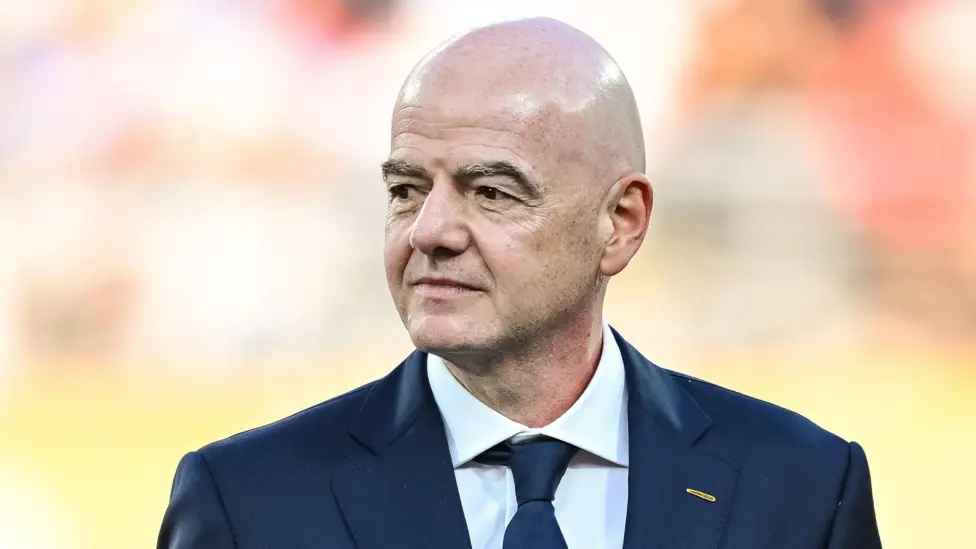

Fifa president Gianni Infantino says he has scrapped the controversial plan to sell off stakes in the governing body’s competitions to private investors following widespread opposition.
Infantino said it had become clear the project had “created divisions” that are “no longer in the interest” of its original objective.
The Swiss official added: “As a result, this proposal will not proceed.”
Infantino had offered Fifa’s 211 member associations $40m (£30m) if they backed a proposal for private investment in its tournaments, including the men’s and women’s World Cups.
However, Uefa – which governs European football – responded by voting to boycott World Cups if the plans went ahead, and other governing bodies also voiced their opposition.
Infantino on the brink? Who might replace him if he goes?
On Friday, Fifa’s chief operating officer Kevin Lamour said the governing body’s own administration had been “deceived” about the project.
Carlos Cordeiro – Infantino’s senior adviser on global strategy and governance – resigned over the matter, saying the proposal was “a bad deal for football” and would “mortgage football’s future”.
That came after two other major confederations spoke out against the plans.
Concacaf, which governs football in North, Central America and the Caribbean – and hosted this summer’s World Cup – said its members “rejected” the proposal, with sources saying the vast majority of associations from the region are losing, or have lost, faith in Infantino.
The Asian Football Confederation (AFC) said it stood in “solidarity” with Uefa and Concacaf, while UK Prime Minister Andy Burnham said Infantino was “the wrong man” to lead Fifa.
It means Infantino is now under immense pressure as he seeks re-election for a fourth term as president at the Fifa Congress in March.
“Our purpose has always been – and will always be – to unite and improve,” the 56-year-old added in a statement.
“Moving forward, my intent is to bring all interested parties back together in the coming days and weeks in the spirit of shared interest in our game.”
“The future of global football must always be shaped through proper consultation, collective dialogue and respect for the established governance structures of our game,” he said.
Infantino’s plans were unlikely to pass
Despite rejections from Uefa and Concacaf, Fifa initially vowed to continue with its proposals on Friday, saying “nobody is selling football”.
However, Infantino would have needed the backing of a majority of member associations to pass the plans – meaning 106 of its 211 members needed to vote in favour.
That became unlikely when the AFC joined Uefa and Concacaf in opposing the plans.
Uefa has 55 votes, Concacaf has 35 and Asia has 46.
If all member associations backed the stance of their governing body, that would have meant 136 nations voting against Infantino’s plan.
Governing bodies in Africa (CAF) and Oceania (OFC) had said they would discuss Fifa’s plan in August.
Conmebol – South American football’s governing body – said it had asked Fifa for “additional information and clarifications” regarding the “scope, structure, governance and possible effects” of the proposals.
What was Infantino’s plan?
Fifa and Infantino wanted to create a commercial subsidiary to run its main events, including its World Cups, with external investors able to buy stakes in it.
It said it would “invite third parties to make minority, non-controlling investments” in a new subsidiary – Fifa Forward Enterprise (FFE).
Infantino set a deadline of 19 September for football federations to accept his plans if they wanted to access an initial $20m (£15m).
A 25-page document created by investment bank JP Morgan laid out how Fifa’s tournaments would expand to hit an estimated increased payout of 24m euros (£20.5m) per member association in the 2035-2039 cycle.
It mentioned “new business initiatives” and “attracting top talent with incentive-driven compensation”.
The World Cup is described in it as the “most widely viewed” sporting event but Fifa, by contrast, is said to be “under-monetised”.
There was no mention in the document of the women’s game.
Fifa said Thrive Eternal was expected to lead the proposed investor group for FFE.
Thrive is an American venture capital firm founded by Joshua Kushner – the brother of US President Donald Trump’s son-in-law Jared.
Trump – addressing the proposals for the first time on Friday – said he had not spoken to Infantino about the plans.
The two have developed a close relationship since Trump assumed office for a second time in 2025.
Can Infantino survive?
Infantino became Fifa president in 2016 when he beat AFC president Sheikh Salman by 115 votes to 88.
Fifa’s next president will be confirmed at the organisation’s 77th Congress in Morocco next March. Candidates have until 18 November to put their names forward.
Prior to this week, it had been anticipated Infantino would be re-elected unopposed.
Associations around the world, including some in Europe, had already confirmed their intention to vote for him.
It remains to be seen if the events of this week will result in a mass withdrawal of their support.
In his statement, Infantino reiterated his plan was designed to strengthen member associations, “especially in countries where support is most needed” – but the proposal clearly created division within Fifa itself.
Cordeiro, who represented Fifa on the White House taskforce for the 2026 World Cup, is the first senior figure at the governing body to resign over the plans.
In a lengthy statement, Cordeiro said he “unequivocally” opposed the plans and “did not accept the proposition” Fifa needed outside investors to “unlock greater value”. He added he had no involvement in the proposal.
It is understood Infantino even left some of Fifa’s eight vice-presidents in the dark about his plan, which it is claimed could have raised $10bn (£7.5bn).
Lamour called it “the project of one person” and said “a president must bring people together, unite them, and inspire them” but this was “the opposite”.
“If that means I lose my job, then so be it,” he added. “I will understand and respect that decision. At least I’ll sleep well tonight.”
‘Bruised Infantino makes humiliating climbdown’ – analysis
As reports first emerged on Tuesday about Fifa’s plans, a senior figure in English football told me the story would be as big, if not bigger, than the European Super League.
I do not think he felt it would unravel in quite the same way – but the idea only took two days longer than Super League to be scrapped.
There have been no fan protests on the streets, but animosity towards the plans was evident from the moment the likely implications dawned on the game.
Infantino is an astute politician. He knew the numbers were against him and has decided to cut his losses now rather than risk further personal damage.
It is a humiliating moment – but for Infantino, the real work starts now. He has some significant bridge building to do.
In their statement – which, in its own way, was just as damning as Uefa’s threatened boycott – the Asian Football Confederation (AFC) pointed to a much wider issue.
“The AFC considers this issue extends far beyond a single proposal,” it read. “Rather, it has exposed fundamental weaknesses in Fifa’s consultation and decision-making processes that must now be addressed.”
Infantino cannot just walk away from the past few days as though nothing has happened.
There are a lot of angry people in football who feel he has been acting beyond his power – just as the organisation’s chief operating officer suggested on Friday.
The immediate crisis has passed. Over the short to medium term, it will be fascinating to see whether Infantino can restore his reputation.
BBC