
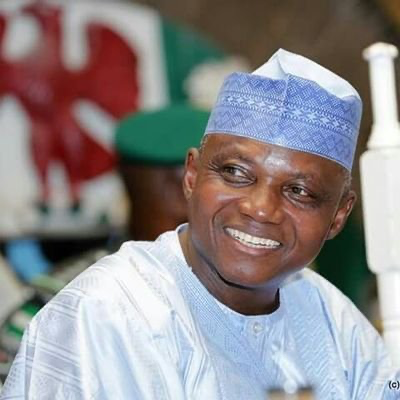

Malam Garba Shehu, former Senior Special Assistant to President Muhammadu Buhari on Media and Publicity, has offered a detailed account of the circumstances surrounding Sunrise Power Transmission Company Limited and its chairman, Leno Adesanya, in the $2.35 billion Mambilla Hydroelectric Power Project arbitration before the International Chamber of Commerce (ICC) in Paris.
Shehu, who was part of the Nigerian team that attended the January 15, 2025 proceedings in Paris, gave the account in a post on his X handle following the tribunal’s rejection of Sunrise’s claims and its order that the company and Adesanya reimburse Nigeria about $11.82 million in legal and other expenses.
There are good reasons why Leno Adesanya and his company, Sunrise Power Transmission Company, lost their case at the International Chamber of Commerce (ICC), an outcome that has sparked widespread celebrations across Nigeria.
The ICC tribunal in Paris threw out Sunrise’s $2.35 billion claim over the Mambilla Hydroelectric Power Project and rejected a separate $400 million settlement claim. It also ordered Sunrise and Adesanya to reimburse Nigeria about $11.82 million in legal and other expenses.
As a news person — perhaps the only one — on the Nigerian team present at the January 15, 2025 sitting of the tribunal in Paris, I had the privilege of witnessing the proceedings at the Ritz-Carlton Hotel, where the case was heard.
At the hearing, former Presidents Olusegun Obasanjo and Muhammadu Buhari featured as key witnesses for Nigeria’s defence, alongside others including National Security Adviser Nuhu Ribadu and former ministers Sulaiman Adamu and Babatunde Raji Fashola.
It became clear during the proceedings that the original Mambilla contract was at the centre of a long-running dispute over whether Sunrise had ever obtained the necessary approval to undertake the project.
At stake was the potential extraction of hundreds of millions of dollars from Nigeria’s treasury, against the background of claims connected to the proposed $6 billion Mambilla project.
The two former presidents and other key witnesses were called upon during the proceedings as Nigeria defended itself against claims arising from the long-running dispute.
The Nigerian legal team was led by the Attorney-General of the Federation and Minister of Justice, Lateef Fagbemi, SAN.
The origins of the dispute date back to May 2003.
At its meeting of May 21, 2003, the Federal Executive Council, chaired by President Olusegun Obasanjo, considered a memorandum concerning the proposed award of the Mambilla contract to Leno Adesanya and Sunrise.
The council refused to approve the proposal and directed that the memorandum be withdrawn, while noting that the establishment of new power plants should be undertaken through a competitive process.
However, on May 22, 2003 — the following day and seven days before the end of President Obasanjo’s first term — the then Minister of Power and Steel, Dr Olu Agunloye, sent Adesanya a letter purporting to indicate preliminary approval for Sunrise to have a role in the construction of the Mambilla Hydroelectric Power Station, estimated at $6 billion.
According to the account presented in the proceedings, Sunrise had no previous expertise in projects of that scale and had limited financial capacity.
Documents placed before the tribunal included statements filed by Sunrise at the Corporate Affairs Commission showing that the company reported no turnover in 2017, 2018 or 2019 and declared total net assets of only N1 million.
At the time of the disputed award, the company’s financial position was stated as N318,685 as of December 3, 2004, and N270,370 as of December 31, 2005.
On September 3, 2003, a new Minister wrote to Adesanya confirming that the Federal Executive Council had not approved the earlier proposal and that there was therefore no contract between Sunrise and the Federal Government.
A fresh tender process was subsequently initiated, and the contract was awarded to two Chinese companies, CGGC and CGC.
Later, during a meeting between President Muhammadu Buhari and Chinese President Xi Jinping, Buhari requested China’s support for financing the Mambilla project and asked President Xi to nominate credible companies to execute the project.
President Xi, according to the account, gave an immediate commitment to promoting the project.
It was against this background that Sunrise began its legal battle.
The company demanded £33 million as alleged costs incurred in preparing for execution of the project. It also demanded $1.2 billion, representing what it described as 20 per cent of the estimated $6 billion project cost as projected profit.
Sunrise subsequently filed a claim at the Federal High Court against Nigeria’s Minister of Power, the Attorney-General of the Federation, CGGC and CGC.
It sought an order preventing development of the project except through Sunrise and, alternatively, claimed $960 million in alleged damages.
The litigation contributed to the prolonged delay of the Mambilla project, while ChinaExim Bank withheld financing pending resolution of the legal dispute.
Nigeria subsequently entered into settlement discussions with Sunrise, CGGC and CGC. Those discussions were inherited by the administration of President Buhari.
In 2012, the Federal Ministry of Power entered into a General Project Execution Agreement with Sunrise and Sinohydro, another Chinese contractor involved by Sunrise.
On January 14, 2015, another letter was signed by the Federal Ministry of Power, purportedly approving Sunrise as the local content partner on the project.
Then, on November 9, 2019, a meeting was held in London involving Adesanya and Nigerian officials, including the Attorney-General and Minister of Justice and the Minister of Water Resources.
At that meeting, it was made clear that any negotiated settlement would require presidential approval.
Adesanya offered to accept $500 million, while the Nigerian ministers made a counter-proposal of $100 million.
After a series of meetings, the Attorney-General and Minister of Justice and the ministers of Power, Finance and Water Resources agreed to propose $200 million as a full and final settlement of Sunrise’s claims, subject to presidential approval.
Sunrise accepted the proposal.
On March 25, 2020, a second document, entitled “Addendum to the Terms of Settlement”, was signed between Sunrise and representatives of Nigeria.
The addendum provided for a potential additional $200 million liability in the event of delayed payment.
On March 31, 2020, the Terms of Settlement and Addendum were presented to President Buhari for the first time for his approval.
The President declined to approve them.
In a handwritten and signed note dated April 20, 2020, Buhari withheld his approval, stating that the Federal Government “hasn’t got USD 200m to pay” Sunrise.
Despite repeated attempts, Buhari remained unconvinced that Nigeria should pay $200 million, or more, to Sunrise over what he regarded as an unauthorised contract.
Sunrise subsequently commenced another arbitration against Nigeria, alleging violation of the settlement terms and seeking $680 million.
That dispute eventually became part of the wider arbitration proceedings before the ICC.
The tribunal has now rejected Sunrise’s claims, bringing to an end a major chapter in the long-running Mambilla dispute.
The award also ordered Sunrise and Adesanya to reimburse Nigeria 75 per cent of its legal fees and expenses, amounting to approximately $11.82 million.
President Bola Ahmed Tinubu has welcomed the verdict, describing it as the removal of the “single biggest legal hurdle” in the path of the 3,960MW Mambilla Hydroelectric Power Project.
He also praised former Presidents Obasanjo and Buhari, as well as members of Nigeria’s legal and government teams, for their roles in the defence of the country.
For Nigeria, the immediate challenge now is to move beyond the legal battle and revive the long-delayed Mambilla project.
The next step, in the national interest and in honour of the late President Buhari, whose administration remained committed to the project, should be to engage the Chinese leadership and pursue the long-standing commitment to financing and developing the Mambilla Hydroelectric Power Project.
NOTE: Views expressed by contributors are strictly personal and not of Theliberationnews