


For Nigerians old enough to remember the 1990s, the phrase “Who build dis gada here?” was proudly hung on Brigadier General Raji Rasaki as his lasting moniker. A former military governor of Ogun, Ondo, and Lagos States, Brigadier Rasaki acquired this viral nickname in the aftermath of an on-site inspection of public works in Lagos. With his fold-able swagger stick held firmly in hand and a penetratingly authoritative aura, Rasaki was touring project sites when, in the searing baritone of military overlords, he loudly demanded of a contractor in a distinct blend of Nigerian English and raw power: “Who build dis gada?”
While “gada” was simply his native tongue’s transplant for a bridge, that dramatic outburst of a no-nonsense soldier became Rasaki’s enduring public trademark. To this day, countrymen who were alive to hear of the event firsthand deploy the phrase to mock poor public infrastructure or as a satirical weapon to question accountability in government construction projects.
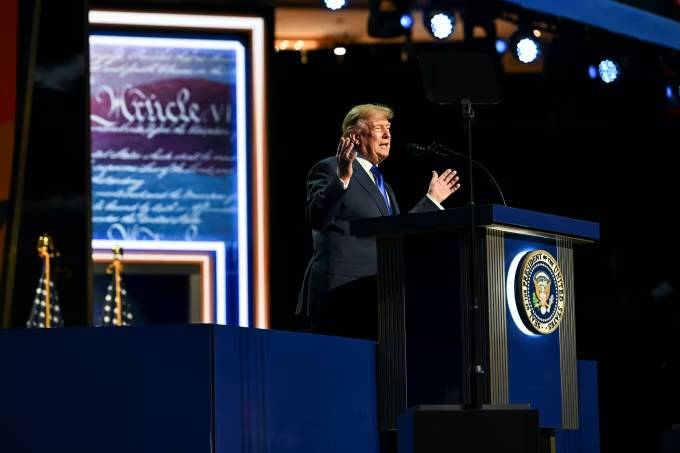
Last week, President Bola Tinubu seemed to transmute into Brigadier Rasaki, bringing the narrative of “Who build dis gada?” right back to life. Whether driven by political malice, the early maneuvers of 2027 politics, or confidential dossiers in his possession, Tinubu raised eyebrows while receiving a delegation of traditional rulers from Oyo State last Thursday. Among other issues, the President literally asked why state governors were busy building ‘gadas’ — now modernized as flyovers — in areas with negligible traffic density. Instead of these projects he seemed to see as vanity, Tinubu demanded that governors channel their enhanced post-subsidy federal allocations into rural road networks which he said would genuinely improve living standards and grant security agencies better access to remote, vulnerable areas.
It is commendable that the President has joined the ranks of the Nigerian commentariat who daily deplore the wonky governance of the country. Over the years, analysts have marveled at the ease with which Nigerian governments at both federal and state levels embark on massive road projects primarily designed to serve as blankets to cover official fraud. Yet, the strategic placement of Tinubu’s office makes his public disclosure feel somewhat mealy-mouthed. As the national leader of the ruling All Progressives Congress (APC) which controls 28 of Nigeria’s 36 states, many of whose governors are guilty of this exact charge, such a rebuke should have been delivered as an internal caucus homily rather than a public spectacle.
Furthermore, throwing such a blanket homily in public is not only self-deprecating but opens wide flank for opposition elements to attack even state governments that are building genuinely strategic roads and bridges, turning them into easy prey for political opportunism.
More importantly, the homily is deeply self-indicting. While scolding governors over unaccountable flyovers, President Tinubu himself is overseeing the construction of the Lagos-Calabar Coastal Highway — one of the most opaque, unaccountable-to-anyone mega projects in modern history. Awarded without a competitive bidding process to the Chagourys, a contractor with long-standing personal ties to the President, and with his own son sitting on the board of an associated entity, the coastal road project makes Tinubu’s scolding of governors feel like a classic case of self-delusion. As the Yoruba adage goes, “Jéwó òbùn k’án dáṣọ ró e!” (Confess, slovenly woman, so that we may help you cover yourself!). The President should confess to his own administration’s transparency flaws before lecturing state governors on theirs.
At that same meeting with the Oyo monarchs, the President also chest-thumped over the recent rescue of the abducted Oriire hostages. For the first time, discarding third-party statements, Tinubu explicitly confirmed that the abducted schoolchildren and teachers were freed because his administration stood firm against paying ransoms or swapping imprisoned terrorists. He also confirmed that a novel military tactic was deployed in the freedom, which entailed that “we were ready to finish with (sic) their families, members of their own communities. They grew up somewhere.” We understood that waffle to mean that the clear implication was that the government was prepared to target the families and strongholds of the terrorists if they refused to release the hostages.
This high-pressure military tactic shares striking similarities with modern intelligence strategies used by agencies like Israel’s Mossad, which deploys psychological pressure against adversaries by leveraging personal family details. This breaks their morale and forces compliance.
However, if such an aggressive model was deployed in Oyo State, its non-application elsewhere raises critical questions about consistency. Does it mean the narrative was exaggerated, or is the strategy being selectively applied? Thousands of Nigerians currently languish in terrorist camps across the country; if this doctrine works, every single hostage in Nigeria deserves the immediate benefit of Mr. President applying that same model.
Again, earlier in the week, while receiving members of the Catholic Bishops’ Conference of Nigeria (CBCN), led by Most Rev. Matthew Ndagoso, at the State House, the President dropped another portion of his mindset. Responding to criticisms and political opposition, he stated: “I asked for this job. I’m in it. Those who will take it from me will try. They will try. All is fair in politics.”
Whenever politicians try to dismiss statecraft as an inherently amoral arena where “all is fair,” one is reminded of A. Appadorai’s classic 1942 text, The Substance of Politics. The Indian political scientist argued that politics is, at its core, an extension of ethics and morality. Regrettably, to Tinubu and much of the contemporary Nigerian political class, politics remains reduced to a ruthless, dog-eat-dog arena where the fittest survive, the weak are eliminated, and moral principle is sacrificed on the altar of power.
NOTE: Views expressed by contributors are strictly personal and not of Theliberationnews