

The Lagos State Governorship Debate has provided an important opportunity for the people of Lagos to examine the candidates, interrogate their policy proposals and assess their understanding of the complexities of governing Africa’s largest sub-national economy.
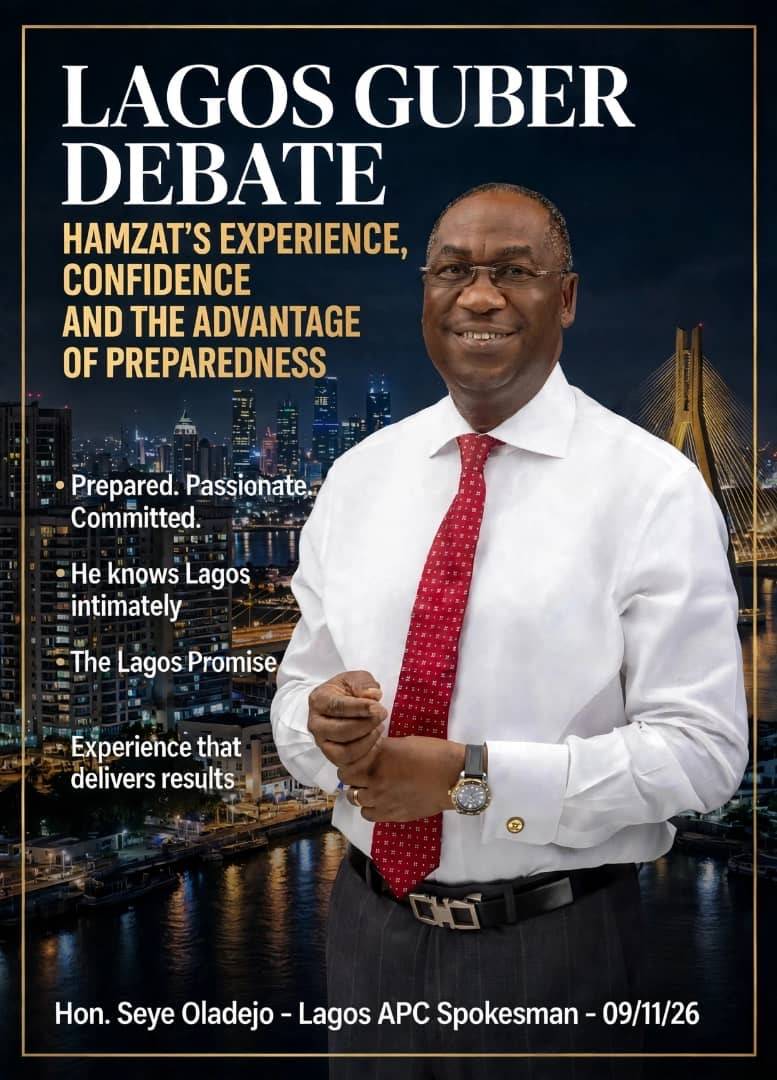
For the All Progressives Congress (APC), the participation of our candidate, Dr. Kadiri Obafemi Hamzat, was an opportunity to articulate the thinking behind his vision for Lagos and demonstrate the policy direction contained in his manifesto, The Lagos Promise.
Beyond the substance of his policy presentation, Dr. Hamzat displayed remarkable preparedness, passion, commitment and an unmistakable determination to perform. His command of the issues, depth of institutional knowledge and familiarity with the workings of government were particularly instructive. He demonstrated an appreciation of the fact that governance is not merely about making attractive promises but about understanding the processes, structures and institutional capacities required to translate vision into tangible results.
Equally noteworthy was his personal disposition throughout the engagement. His calmness was infectious, his confidence inspiring and his responses reflective of someone who understands the weight and responsibilities of public office. He approached the debate without unnecessary theatrics, allowing his ideas, experience and understanding of Lagos to take centre stage.
Indeed, his delivery underscored why the Lagos APC was deliberate and intentional in its choice of governorship candidate. Dr. Hamzat is a candidate who needs no introduction to Lagosians, the business of governance or the state’s longstanding tradition of excellence. He is a man who knows Lagos intimately: her culture, traditions, values, aspirations and development vision. He understands the DNA of the state, the peculiarities of its people, the demands of its economy and the institutional architecture that has sustained its growth over the years.
His description of the debate as a job interview was particularly instructive. Governing Lagos is not an experimental exercise, neither is it an assignment for political apprentices. It requires a thorough understanding of the machinery of government, the peculiarities of the state’s economy and the intricate relationship between policy formulation and implementation.
On transportation, Hamzat outlined an ambitious multi-modal approach involving rail, road and water transportation, including plans for 4,000 CNG buses and 77 electric ferries. On housing, he addressed the need to expand mortgage opportunities, complete ongoing housing projects and enforce existing laws against arbitrary rental demands.
On environmental management, he addressed the importance of drainage infrastructure, effective maintenance and improved waste management. On healthcare and social infrastructure, he reiterated the need to expand access and consolidate on-going investments.
These are not isolated policy propositions. They speak to the interconnected challenges of a rapidly expanding megacity and the necessity for coordinated, long-term planning.
The debate also brought competing perspectives on the future of Lagos into public view. That is precisely what democratic engagement should achieve. Citizens deserve the opportunity to hear different candidates explain not just what they intend to do, but how they propose to achieve their objectives, finance their promises and sustain the institutions required for delivery.
However, the Lagos question goes beyond the attraction of campaign promises. It is about understanding the journey so far, appreciating the investments already made and identifying how to take the state to its next level of development.
Dr. Hamzat’s extensive involvement in Lagos governance, spanning his service as Commissioner for Science and Technology, Commissioner for Works and two-term Deputy Governor, provides substantial institutional experience and a practical understanding of the challenges and opportunities ahead.
The Lagos Promise is therefore presented against the background of institutional experience, accumulated lessons and a clearly articulated development agenda. The task ahead is to translate its commitments into measurable outcomes that improve the quality of life of every Lagosian.
We commend the Nigeria Debate Consortium and the participating media organisations for providing a platform for issue-based democratic engagement. We equally encourage Lagos residents to look beyond political theatrics and personality contests, and subject the competing proposals to informed scrutiny.
Ultimately, the future of Lagos deserves more than slogans. It demands experience, tested leadership, policy depth, institutional understanding and a demonstrable commitment to delivering results.
The Lagos governorship debate has once again brought the critical question of leadership and preparedness to the fore. For Dr. Kadiri Obafemi Hamzat, the challenge is to sustain the momentum of his presentation and translate the vision of The Lagos Promise into tangible benefits for the people.