

When a writer sets out to shed further light on recent history, the result can unsettle familiar assumptions about how power was won.
What might have happened if the Action Congress of Nigeria (ACN) had not emerged from the ruins of the Alliance for Democracy (AD)? What if the ambitious project of forming the All Progressives Congress (APC) had failed? NigerianTourism Guide
These counterfactual questions are inevitable in the context of the revelations in Sam Omatseye’s latest non-fiction work titled From AD to APC: The Evolution of Nigerian Political Parties and the Exploits of One Man (1998–2015).
An effervescent columnist and Chairman of the Editorial Board of The Nation, he studied History at the University of Ife, now Obafemi Awolowo University, Osun State. NigeriaNews Subscription
The book will be launched on November 24 at the Banquet Hall, State House, Aso Rock Presidential Villa, Abuja. Taking place in the middle of electioneering for the 2027 general elections, the event promises to be a political mega-carnival.
It traces the trajectory of party politics in Nigeria’s Fourth Republic, from the formation of the AD at the return to civil rule in 1998 through the political realignments and mergers that culminated in the APC victory in 2015.
Chronicling nearly two decades of Nigerian political history, the 625-page volume focuses heavily on the strategic political interventions of Bola Ahmed Tinubu alongside key actors across the political divide. NigerianTourism Guide
The book begins after the death of the military dictator Sani Abacha, amid manoeuvres toward a democratic dispensation, and runs through the swearing-in of Muhammadu Buhari in 2015.
In the author’s note, Omatseye recalls, “The spark for this book leapt from the lips of Aremo Olusegun Osoba, evergreen reporter and former governor of Osun State. One evening in March 2024, in the midst of his politician colleagues, he made a remark perhaps with an eye to my ear.
“He observed that an epic manoeuvre in Nigerian history remained untold. It was how as Governor of Lagos State, Asiwaju Bola Ahmed Tinubu outplayed the forces of the PDP under then President Olusegun Obasanjo to form the Action Congress.
The author interpreted this fortuitous information as a challenge to discover the “untold” history. Writing the book was, therefore, a journey of excavation.
Omatseye says he spent “close to two and a half years” working on this book, adding that he “spoke with over 25 persons,” which means he used “mainly primary source materials.”
He notes that “Few journalists or writers have the reach and fortune to sit with the personages that invited me into the intimacies of their homes, offices and even the treasures of their memories… I thought I owed my country the sacrifice of my privilege of contacts to produce this tome.”
The book, rich in insider narratives, features behind-the-scenes accounts, interviews, and political anecdotes involving prominent figures from that era, such as Olusegun Obasanjo, Atiku Abubakar (including an account of governors plotting with him to replace Obasanjo), Aremo Segun Osoba, and Chief Bode George.
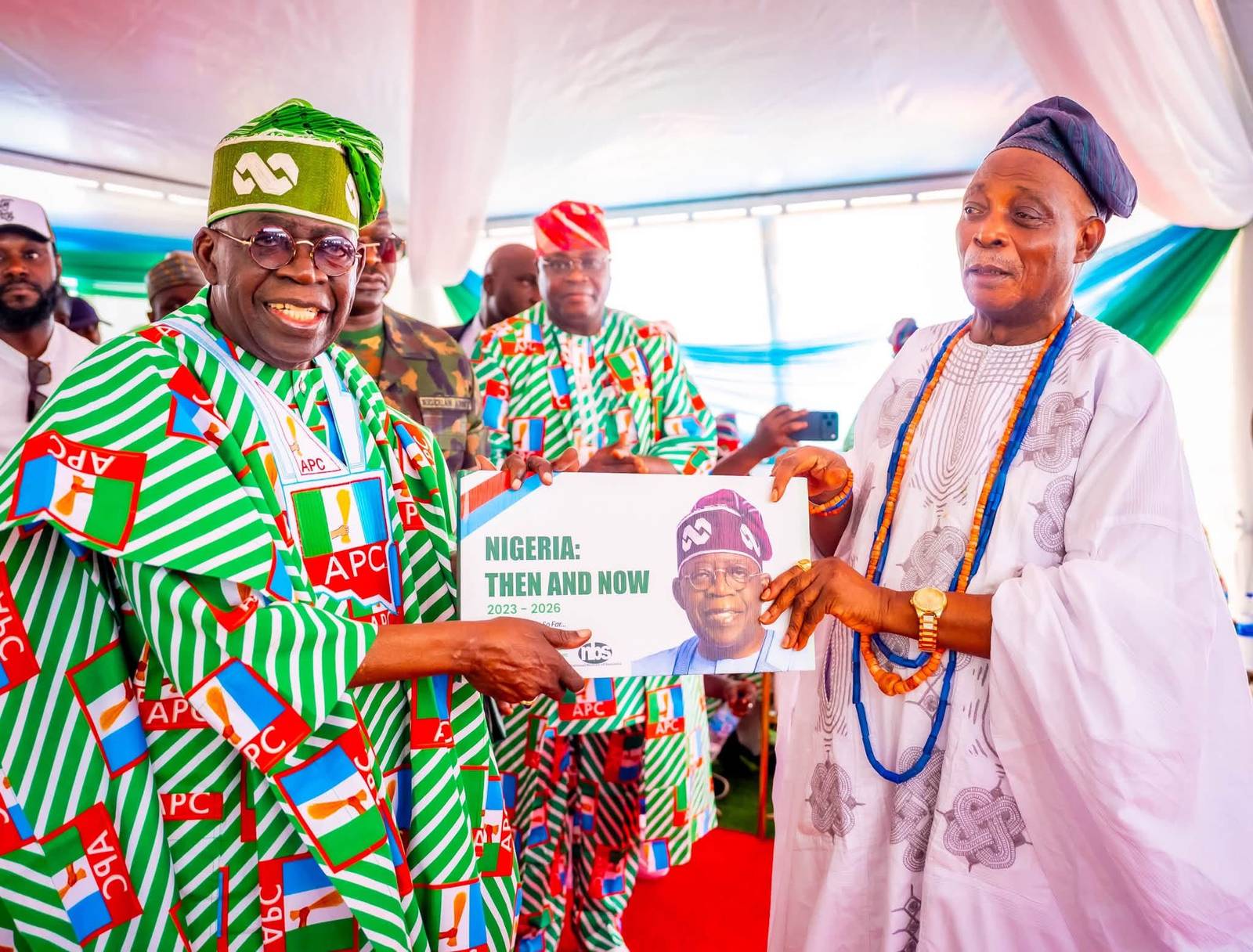
One man of extraordinary dimensions stands out in the book: Asiwaju Bola Ahmed Tinubu. He masterminded the emergence of the ACN and the formation of the APC. His political shrewdness ensured the birth of the ACN when the AD fractured, a moment that threatened to leave progressives without a platform ahead of elections.
Tinubu’s crucial political engineering led to the creation of the APC in 2013 through the merger of Nigeria’s three largest opposition parties—the ACN, the Congress for Progressive Change (CPC), and the All Nigeria Peoples Party (ANPP)—along with a breakaway faction of the All Progressives Grand Alliance (APGA) and the New PDP (a faction of the then-ruling Peoples Democratic Party).
Tinubu is quoted as saying, “The merger is for the unity and stability of this country; for the progressive thinkers to be together and start working on the stability of this country and a new vision that will put the people first.”
The APC came to power following the victory of Muhammadu Buhari in the 2015 presidential election, marking the first time in Nigerian history that an opposition party unseated a governing party in a peaceful transition. Tinubu, who succeeded Buhari, is set for re-election in 2027.
According to Omatseye’s book, to achieve the APC merger, Tinubu “enunciated what he described as the abattoir principle. What it meant was any cow that walked or moved into an abattoir did not leave the slaughterhouse alive. FollowPolitics
“It became liver, innards, head, tail, legs, all apart and ready for the collective stew. In that way, the only identity was the new party, which would become the APC.”
The author adds:” In Nigerian politics in which the ego system of leaders prevailed over its political ecosystem, making such a policy out of such a scenario required a lot of work, wheeling and dealings, compromise, sacrifices, strong arm here, subtle blackmail there, a quarrel and a reconciliation.”
The outcome was unprecedented in the country’s political history. Omatseye writes: ”They were dissolved. They no longer existed. So, they had no fallback position. They each held a convention to dissolve the parties. Somebody moved a motion, another seconded it, put it to the vote that the party was hereby dissolved as provided by the law. Each party did it.”
Omatseye grabbed the headlines in March 2024 when he unveiled his book, Beating All Odds: Diaries and Essays on How Bola Tinubu Became President, in Abuja. From August 19, 2022 to February 17, 2023, he wrote private diary entries documenting the various political dramas that preceded Nigeria’s Presidential and National Assembly elections held on February 25, 2023.
He kept the diary for seven months, ending his record-keeping a week to the elections. The diary is combined with a collection of his columns. His weekly column in The Nation, ‘In Touch,’ is known for its colour and assertiveness.
He brings this background in political documentation to his new book, demonstrating his multiple dimensions as a journalist, historian, philosopher, and literary artist.
“I have enough on these pages to inform, stun and challenge the historian, political scientist, journalist, student and, of course, politicians for, at least, a generation,” he says of the new work.