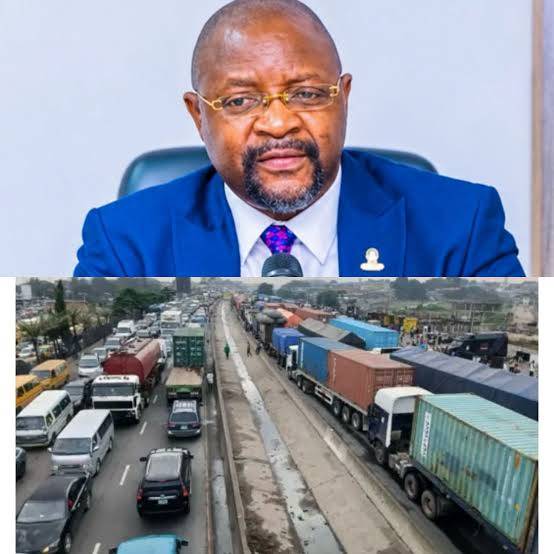

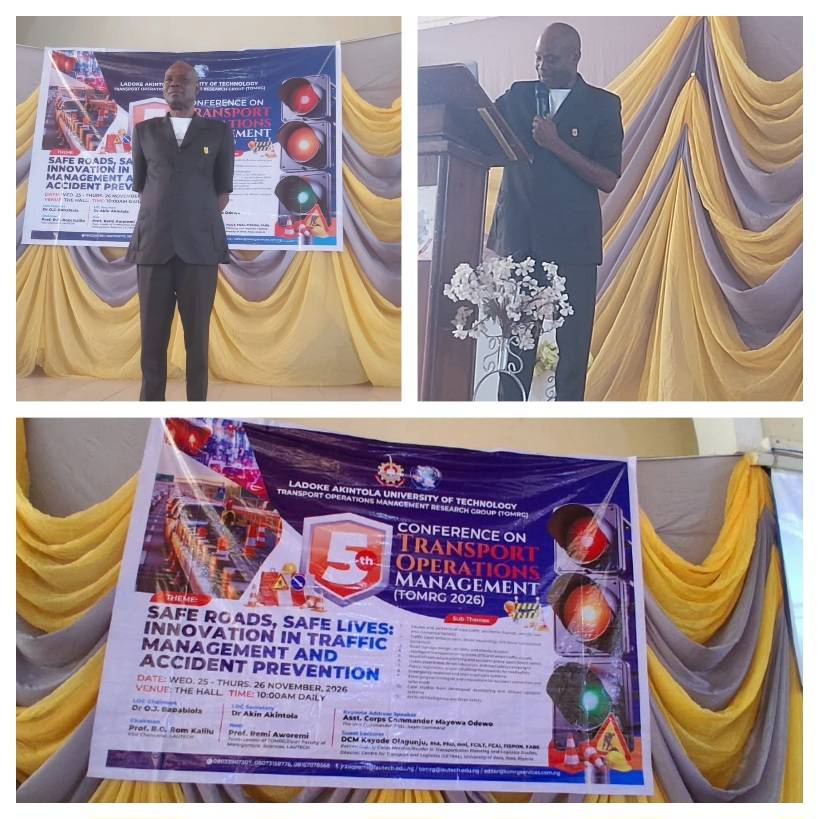

THE GUEST LECTURE DELIVERED AT THE CONFERENCE ON TRANSPORT OPERATIONS MANAGEMENT (TOMRG 2026). ORGANISED BY THE LADOKE AKINTOLA UNIVERSITY OF TECHNOLOGY TRANSPORT OPERATIONS MANAGEMENT RESEARCH GROUP (TORMRG).
25-26 NOVEMBER, 2026
Overview
Road transportation is fundamental to economic development, social interaction, mobility and national integration. However, the benefits of road transport are accompanied by a major public-health and development challenge: Road Traffic Crashes (RTCs). Road crashes cause deaths, injuries, disability, property damage, congestion, psychological trauma and significant economic losses. (World Health Organization [WHO], 2023)
The traditional approach to road safety has often focused on correcting driver behavior after crashes occur. Modern road safety thinking has shifted toward a proactive, data-driven and Safe System approach, in which roads, vehicles, speeds, enforcement systems and road users are designed to reduce the likelihood and severity of crashes (International Transport Forum [ITF], 2016; WHO, 2023).
This lecture examines how innovation in traffic management, engineering, technology, enforcement, data analytics and human-factor interventions can contribute to safer roads and ultimately save lives.
1. Introduction
The theme “Safe Roads, Safe Lives” reflects a fundamental principle of contemporary road safety: every road user has the right to use the transport system without being exposed to an unacceptable risk of death or serious injury.
Road traffic crashes should not be viewed merely as isolated incidents caused by careless drivers but deeper understanding revealed that, they are frequently the result of interactions among: Human behavior; Vehicle characteristics; Road geometry and condition; Traffic volume, composition and exposure; Speed; Weather and environmental conditions; Enforcement; Emergency medical response; and Institutional and policy failures (ITF, 2016; WHO, 2017).
Consequently, crash prevention requires a multidisciplinary approach. A modern road safety system asks not only:
“Who caused the crash?” but also:
“Why did the system allow the crash to occur, and why did it result in death or serious injury?”
This represents an important transition from a traditional blame-oriented approach to a system-oriented approach.
2. Learning Objectives
At the end of this lecture, participants should be able to:
a. Explain the relationship between traffic management and road safety.
b. Identify major causes and risk factors associated with road traffic crashes.
c. Explain the principles of the Safe System approach.
d. Discuss emerging innovations and their applications in traffic management.
e. Explain the application of GIS and spatial analysis in crash prevention.
f. Relate to the importance of speed management.
g. Appreciate artificial intelligence and big data support for crash prevention.
h. Evaluate the role of enforcement technology in reducing risky behavior.
i. Understand innovative strategies for improving road safety, particularly in developing countries such as Nigeria.
3. Understanding Road Traffic Crashes
A road traffic crash is not simply a transportation problem. It is simultaneously a: public-health problem; engineering problem; economic problem; social problem; environmental problem; governance problem; and human-behavior problem.
3.1 Major crash risk factors
Road traffic crashes generally emerge from the interaction of several factors which can be summed up under four broad factors which are: human factors, road and infrastructure factors, vehicle factors, and environmental factors (WHO, 2023).
a. Human factors
These include excessive speed, distracted driving, fatigue, alcohol and drug impairment, aggressive driving, unsafe overtaking, failure to obey traffic signals, inadequate driving skills, poor knowledge of traffic regulations, risk-taking behavior, and failure to use seat belts and helmets and the rest. Among all, human behavior is particularly important because road users make decisions within a constantly changing traffic environment.
b. Road and infrastructure factors
Examples include poor road geometry, inadequate sight distance, potholes, poor drainage, inadequate road markings, missing or damaged signs, inadequate lighting, unsafe intersections, inadequate pedestrian facilities, roadside obstacles, and poorly designed median openings
c. Vehicle factors
Vehicle-related risks include brake failure, defective tyres, poor lighting, overloading, poor vehicle maintenance, vehicle instability, and inadequate safety technology.
d. Environmental factors
These include: rainfall, flooding, fog, dust, night-time conditions, poor visibility, roadside activities, and animals crossing roads.
4. From Crash Response to Crash Prevention
Historically, road safety interventions have often been reactive. According to ITF (2016) and WHO (2017), the traditional cycle is:
Crash occurrence → Investigation → Identify cause → Correct problem
Modern road safety seeks to reverse this process in accordance to the ITF (2016) and WHO (2017):
Collect data → Identify risk → Predict crashes → Intervene → Monitor → Prevent crashes
This is one of the most important applications of innovation. Instead of waiting for people to die at a particular location before intervention, traffic authorities can identify locations where the risk of a serious crash is increasing and intervene before fatalities occur.
5. The Safe System Approach
The Safe System approach represents a major paradigm shift in road safety (International Transport Forum [ITF], 2016; WHO, 2023).
Its fundamental principle is: People make mistakes, but mistakes should not result in death or serious injury. The approach recognizes that human beings are fallible and that the transportation system must accommodate human error. The Safe System generally rests on five (5) cardinal interconnected principles:
5.1 Safe speeds
Speed is one of the most important determinants of crash severity (Global Road Safety Partnership [GRSP] & International Federation of Red Cross and Red Crescent Societies [IFRC], 2023; WHO, 2023).
As speed increases, the following occurs:
a. Stopping distance increases
b. Available reaction time decreases
c. Crash energy increases
d. The probability of severe injury increases (Global Road Safety Partnership [GRSP] & International Federation of Red Cross and Red Crescent Societies [IFRC], 2023; WHO, 2023).
Therefore, speed management is not simply about enforcing speed limits. It involves:
a. Determining appropriate speed limits
b. Road design
c. Traffic calming
d. Automated enforcement
e. Driver education
f. Vehicle technology
g. Intelligent speed assistance.
5.2 Safe roads and roadsides
Roads should be designed to reduce conflict points, separate incompatible road users, provide adequate visibility, forgive human mistakes and minimize roadside hazards (ITF, 2016; WHO, 2017).
5.3 Safe vehicles
Modern vehicles increasingly incorporate anti-lock braking systems, electronic stability control, airbags, adaptive cruise control, autonomous emergency braking, lane-departure warning, blind-spot monitoring, and intelligent speed assistance.
5.4 Safe road users
Road users should understand traffic rules, avoid impairment, maintain appropriate speeds, use protective equipment, and avoid distractions.
5.5 Post-crash care
When crashes occur, rapid emergency response can determine whether an injured person survives. Important interventions include; rapid ambulance response, emergency communication, trauma centers, trained first responders and efficient incident clearance. The golden hour, which is the first hour of a crash when most fatalities occur must be targeted (WHO, 2017, 2023).
6. Innovation in Traffic Management
Traffic management is increasingly moving from conventional methods toward intelligent, automated and predictive systems. These are:
6.1 Intelligent Transportation Systems (ITS)
Intelligent Transportation Systems (ITS) integrates information, communication and control technologies into transportation systems.
Examples include: Traffic sensors, CCTV cameras, variable message signs, automated traffic signals, vehicle detection systems, electronic tolling, GPS-based traffic monitoring and traffic management centers (Guo et al., 2019; Lee et al., 2022).
ITS also allows authorities to monitor traffic conditions in real time and respond rapidly to emerging hazards.
The Conventional traffic management ONLY Observe → Decide → Respond
While Intelligent traffic management
Sense → Analyze → Predict → Decide → Respond → Learn
This transition can significantly improve traffic safety and efficiency.
6.2 Artificial Intelligence and Machine Learning
Artificial intelligence is increasingly becoming an important tool for road safety. AI can analyze large datasets from crash records, traffic counters, CCTV, GPS devices, mobile phones, weather stations, vehicle sensors and road-condition surveys (Mannering et al., 2020).
AI algorithms can identify patterns that may not be immediately visible through conventional analysis. For example; suppose crash records show that crashes are concentrated around a particular kilometer point. AI can combine crash frequency, speed, traffic volume, weather, time of day, vehicle type, road geometry and driver behavior to estimate the probability of future crashes. This enables authorities to move from:
“Where have crashes occurred?”
to:
“Where and when is a crash most likely to occur?”
6.3 Geographic Information Systems and Crash Hotspot Analysis
GIS has become one of the most important innovations in road safety planning. Crash locations can be represented spatially to identify, crash clusters, blackspots, high-risk corridors, high-risk intersections, spatial patterns and crash severity zones. The integration of Kernel Density Estimation (KDE) transforms individual crash locations into a continuous surface showing areas of higher crash concentration (Anderson, 2009; Endashaw et al., 2025).
Conceptually these combinations transform
Individual crashes → Spatial analysis → Density surface → Hotspot identification → Targeted intervention
Generally, GIS/KDE-based hotspot analysis can help road safety authorities prioritize limited resources toward locations where risk is greatest.
6.4 Big Data and Predictive Road Safety
The future of traffic management will increasingly depend on integrating multiple sources of data as revealed in Table 1.
Table 1: Modern road safety database could integrate:
Data Source
Safety Information
Crash database
Location, severity, crash type
Traffic counters
Traffic volume and composition
Speed sensors
Vehicle speed distribution
GPS
Movement and travel patterns
CCTV
Driver and traffic behavior
Weather stations
Rainfall and visibility
Road inspection
Pavement and infrastructure condition
Vehicle inspection
Vehicle safety condition
Emergency services
Response and casualty information
The integration of these datasets enables evidence-based decision-making (Mannering et al., 2020).
6.5 Speed Management: The Central Pillar of Crash Prevention
Speed deserves particular attention because it influences both Crash probability, and Crash severity. A vehicle travelling at higher speed requires a longer distance to stop. The kinetic energy associated with a moving vehicle increases approximately with the square of velocity; given by the formular (GRSP & IFRC, 2023; WHO, 2023).
Ek = ½ mv2
where:
Ek = kinetic energy
m= vehicle mass
v= vehicle speed
Therefore, a relatively small increase in speed can produce a disproportionately large increase in crash energy.
6.5.1 Innovative speed-management technologies
These include:
a. Automated speed cameras
b. Average-speed cameras
c. Section-control systems;
d. GPS-based speed monitoring
e. Intelligent Speed Assistance
f. Variable speed limits
g. In-vehicle speed alerts
h. Dynamic speed enforcement.
6.6 Automated Traffic Enforcement
Traditional enforcement depends heavily on the physical presence of police or traffic officers (WHO, 2017; WHO, 2023).
Technology allows enforcement to become more continuous. Examples include:
a. Speed cameras: Detect vehicles travelling above prescribed limits.
b. Red-light cameras: Identify vehicles that violate traffic signals.
c. Automatic Number Plate Recognition: ANPR can assist authorities in identifying vehicles associated with:
i. Traffic violations;
ii. Stolen vehicles;
iii. Outstanding enforcement actions.
Average-speed enforcement. Instead of measuring speed at one location, the system calculates:
Speed =
This discourages drivers from slowing down only when approaching a speed camera.
6.7 Connected Vehicles and Vehicle-to-Everything Communication
The next generation of road safety will increasingly involve communication between vehicles, road infrastructure, traffic control centers, pedestrians and emergency services. This is often referred to as Vehicle-to-Everything (V2X) communication (Lee et al., 2022). A vehicle could potentially receive warnings about:
a. A crash ahead
b. A stopped vehicle
c. Roadworks
d. Severe weather
e. Congestion
f. A pedestrian or cyclist
g. Hazardous road conditions.
This changes road safety from passive infrastructure to communicating infrastructure.
6.8 Drones and Remote Road Monitoring
Drones can provide rapid aerial inspection of traffic congestion, crash scenes, road damage, illegal parking, road construction, flooding and traffic bottlenecks.
Following a major crash, drones can also support rapid scene documentation while reducing the need for personnel to remain within hazardous traffic environments.
6.9 Smart Traffic Signals
Traditional traffic signals operate using predetermined timing plans. Smart signals can use sensors and AI to adjust signal timing according to real-time traffic conditions. For example:
Low traffic → Shorter cycle
Heavy traffic → Adaptive cycle
Emergency vehicle detected → Priority signal
This can improve traffic flow, intersection safety, emergency response, fuel efficiency and travel time.
6.10 Emergency Response Innovation
Preventing crashes is the first objective, but crashes will continue to occur. Therefore, a safe transportation system must also minimize the consequences. Technology can improve emergency response through:
a. Automatic crash notification
b. GPS location of crash victims
c. Emergency call centers
d. Ambulance tracking
e. Digital incident management
f. Drone reconnaissance
g. Integrated police-fire-medical response
The golden principle is that every minute saved after a serious crash can potentially save a life.
7. Human Behavior and Road Safety
Technology alone cannot solve road safety problems. Human behavior remains central.
Important behavioral factors include: perception of risk; attitudes toward speed; social norms; enforcement perception; peer influence; experience; driver training; fatigue; aggression; and distraction (WHO, 2017; WHO, 2023).
A driver may understand that speeding is dangerous but still speed because the perceived benefits outweigh the perceived risks. This is why effective road safety strategies must combine:
Education + Engineering + Enforcement + Technology + Evaluation
7.1 Behavioral Science and Innovative Road Safety
Modern road safety increasingly incorporates behavioral science. For example, interventions can use:
a. Social norms: Communicating that responsible driving is the expected behavior.
b. Behavioral feedback: Providing drivers with information about their average speed, hard braking, acceleration and risky driving.
c. Incentives: Encouraging safe driving through insurance incentives, fleet performance programs, and recognition systems.
d. Targeted communication: Instead of generic messages such as: “Speed kills.” campaigns can target specific behaviors: “Arriving five minutes earlier is not worth risking a life” (WHO, 2017; ITF, 2016).
8. Application to Nigeria
Nigeria faces significant challenges in road safety management, (WHO, 2023a) including:
a. Rapid motorization
b. High traffic growth
c. Inadequate enforcement resources
d. Poor vehicle maintenance
e. Overloading
f. Speeding
g. Inconsistent road infrastructure
h. Pedestrian exposure
i. Weak data integration
j. Emergence and rapid growth of tricycles and motorcycles as new means of transportation
k. Delayed emergency response.
8.1. Overview of Road Traffic Crash Cases and Fatalities in Nigeria (2016-2025)
Table 2 presents the trends in the number of road traffic crashes and fatalities from 2016 to 2025, together with the corresponding percentage changes in Nigeria, using 2016 as the baseline year. Overall, the number of crashes increased by 8%, while fatalities increased by 5% in 2025 relative to the 2016 baseline. However, the trend was not consistent throughout the period. The number of crashes declined in 2017 and 2024, whereas the number of fatalities generally increased from 2017 through 2025. This divergence suggests that although crash occurrence fluctuated over the period, the severity of crashes, as reflected by fatalities, remained a persistent road safety concern.
Similarly, Table 3 presents the trends in road traffic crashes, injuries, and fatalities across the 36 states and the Federal Capital Territory (FCT). Borno State recorded the highest increase in the number of crash cases (107.7%) and injured victims (91.3%) between 2024 and 2025. In contrast, Zamfara State, despite recording a 17.4% increase in crash cases, experienced the highest increase in fatalities, at 79.3%, during the same period. Conversely, some states recorded substantial declines across the three indicators. Nasarawa State recorded a 20.1% decrease in crash cases, Ekiti State reported a 38.5% reduction in the number of injured victims, while Jigawa State recorded the largest decline in fatalities, at 57.2%, between 2024 and 2025.
Table 3: Percentage Change of RTCs in 2025 over 2024 on State Basis
STATE
TOTAL CASES
PERSONS KILLED
PERSONS INJURED
2024
2025
% Change
2024
2025
% Change
2024
2025
% Change
Abia
74
80
8.11%
59
55
-6.78%
334
418
25.15%
Adamawa
181
178
-1.66%
52
23
-55.77%
565
509
-9.91%
Akwa Ibom
47
60
27
However, Nigeria also has opportunities to leapfrog traditional systems through technology.
Potential Nigerian innovation framework through FRSC + Police + Road agencies + Emergency services + Transport operators + Universities + Technology providers could develop an integrated road safety platform incorporating Crash data + Traffic data + Speed data + GIS + CCTV + Weather + Vehicle information + Emergency response.
8.2. The 7Es of Road Safety
Over the years, we are familiar with the road safety program integrating the traditional 4Es of Education, Engineering, Enforcement and Environment. Rather, I will opt for more Comprehensive 7Es, due to the current realities and trends. The 7Es are:
a. Engineering: Design safer roads, vehicles and infrastructure. This encompasses the Science, Technology and Innovations (STI). This includes Use of digital systems, AI, sensors and connected infrastructure.
b. Education: Develop knowledgeable and responsible road users. We are dealing with the basic knowledge of training of drivers as more competent drivers will enhance safety on our roads.
c. Enlightenment: This entails providing information that could affect road use. Such information on weather, traffic and road conditions, certain developments in the sector, trends in the industry, and other information that goes beyond the general basic knowledge required while developing driving competency.
d. Enforcement: Ensure compliance with traffic laws (rules and regulations)
e. Environment: This deals with the driving environment such as the road conditions, traffic situation, weather conditions and other operating environment which also includes certain policies of government, the culture of the people, the level of discipline among others.
f. Emergency Management Services: Relating with the Rescue and Post-Crash care.
g. Evaluation: Determines the right strategy or the combination of the ‘Es’ to be adopted in addressing a particular issue/challenge. It also measures whether interventions are effective and how effective.
9. Key Performance Indicators
Road safety innovations should be evaluated using measurable indicators (ITF, 2016; WHO, 2017), such as
a. Outcome indicators; number of fatalities, fatality rate, serious injuries, crash frequency and crash severity.
b. Behavioral indicators; average speed, percentage exceeding speed limit, seat-belt compliance, helmet compliance and distracted-driving rates.
c. System indicators; emergency response time, enforcement coverage, road-condition improvement and blackspot treatment rate.
d. Economic indicators; crash-related economic losses, cost of intervention and benefit-cost ratio.
10. The Future of Road Safety
The future transportation system will increasingly be
a. Connected: vehicles and infrastructure communicate
b. Intelligent: AI analyses transportation conditions.
c. Predictive: Systems identify risks before crashes occur.
d. Automated: Enforcement and traffic management become increasingly automated.
e. Data-driven: Policies are based on evidence rather than assumptions.
f. Human-centered: Technology supports safer human decisions.
Ultimately, however, technology should serve one fundamental objective “Saving human lives”
11. Challenges of Technological Innovation
Innovation is not without challenges. Some of these include; (ITF, 2016; WHO, 2023)
a. Financial constraints: Advanced systems require significant investment.
b. Data quality: Poor or incomplete crash data can produce misleading conclusions.
c. Institutional fragmentation: Multiple agencies may collect information independently.
d. Technical capacity: Specialized personnel are required to manage advanced systems.
e. Privacy and cybersecurity: Connected transportation systems generate large quantities of potentially sensitive information.
f. Public acceptance: Automated enforcement may face resistance if perceived as primarily revenue-generating.
g. Maintenance: Technology must be maintained after installation.
Therefore, innovation must be sustainable, not merely sophisticated.
12. Recommended Strategic Framework for Nigeria
A practical national strategy could be organized around seven pillars:
Pillar 1 — Safe speed
a. Evidence-based speed limits
b. Automated enforcement
c. Average-speed monitoring
d. Intelligent speed assistance
Pillar 2 — Safe infrastructure
a. Blackspot treatment
b. Road safety audits
c. Median protection;
d. Better signage and markings
e. Pedestrian facilities
Pillar 3 — Safe vehicles
a. Periodic vehicle inspection
b. Commercial vehicle monitoring
c. Anti-overloading systems
d. Adoption of advanced safety technologies
Pillar 4 — Safe road users
a. Driver education
b. Behavioral campaigns
c. Professional driver training
d. Anti-drunk-driving programs
Pillar 5 — Intelligent enforcement
a. CCTV
b. ANPR
c. Speed cameras
d. Digital citation systems
Pillar 6 — Data and research
a. Integrated crash database
b. GIS/KDE integration
c. Predictive analytics
d. University–government research partnerships
Pillar 7 — Post-crash response
a. Emergency communication
b. Ambulance networks
c. Trauma centers
d. Rapid incident clearance (WHO, 2017; WHO, 2023b).
13. Conclusion
The concept of “Safe Roads, Safe Lives” represents a fundamental transformation in road safety thinking. The future of traffic management lies at the intersection of Engineering + Human Behavior + Data + Technology + Enforcement + Policy + Emergency Response. (ITF, 2016; WHO, 2023a)
Innovations such as GIS, Kernel Density
Estimation, intelligent transportation systems, artificial intelligence, predictive analytics, automated speed enforcement, connected vehicles, adaptive traffic signals and real-time monitoring provide powerful opportunities to prevent crashes. However, technology should not be regarded as a substitute for sound institutions, effective enforcement or responsible road-user behavior. The most effective road safety system is one that: (Anderson, 2009; Endashaw et al., 2025) anticipates risk, prevents crashes, protects road users when crashes occur, and learns continuously from evidence.
For Nigeria, particularly on high-risk inter-urban corridors, the opportunity is enormous. By integrating crash data, traffic and speed data, spatial analysis, intelligent enforcement and Safe System principles, road safety agencies can move from reactive crash management to proactive risk management. Ultimately, the measure of a successful transportation system should not simply be how quickly or efficiently people move. It should also be How safely they arrive.
Closing statement
Every crash prevented is a life protected; every life protected strengthens the nation. Safe roads are therefore not merely an engineering achievement—they are a moral, economic and national development imperative.