
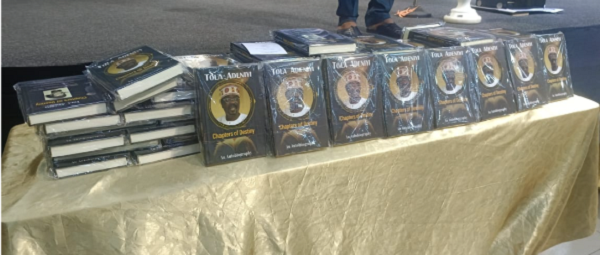

From the opening pages to the end of this near 500-page tome, Akogun Tola Adeniyi’s autobiographical odyssey, ‘Chapters of Destiny’, is, not unexpectedly, a ceaseless page-turning thriller. Poet, dramatist, theatre arts practitioner, journalist, polemicist, columnist, cultural aficionado, author, administrator, successful business entrepreneur, spiritualist and more, the famed pseudonymous ‘Aba Saheed’ of the defunct Daily Times and enduring Nigerian Tribune fame has, indeed, had an epochal life. And with the aid of a capacious, elephantine memory, the interstices, triumphs and travails of that many-sided existential trajectory spring to sparkling life in this narrative like a many- sided diamond.
What unfolds in the hands of the reader across the book’s eighteen chapters plus appendices is the fulsome blossoming and fruition of a life rooted from infancy in the spoken and written word. Right from the beginning, his father’s spiritual counsellor had divined that the young Tola would be a journalist and writer of renown with a fame far exceeding his native origins. It did not turn out to be a fake prophecy. This writer became acquainted with the writings of the famed Aba Saheed as a form three secondary school student in Ilorin, Kwara State.
It was through a small collection of newspaper columns published in the Daily Times at the height of the newspaper’s glory and broadly titled ‘Death, I salute you!’ It was a classic journalistic essay on the vanity and ephemeral nature of power and the temporariness of mortal human glory. The essays were unsparing. They were Epistles of courage. The columnist spoke truth to power with audacious boldness, not caring whose ox was gored. He inspired in the young reader an idea of what the ideal journalist should be and implanted in him the seeds of a burning desire to follow that professional path.
Was it fortuitous that the star-struck, teenage reader of Aba Saheed of the mid-to-late seventies was himself to become, years later, a journalist, columnist, analyst and editor with the same newspaper even though the publication’s glory had become much subdued, albeit with its influence still considerable. Aba Saheed ‘s anonymous protege was later to graduate from the University of Ibadan decades after Akogun had passed through the portals of the great institution as a student of English, Literature and Theatre Arts.
Akogun Tola Adeniyi was far from the ‘flotsam and jetsam’ of society as the great Chief Obafemi Awolowo was to derisively refer to the journalists of his time and cited this as a reason for his quickly exiting the profession for the more prestigious practice of law. His star had begun to shine early. As a young boy, he had performed Yoruba poetry on radio. In his teens, he had published a collection of Yoruba poems and was already reaping monetary rewards from his writing.
Before the age of 20, Akogun Tola Adeniyi had adapted the great writer Chinua Achebe’s immortal novel, ‘Things Fall Apart’ for the stage, met and got the writer’s go-ahead, and publicly presented the drama. It was no mean feat. Before venturing into full-scale journalism, the young Tola Adeniyi had taught in several secondary schools across Western Nigeria, imparting knowledge to young minds in several subjects including English, Literature, Government and Economics. In all the schools where he taught, he established journalism and press clubs, drama and debating societies and nurtured the literary seed in young minds.
Tola Adeniyi’s immersion in both Quranic and Western education no doubt greatly aided his intellectual development. The sizable scriptural memorisation key to Quranic education became of great value to him in his mastery and retention of knowledge in secular Western subjects. Another interesting feature of his early development and consciousness was his strong grounding in the Muslim, Christian and traditional African spirituality. This was what the late Ali Mazrui referred to as the African’s unique triple spiritual heritage.
A gripping episode in the narrative is when, on a trip back to Ijebu from Lagos, the author became the victim of kidnappers who, from all indications, were ritualists hunting for blood. Trapped with them in the vehicle, which had been unaccountably diverted from its normal route, the desperate Adeniyi first began to mutter native incantations; later he resorted to singing Christian choruses at the top of his voice and thereafter began to intone Islamic chants. He was finally able to escape from his captors after a nerve-wracking accident that could well have claimed the lives of everyone in the vehicle.
All through his vocation and later career as a journalist, what shines through is Akogun Tola Adeniyi’s commitment to the values of bruising hard work, honesty, discipline, respect for rules, laws and elders, but also a boldness and uncompromising forthrightness in standing for the right, truthful and ennobling values. His consistent demonstration of courage right from a young age is admirable and shows the roots of the audacity that characterised the famous Aba Saheed column.
Trying to take advantage of the young Adeniyi’s popularity with the students’ population, one of his principals tried to get him to distribute propaganda materials popularising the detested NNDP government in the Western Region. When he discovered the nature of the pamphlets, the author made a bonfire of them on an open field well within view of the Principal’s office! Years later, as a student at the University of Ibadan, his studies were nearly derailed when he participated in various protests against the detention without trial of famous dramatist, Professor Wole Soyinka, by the General Gowon military regime.
Akogun Tola Adeniyi demonstrates through his vivid accounts in this book that the journalist can still practice his profession with courage and integrity while achieving admirable business success and financial solidity. This is indeed a key reason why this autobiography should be a compelling read, particularly for journalists. This autobiography understandably offers interesting and hitherto not too well-known insights into diverse personalities and events in Nigerian politics at different moments of the country’s evolution in which Akogun has been a key actor.
With this scintillating offering, Akogun Tola Adeniyi joins former Managing Directors of the Daily Times – Alhaji Babatunde Jose, Aremo Olusegun Osoba, Dr Yemi Ogunbiyi and Mr Peter Enahoro – who have bequeathed to the nation and posterity the imperishable legacy of their life experiences.