

Inveterate adversaries of the President Bola Tinubu administration have been in celebratory mood ever since the recent seeming face-off between the Catholic Bishops Conference of Nigeria (CBCN) and the incumbent government.
There seems to have been more public interest in the dangerously combustible and barely disguised incendiary amplification of the interactions between the clerics and the President and his team by the Archbishop Emeritus of the Catholic Archdiocese of Abuja, John Cardinal Onaiyekan, on an Arise Television programme shortly after the Bishops’ visit to the Presidential Villa.
One of the most eminent leaders of the Catholic church in Nigeria and beyond, John Cardinal Onaiyekan is a man with impressive scholastic attainment, high intellect and, presumably, elevated moral and spiritual virtues. But he also came across in his television interview as a man who has hitherto unknown considerable expertise in the art of body language reading. For, he claimed to have read in President Tinubu’s body language the desperation of a man who wants to remain in office by all means and will thus not allow free, fair and credible elections in 2027.
These are exceedingly strong assertions which a media, less permissive of attacks against a government it holds in disdain, would have demanded concrete evidence and credible validation since he who asserts must prove. A leading columnist with The Punch newspaper on Thursday vehemently condemned allegations of political partisanship levelled against the Cardinal. But it is an irrefutable truth. John Cardinal Onaiyekan has been brazenly partisan before, during and after the 2023 presidential election.
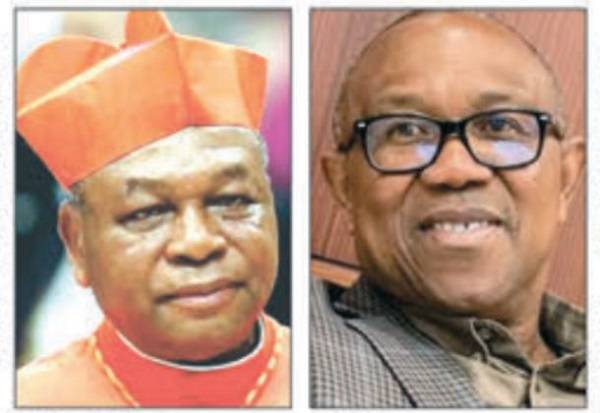
The Cardinal, as far as I know, is the only cleric of his stature and status in the hierarchy of the Catholic Church in Nigeria who openly adopted, anointed and fervently supported a candidate in the 2023 presidential contest. That candidate was Mr Peter Obi of the Labour Party (LP). When the latter lost at the polls, an exercise in which he came third, John Cardinal Onaiyekan identified with the LP’s arbitrary claim to have won the election and advocated that the winner, Tinubu, should not be sworn in before the Supreme Court delivered its verdict on petitions against the outcome of the election. The eminent cleric possibly presumed that the authority of his ecclesiastical toga should substitute for stipulated constitutional provisions on the matter.
The silence of other members of the Catholic Bishops’ delegation on the presidential visitation on John Cardinal Onaiyekan’s outbursts on national television suggests that he was speaking the mind of the group in his outlandishly partisan rendering of their interactions with the President. It is not impossible that the stance of the other Bishops is informed by reasons of ecclesiastical esprit de corps and restraints informed by considerations of seniority within the Catholic leadership hierarchy.
But the blunt truth is that the unbridled partisanship of the otherwise highly respected cleric has serious negative implications for the credibility, integrity and perceived objectivity of the CBCN. True, Onaiyekan’s clerical status does not denude him of his constitutional right to support any candidate or party in any election. But when he purportedly speaks for the CBCN on national television, it becomes difficult to distinguish between his sentiments as a rabid supporter of Mr Peter Obi and the views of the leadership hierarchy of the Catholic Church in Nigeria.
It is true that many Pentecostal pastors went overboard in their support for Mr Peter Obi in the last presidential election. But the Catholic Church is known to exhibit far higher standards of individual and organisational restraint and discipline. In his leaked telephone conversation with a leading Pentecostal Bishop before the 2023 polls, Obi described the presidential election as the equivalent of a religious war, a position the Bishop in question did not disagree with.
But then, to the best of my knowledge, the Catholic Church comprises members of diverse ethnic, cultural, regional and political orientations and affiliations. Is the church now, through its Bishops as best exemplified by John Cardinal Onaiyekan, now identifying institutionally with a particular candidate, political party and religion?
Those who have vociferously applauded John Cardinal Onaiyekan’s articulation of the CBCN’s position in their meeting with President Tinubu commend the clerics for ‘speaking truth to power’. No less is expected of a body like the CBCN, which spoke boldly against military dictatorship and contributed significantly to the emergence of the democracy we have today. Indeed, an objective critique of government is far more to be desired and of infinitely greater benefit both to government and the nation as a whole than engaging in sycophantic drivel.
But unrestrained clerical partisanship as embodied by John Cardinal Onaiyekan obstructs the capacity for objective analysis and erodes confidence in the credibility of political critiques by a body like the CBCN. Indeed, the imperative of speaking truth to power is not a one-track or unidirectional affair. Spiritual leaders too, such as the Catholic Bishops, are men who wield considerable power. But it is not only in politics and government that power corrupts and absolute power corrupts absolutely. The same is also true of spiritual power, which is all too often prone to abuse.
Spiritual leaders are seen by millions of their adherents as representatives of deity on earth. For the Pentecostals, the dictum is “touch not my anointed and do my prophets no harm”. The word of the spiritual leader is thus routinely seen as emanating from the very throne of God. Among Catholics, the leadership of the Church from the Pope through the Cardinals, Archbishops down to the priests are greatly venerated.
It is therefore very tempting for men of God to imperceptibly transform into gods of men. In particular, brazen partisanship emboldens men of God to purportedly speak and act at the behest of God when they are surreptitiously actuated by base partisan and diverse primordial sentiments.
In the case of the Catholic Church, its leadership hierarchy is made of men who have received education up to the highest levels at the best academic institutions across the world. Thus, they wield considerable intellectual power.
This imposes on them the burden of unflagging fidelity to truth and commitment to intellectual honesty and integrity at all times. Thus, it is commendable, as Cardinal Onaiyekan stated, that the Bishops raised the issue of the current economic hardships faced by Nigerians and the need for urgent remedial policies with the President.
But it is intellectually dishonest, given the high scholastic attainment of most of the Bishops, to give the impression that the current economic crisis or severe security challenges started with the Tinubu administration in 2023. It is equally grossly unfair and reeking of crass partisanship to turn a blind eye to the courageous reforms initiated in the economic sector over the last three years to address these issues and the positive impacts these initiatives have begun to have.
It is thus not surprising that the opposition, especially the likes of Alhaji Atiku Abubakar, Mr Peter Obi and Hon. Rotimi Amaechi, have supported and amplified the Bishops’ lamentations about poverty in the land without stating what they would have done differently to address the deep-seated and protracted structural economic distortions were they in power. Poverty and other manifestations of economic crisis will not disappear magically overnight at the wave of a wand by a hypothetical Peter Obi so fondly admired by Cardinal Onaiyekan.
Rather, the macroeconomic successes pointed out by the Tinubu administration in key areas such as strengthening the exchange rate, gradually declining inflation levels, geometrically growing external reserves, enhanced tax revenues, continuously improving balance of trade statistics, etc are critical for the economic stabilisation that must necessarily precede the much-needed microeconomic impact on the living standards of the majority of Nigerians. Government
The Catholic Bishops were bold and blunt in their presentation to the President. It is surprising that John Cardinal Onaiyekan expected Tinubu to be less than candid and to be timid in responding to them. He stated clearly that it was not his duty to help organise the opposition and that he would not roll out the red carpet for them to steamroll him out of office on a platter. Rather, he signified his readiness to compete vigorously for his reelection as required in a multi-party system like ours.
This is certainly nowhere near the declaration of former President Olusegun Obasanjo on national television that the 2007 elections would be a “do or die affair”. I am unaware that Cardinal Onaiyekan’s cautionary voice was heard at the time.
The good Cardinal expressed reservations that the President appoints members of the Independent National Electoral Commission (INEC), saying this is prejudicial to the conduct of free, fair and credible elections. But this is the provision of the Constitution, which predates Tinubu’s election as President. While efforts must continue to be made to strengthen the autonomy of the electoral umpire and improve the integrity of elections, it will be dishonest to say that some progress has not been made in this regard over the last decade. Government
Unlike in 2003 and 2007, for instance, the National Chairman of INEC can no longer unilaterally announce the results of elections in the various states from Abuja. Through the Bimodal Voters Accreditation System (BVAS), the voters register has been considerably sanitised and the possibility of multiple voting eliminated. This is partly responsible for the substantial reduction in the number of votes recorded in elections now compared to a decade and a half ago. Again, most times votes are now electronically transferred to the INEC Result Viewing portal after collation at the polling unit to guarantee greater transparency, even though the law also allows for manual collation and documentation of votes in case of unanticipated glitches in the electronic transmission process.
John Cardinal Onaiyekan on a radio programme suggested that Nigerians would not turn out to vote in 2027 if they believe that the APC is going to win. So will they turn out to vote in large numbers to vote if they believe the ADC or NDC will win? What is the empirical basis for this illogic? Another danger of brazen partisanship.
NOTE: Views expressed by contributors are strictly personal and not of Theliberationnews