

On 13 February 1976, Nigeria witnessed one of the darkest moments in its post-independence history. Head of State General Murtala Ramat Muhammed was assassinated in Lagos during an attempted military coup led by Lieutenant Colonel Bukar Suwa Dimka. The failed coup reshaped Nigeria’s political landscape and led to the execution of more than thirty military officers and civilians.
Among those executed was Major General Iliya D. Bisalla, Nigeria’s Commissioner (Minister) for Defence, whose alleged involvement in the coup remains one of the most debated aspects of the tragedy.
A Photograph Before History Changed
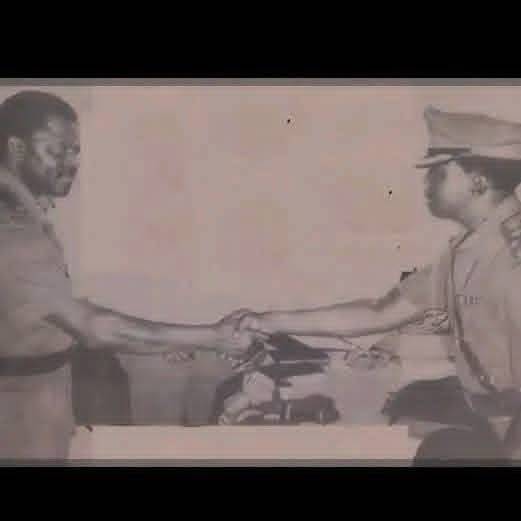
One surviving photograph captures General Murtala Muhammed and Major General Iliya Bisalla standing side by side in military uniform, exchanging a formal handshake.
At the time, Murtala Muhammed was Nigeria’s military Head of State, having assumed power following the bloodless coup of July 1975. His administration quickly gained public support through an energetic campaign against corruption, sweeping reforms in the civil service, and a commitment to returning the country to civilian rule.
Standing opposite him was Major General Iliya Bisalla, the nation’s Defence Commissioner and one of the senior officers entrusted with safeguarding the military government.
In retrospect, the image has become symbolic of the trust—and tensions—that existed within Nigeria’s military hierarchy before the events of February 1976.
The Assassination of Murtala Muhammed
On the morning of 13 February 1976, General Murtala Muhammed was travelling through Lagos in his official black Mercedes-Benz when his convoy was ambushed near Ikoyi by soldiers loyal to Lieutenant Colonel Bukar Suwa Dimka.
The attackers opened fire, killing the Head of State and several members of his entourage. The coup plotters simultaneously attempted to seize strategic installations across the country but failed to gain nationwide military support.
Within hours, loyal troops regained control, and the coup collapsed.
General Olusegun Obasanjo, then Chief of Staff, Supreme Headquarters, subsequently emerged as Nigeria’s new Head of State.
The Trial of Major General Iliya Bisalla
Following the failed coup, the military government established special tribunals to investigate those suspected of participating in the plot.
Lieutenant Colonel Dimka was identified as the principal leader of the coup. During interrogations, statements attributed to him implicated several senior officers, including Major General Iliya Bisalla. The military authorities alleged that Bisalla had played a coordinating role in the conspiracy.
Bisalla consistently denied involvement in the coup. Historical accounts indicate that some of Dimka’s statements were inconsistent, with different names reportedly mentioned during the investigation, including that of Major Rabo. Because the tribunal proceedings were conducted under military rule and much of the evidence has never been fully made public, historians continue to debate the precise extent of Bisalla’s involvement.
Execution
After being convicted by the military tribunal, Major General Iliya Bisalla was sentenced to death.
On 11 March 1976, less than one month after the assassination of General Murtala Muhammed, Bisalla was executed by firing squad alongside 31 others convicted in connection with the coup attempt.
The executions marked one of the largest mass executions in Nigeria’s military history and underscored the government’s determination to deter future coups.
An Enduring Historical Debate
Nearly five decades later, the question surrounding Major General Bisalla’s role continues to generate discussion among historians and political observers.
The official position of the Federal Military Government was that he participated in the conspiracy against General Murtala Muhammed and was lawfully convicted by a military tribunal.
However, some scholars and commentators have questioned whether all those convicted received a transparent and impartial trial, noting the limited public access to tribunal proceedings and the political atmosphere that followed the assassination.
Because many official records remain unavailable and no independent judicial review was ever conducted, definitive conclusions about Bisalla’s precise role remain difficult to establish.
Legacy
The assassination of General Murtala Muhammed profoundly altered Nigeria’s political trajectory. It brought General Olusegun Obasanjo to power, accelerated plans for a return to civilian rule, and prompted significant changes in Nigeria’s military and security institutions.
The image of Murtala Muhammed shaking hands with Major General Iliya Bisalla endures as a powerful reminder of a moment before tragedy struck—a photograph that captures two senior military leaders whose destinies would become permanently intertwined in one of the most consequential events in Nigeria’s history.
References
Max Siollun, Oil, Politics and Violence: Nigeria’s Military Coup Culture (1966–1976).
Nowa Omoigui, “The February 13, 1976 Coup Attempt” (historical research series).
Toyin Falola and Matthew Heaton, A History of Nigeria.
Federal Military Government records on the 1976 coup tribunals.
Nigerian newspapers and archival reports on the February–March 1976 coup investigations.