
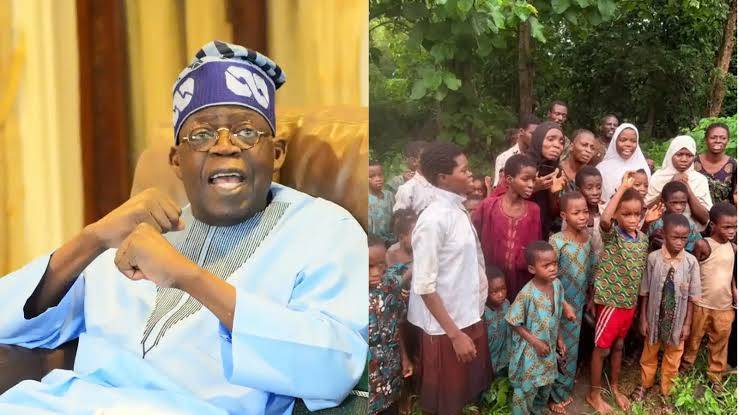

The June 9 rescue of the 44 abducted Oriire local government area, Oyo State, schoolchildren and teachers was probably the first time the federal government would deploy an unorthodox and almost Machiavellian template to fight school abductions. That such a template worked spectacularly is an indication that President Bola Tinubu held his nerves in dealing with a matter that, if the plan miscarried, could have affected, if not doomed, his presidency and reelection chances. It could have gone all wrong had one, two or more children been slaughtered and the video disseminated to the world. It could have gone wrong still if troops had stormed the lair of the terrorists reportedly linked to the dreaded Ansaru group and tens of abducted victims had died in a shootout with the terrorists. Many things could have gone dreadfully wrong in a terrible terrorist saga that lasted some 56 days. But in the end, all the 44 or so victims were reportedly rescued, eight terrorists were arrested, unspecified number of local facilitators and collaborators were also apprehended, and several others neutralised.
Having deployed the template and seen it work, the administration, which has now broken the mould, must develop the nerves to replicate the method nationwide in tackling schoolchildren and mass abductions. The template may prove less feasible in dealing with individual abductions, but something has to be done to extirpate the crime. According to a report published by this newspaper, the template used by the administration involved cordoning off the area of crime and sealing it up like Magdeburg hemispheres, gradually constricting the cordon to suffocate the terrorists, quickly identifying and arresting local collaborators and provisions suppliers to the terrorists, arresting all family members of the terrorists and disseminating the videos to the abductors, making certain punitive insinuations should harm come to the abductees, and completely restricting the movement of the terrorists using measures inspired and executed by all the specialised arms of the security agencies involved in the rescue. According to the government, the measures worked, and no ransom was paid or any preconditions of the terrorists met.
Unfathomably, nearly all print and electronic media in Nigeria which published or broadcast news of the rescue were deliberately muted in celebrating the feat. They hid behind journalistic principles to express their reservations. They either insinuated that ransom was paid or some terms of the terrorists were met, or they gave hints that had the rescue gone tragically awry, it would have been more newsworthy. There was none of the uproarious displays that accompanied initial reports of the May 15 children abductees from three schools in Oriire local government area of Oyo State, or the 42 schoolchildren taken from two schools in Mussa, Askira-Uba local government area of Borno State, or the about 36 people taken from Lassa community also in Borno State. Instead, the said media houses were tentative, if not skeptical, in their view of the statement issued by presidential spokesman Bayo Onanuga. The media professionals wondered if it was feasible or realistic that the rapturous government did not meet the terrorists’ terms. The media establishments in question declined to celebrate the rescue feats, not to talk of encouraging the security agencies or even inspiring them to go ahead and deploy the same Oyo rescue template to focus on other abductions in the country, such as the pending Kwara State abduction in which about 176 are still held.
The Oyo and Borno abductions occurred on the same date, almost down to the number, with Oyo having 46 abductees, and Borno having 42. The abductions were more likely than not designed, especially if media reports and features and protests in the Southwest were taken into consideration, to dent the image of the Bola Tinubu administration and portray it as incompetent and clueless. In the days and weeks ahead, there will be many more reports and essays, not to talk of television analyses, decidedly less effusive about the feats recorded last week by the security forces. The analyses will point at many abductions and terrorist activities in other states yet to be resolved. It will not matter to the analysts that the freed abductees are Nigerians, or that the security forces who spent weeks in the forests and some of them who died in the operations are also Nigerians. Whether the media are enthusiastic or not, it is reassuring that Ogbomosho jubilated on Friday, though the rescue was done on Thursday, Oyo also broke out in raptures of joy, and a restive country has once again not only been reassured of their security but also that there is now a ray of hope concerning the extirpation of the kidnapping cancer.
Hopefully, even if slowly, the seeming abandonment of abducted Nigerians in kidnappers’ lairs will start coming to an end. It took over 65 days for the 16 abducted Christ Apostolic Church worshippers in Eda Oniyo, Ekiti State, to be released after ransom payment. Thousands of other abducted Nigerians have either died in captivity or paid their way out of terrorists’ dens. For more than a decade, the story of bandits and insurgents besieging the country had alarmed and unnerved Nigerians. Finally, it seems, the tide and hysteria may be turning. There will undoubtedly still be cause for concern on insecurity, perhaps more kidnappings, and a lot of activities by terrorists both to make commercial profit and to, from all indications, achieve regional and political goals to discredit the administration. But having tasted this victory, the administration’s appetite to go all out against terrorists and insurgents is likely to become insatiable.
The administration recognises that the battle for the soul of Nigeria is ongoing. It understands how the battlefield is set, and how combatants are positioned. The president had marshalled his tactics and refined his strategies on assumption of office, and had intentionally and incrementally accreted power, starting from state governorship to the legislature. By early this year, the plan had brought 31 states into the All Progressives Congress (APC) column. Furthermore, the president knew that if measurable progress had not been made in combating insecurity in the build-up to the next polls, his campaign would lack conviction. To that end, he had begun quietly but firmly to substantially degrade banditry and insurgency, quietened the international furore championed by the United States on behalf of Christians but regurgitated by Nigeria’s bewildered local media, and consolidated the significant economic progress the country had recorded despite the global tumult stoked by the Russo-Ukrainian war and the triple-sided war between Israel and US on one side and Iran on the other side.
It is unlikely that as far as this campaign cycle and the 2027 polls due to start in January 2026 is concerned the progress sustained in fighting insecurity will be reversed. Indeed, occasional eruptions or economic reform hiccups will prove inadequate to stymie the march to peace and stability. The African Democratic Congress (ADC) may even out of desperation promise a populist review of the fuel subsidy reform, but no other party or business stakeholder will take the Atiku Abubakar-led party seriously. No one will also touch the exchange rate policy with a view to returning it to what it was pre-2023. The two measures, in addition to a host of other reforms, appear to be irreversible. Those measures have freed funds for development where resources were once sequestered in private pockets, and occasioned stability that makes businesses able to plan for the future despite inflationary undertow. Once the US/Israeli – Iran war finally quietens down, even if not finally resolved, oil price may plunge to as low as $50/barrel. Without the reforms engineered by President Tinubu, and the global confidence in the Nigerian economy they have inspired, the economy could very well be imperiled.
It is too early to be complacent about the outcome of the next polls, because the opposition will not roll over and die. The administration must, therefore, develop a holistic measure to tackle and rein in insecurity nationwide. The Oyo template may have assuaged the anxiety of many about the competence of the security agencies, but if it is not replicated in as many places in the country as possible, the administration may again find itself besieged or, worse, overwhelmed. It has achieved a major success in fight terrorism, as exampled by the Oyo State saga; but to prevent a collapse, the administration must press the battle against repeated attacks orchestrated by at least three different sets of terrorist groups in Nigeria, and against the mindless bloodletting perpetrated by insurgents in the Northeast, often indiscriminately. They must also intentionally wage a subterranean war against local collaborators and informants, revisit the atrocious policy of rehabilitating and reintegrating so-called repentant insurgents while their victims are still wasting away in refugee camps.
And, finally, when next the administration achieves the kind of success the Oyo saga exemplifies, the announcement of the feat, no matter how short and cryptic, should be made by either the Defence minister, Army chief, the Department of State Service (DSS) director general, or a joint press conference by the military and intelligence chiefs. But one question that will not go away is how the administration hopes to resolve the abductions in Kwara, Borno and other states where mass kidnapping by terrorists are yet to be resolved.
They must be ready to provide answers.
NOTE: Views expressed by contributors are strictly personal and not of Theliberationnews.