
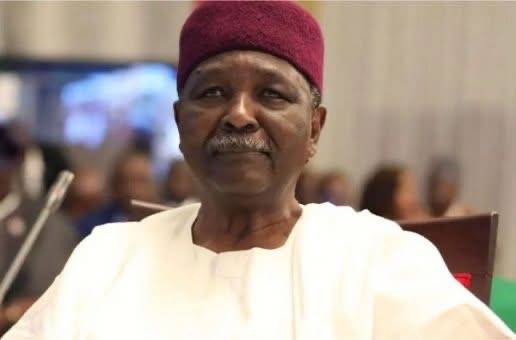

As a little boy in Lagos, General Yakubu Gowon was an icon in the way that a child could conceive that word. My father Moses serenaded him. My mother Salome approved. I watched, ogle-eyed, his wedding to Victoria, lithe in white beside him in his army uniform. It was my first inkling of the idea of man and wife. Each evening, I thrilled to the slogan, “To keep Nigeria one is a task that must be done. Osho be…” Soldiers in battle gear heaved their martial bodies, battle cries on their lips, into trucks as their engines roared away.
This preceded the evening news on our Sanyo Television. It ended with, “What is the meaning of Gowon?” A chorus of cheerful fidelity ensued, “Go on with One Nigeria.” “Again?” asked a voice of mellifluous masculinity. The chorus? “Go on with one Nigeria.”
I sheltered that image of Gowon until, as a secondary student, when Murtala Muhammed struck. He was in my boyish fancies, a different sort of soldier. Gravelly, imposing, brutal. He seemed a fraud of a soldier beside Gowon. Especially when he started firing civil servants and tried to canonise impetuosity as a credo of the messiah. Some of my classmates seemed to love the brawn in his voice. The phrase “with immediate effect,” appealed to some primitive joy in some boys.
But when I took a political class at Ife, the professor – I don’t recall his name – gave an image of Gowon as a weak general, that he could not contain Adekunle and the Cement armada, the governors defied his authority without consequence.
Between my time in the university and last week when I finished his autobiography of over 800 pages, I developed a more nuanced view of my childhood hero. The first impression from his memoirs is the tone. It is written almost without guile or self-awareness. He allows himself to be naïve, vulnerable, angry, wrong, weak, strong. This is the sort of writing that upends French novelist and philosopher Jean Jacque Rouseau, who poked the idea that an autobiography can be sincere but wrote his own titled: self-mockingly, Confessions. He does not preface it with the article “The.”
I finished the book telling myself that this is a gift, a big one to his country. This is the first of such books with immense significance. Not Obasanjo’s Not My Will that others have panned, including Gowon and General Alabi Isama. Or Zik’s My Odyssey, or Awo’s My Early Life. None of these addresses the story of pivotal moments of our nationhood. After boasting vaingloriously in public about his oncoming “the book,” Emeka Ojukwu’s pen froze before his bones did.
Whatever anyone says about Gowon, he is a gift to Nigeria as is his book titled: My Life of Duty and Allegiance. The big parts of his life and our nation concentrate the minds of any student of history and politics. One, the Nigerian crisis of the 1960’s including the Civil War, his overthrow in 1975 and the Dimka adventure of 1976.
The Nigerian crisis actually began, depending on anyone’s arbitrary chronology, with the crisis of the Western Region. But his odyssey kicks off in the first coup of January 15, 1966. It was a time of chaos and bloodshed, of entropy and end of innocence of the young nation. He ended up promoted from chief of army staff to the head of state and supreme commander of the armed forces. Many things happened before that. The coup involved the savage killings of mainly northern and some Yoruba army officers, the abduction of prime minister Tafawa Balewa , whose body was discovered by ace reporter Segun Osoba. It was Nigeria’s version of what the Nazi’s called Kristallnacht, a night of slaughter. Gowon himself escaped unhurt by the act of providence. He was to spend the night with Adjutant General Yakubu Pam, whose home was full of relatives. He was to lodge at Ikoyi Hotel where some officers were slaughtered. But his boss Maimalari ordered him to go to his Ikeja home of his new posting as staff officer, in what is today’s Ikeja Cantonment. His girlfriend, whom he said he no longer wanted, had received him at the port of arrival from a London Course 36 hours earlier. She was Edith Ike, and he told his boss Maimalari that he wanted to take her back to the University of Ibadan where she was a student. Major Ifeajuna was asked to provide escort for them. Gowon changed his mind and spent the night in Ikeja with her. That might have saved his life. He might have gone with Largema and Akintola in Ibadan. Pam was abducted and killed. Ejoor escaped from Ikoyi Hotel, and Major Henry Chukwuka, who was assigned to kill Gowon might have developed a soft heart because Gowon did him a favour when other officers did not.
It was a time of existential tempest. The coup plotters, mainly Igbo, did not kill their kinsmen, including the GOC Aguiyi Ironsi. This angered northern officers who killed him in a revenge coup, especially against the backdrop that there were speculations that the Igbo officers wanted to finish the job and despatch those who survived like Gowon. Ironsi enacted Decree 34 that reportedly gave Igbo control of the civil service across the country. Police officer M.D. Yusufu in a book authored by Ayo Opadokun, recalls Ojukwu saying that all prefects should take over their ministries, a whistle for tribal dominance. The revenge coup was a chapter of savagery as Igbo officers died like flies in the night. Gowon implied that the Nzeogwu coup was no licence for military rule since the plot had been quelled, and he could have handed over to a politician from the north as the lawmakers had wanted. However, Senate president Nwafor Orizu conspired with Ironsi to compel the surrender of the elected civilians. Akinjide confirmed the episode. The nation would have been saved the mayhem to come. Gowon says he was unsure of Ironsi’s right to take over but he yielded. When Ironsi died, the nation looked like a man beheaded. It was tense before that with a restive northern army. The nation had no purpose, no joy, no direction. It was like what the Hungarian Nobel Prize winner, Imre Kertesz, has designated as fatelessness in a novel of that name. It is a state where you cannot control your destiny. This became worse with the Igbo pogrom that led to mass movement to the East. Nigeria now faced secession, as Ojukwu called for it, and encouraged by the Igbo intelligentsia. Gowon implied the pogrom was a revenge for the mass killings of Hausa-Fulanis in the East and that responded to a news report on radio from Cameroun. This is an important revelation that requires historical verification.
The Aburi Accord became a sticking point. Some people have distorted the book claiming that Gowon said he agreed to Biafra because he was not well. He wrote no such thing in the book. He said he did not make any broadcast on the Aburi Accord ahead of Ojukwu’s distortion because he was woozy from medication. He did not say the illness made him concede at Aburi. The Aburi Accord is a public document. In no line does it say that we should have a confederal arrangement or permit a secession. It actually called for a return to the pre-Ironsi arrangement. Any other reading is tendentious mischief! Ojukwu was an ambitious opportunist who wanted to take advantage of the frail tempers of the day. Gowon also spoke of an attempt by Ojukwu to rally his colleagues, including Banjo and Ejoor on how to take over the government to benefit Azikiwe. Gowon says he was happy he did not continue with them. It seemed Banjo and Ojukwu were allies but Gowon was not clear on Ejoor’s stand. Justice Taslim Elias described what happened as a coup plot and he might have been in trouble if it was unearthed. Was that connected with the Nzeogwu putsch? He reported an exchange between him and Ojukwu in the heat of the Nzeogwu coup. He asked Ojukwu why he put the Emir of Kano under house arrest. M.D. Yusufu states that Ojukwu was in touch with Ironsi during the coup in order to know whether or not it succeeded. Once it failed, he withdrew and became governor of the Eastern Region. He also had a dialogue with Nzeogwu after the coup and the young man said the planners did not intend it to be one-sided. He implied it was not so. Gowon did not believe him but described him as misguided. Yet, he was a Biafran soldier.
The providence favoured Nigeria. Gowon was the most senior northern officer and the only one with an equable temperament. That moment called for a reasoning man like Gowon. The July countercoup that killed men like Fajuyi and Ironsi opened the way for a fear of northern irridentism. But Gowon, an Angas native, wanted to stabilise things. Even when Ojukwu kept undermining him, he sought to hold a meeting for peace. In You Must set Forth at Dawn, Wole Soyinka reports that Awo had led a reconciliation meeting with Ojukwu in Enugu. But it was deadlocked. Awo told the bard that after the long stretch of fruitless talks, Ojukwu met Awo in private to confess that he and his people had decided to go to war. Which reinforces Gowon’s claim in the book that Ojukwu was buying time to acquire arms. Even at that, Gowon did not want war. He declared what is called a police action. In the Second World War, it was called a phony war.
The war happened, and Gowon’s nine-year reign was a stabilising force for the nation. During his time, he sheltered Nigerians from the true nature of army rule that we would see later, especially under Murtala Muhammed , Buhari, Babangida and Abacha. He was an officer and gentleman. His time was shorn of the decrees that mangled free speech and the press, opposition voices. He also hired men of credibility, including Obafemi Awolowo, who was the de facto deputy head of state and finance commissioner. Gowon was a benevolent misnomer as an army chief. Ojukwu called him “bible thumping Jack.” Yet, as this essayist will show in my next instalment, Gowon was no weakling. On the coup night, he rallied a battalion in pursuit of the coup detachment led by major Anuforo, who fled under the arms of Michael Opara in Enugu. We forget the Sandhurst-trained officer put down the Jos riots. He is a man of faith with a tough interior. His genial look and disarming smile were a deceptive exterior of a man who has not seen life as a Faustian bargain…