
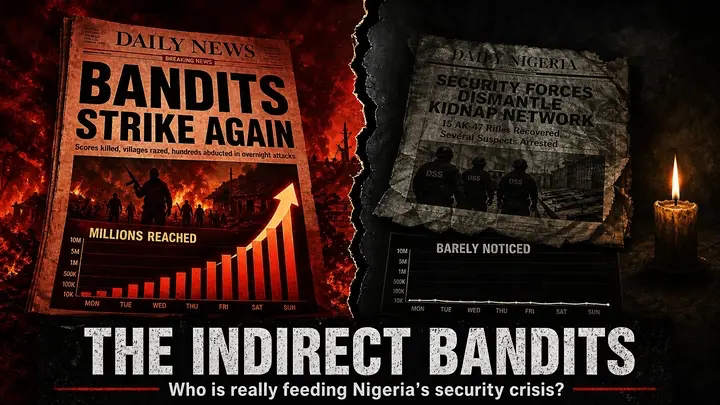

There is a story Nigerian media rarely get to tell about the security situation in this country. On May 29, 2026, operatives of the Department of State Services dismantled an arms trafficking network linked to the November 2025 abduction of 315 Catholic students and staff at St. Mary’s School in Papiri, Niger State. They arrested five men, including two foreign nationals from Niger Republic’s Diffa Region, and recovered fifteen AK-47 rifles and 1,434 rounds of live ammunition. The operation was painstaking, intelligence-led, and consequential.
You probably didn’t see it trending. The comment sections were quiet. The retweets were negligible. The Instagram post about the operation, soldiers and DSS operatives repelling a bandit attack and killing scores of militants, registered few likes and few comments in many platforms.
Now compare that to the last attack story that crossed your timeline. You remember it. You may have shared it. Perhaps you added a line about how the government had failed, how Nigeria was collapsing, how nobody was safe. That post moved. That post gained traction.
That is not an accident. That is the crisis this essay is about.
The Architecture of Banditry
To understand the indirect bandit, you must first understand that banditry in Nigeria is not a single phenomenon. It is an ecosystem: layered, functional, and disturbingly rational from within. Its architects do not all carry guns.
There is the bandit of wealth, the man who discovered, long before the economist did, that kidnapping is the most viable return on investment in a society without accountability. With ransoms running into tens of millions of naira per victim, the enterprise now has sponsors, logistics managers, and financial intelligence networks that many legitimate businesses would envy. Wealth generation is no longer the side effect of banditry. It is the product.
There is the political bandit, not always armed, but often dressed in a flowing agbada or the long-sleeved native wear Nigerians popularly call the Senator suit. This character has a profound vested interest in the perpetuation of insecurity. In a country where incumbency is challenged through narrative more than policy, a government that cannot protect its citizens is a government that loses elections. The political bandit does not need to fire a shot. He only needs to ensure that every shot fired is amplified, and every success is buried. To him, the policies adopted such as ranching initiatives designed to lower the perennial and deadly rift between herders and farmers are inconsequential. To him, the military hardware procured to fight insecurity is a mirage. The troops trained, equipped, and deployed did not happen. The schoolchildren rescued, the arms caches seized, the networks dismantled, none of it exists in the story he chooses to tell.
There is the hegemonic bandit, perhaps the most dangerous because his violence is ideological. He uses terror not to extract wealth but to rearrange geography. Drive the original owners from the land through sustained fear, decimate community structures, and let demographic reality do the rest. The land becomes available. The people become statistics. History is rewritten at gunpoint.
There is the Me Too bandit, a product of moral entropy. When criminality is seen to pay, and when those who profit from it are not visibly punished but occasionally celebrated, imitation follows. In a society where structural failure has reduced the horizon of ambition, the bandit is sometimes the most successful man a young person knows. If he is getting away with it, why can’t I?
And then there is the fifth type. The one this essay is really about.
The Indirect Bandit
The indirect bandit does not wear a mask. He may wear a press card. He may carry a verified blue tick. He may have a podcast with forty thousand listeners, a column in a national newspaper, host a regular TV show. or have a WhatsApp broadcast list that reaches fifteen hundred people by 7 a.m. He is not afraid of the law because what he does is not, strictly speaking, illegal. And that is precisely what makes him so dangerous.
The indirect bandit is the media practitioner who has, whether through frustration, ideology, political alignment, or personal animosity toward a sitting government, made a permanent editorial decision: that every bandit attack must be loudly amplified, and that every security breakthrough must be quietly buried. He will write three thousand words on a kidnapping in Zamfara and ignore the army’s elimination of forty-five bandits in a Niger State operation. He will not explain the difference between Boko Haram, ISWAP, Lakurawa, and farmer-herder militias, distinctions that the BBC has acknowledged are critically important to understanding Nigeria’s overlapping security crises because ambiguity is more terrifying than clarity, and terror drives engagement.
Some are doing this out of genuine frustration with the system, and that frustration is legitimate. The Nigerian state has failed its citizens in profound and documented ways. But frustration does not absolve editorial responsibility. Others have been retained, explicitly or implicitly, by political actors whose fortunes rise when the national mood is dark.
Some of these commentators have become so emboldened in retailing perjury. Yes, it is ethical perjury, because for any media practitioner to wilfully ignore documented facts about governance and security in order to sell a preferred narrative of underwhelming performance is a lie told with credentials. And so they invent narratives to sustain the mischievous claim that the Tinubu administration has done nothing to address the challenge of insecurity facing the nation. They would even challenge their followers to name one thing the administration has achieved in three years of tackling insecurity. The answer, of course, exists. President Tinubu declared a national security emergency and ordered the recruitment of 20,000 additional police officers, redeploying personnel from VIP protection duties to active conflict zones. His administration ordered security agencies to crush bandit networks across the north. The DSS, the military, and allied operatives have recorded documented operational breakthroughs from Papiri to the Lake Chad Basin that these commentators have chosen not to report. They have mortgaged their credibility. The bandits received it as a gift.
The Oxygen of Publicity
In 1985, British Prime Minister Margaret Thatcher stood before the American Bar Association and made a statement that has defined the ethics of conflict journalism ever since. She accused the news media of giving terrorists “the oxygen of publicity”, arguing that without the amplification of their acts, political violence would suffocate. She was prescient.
Academic research has since given her instinct an empirical spine. Economists Bruno Frey and Dominic Rohner found that for every act of terror, newspaper circulation and profits increase, and that this incentive structure creates a perverse feedback loop in which media profit from covering violence, and violence is encouraged by media coverage, in an escalating cycle of spectacle and response. Journalism scholar Gabriel Weimann concluded that terrorism is, at its core, a media phenomenon: theatre designed for an audience. Without the audience, the show closes.
This is not, however, a case for silence. A free press is the architecture of accountability. Without it, governments abuse power, officials loot with impunity, and the public is left uninformed and defenceless. The Organisation for Security and Cooperation in Europe (OSCE), UNESCO, and every credible institution that has studied the relationship between media and political violence have been unambiguous: reporting on terrorism and banditry is not only permissible, it is necessary. The public must know. Victims must be heard. Accountability must be demanded.
But accountability requires balance, and balance is where Nigeria’s media landscape has most dramatically failed. The line between responsible journalism and the oxygen of publicity is this: reporting shifts from the former to the latter when it stops informing the public about a security threat and begins performing that threat for an audience. When the camera lingers on the grieving family not to demand accountability but to produce emotional content. When the journalist reports every abduction with full operational detail including locations, timing, routes but cannot find space for the DSS operation that ended the same abductors’ network. When the byline becomes a production credit for the bandit’s recruitment campaign. The UK’s Survivors Against Terror, a coalition of people who lived through bombings and shootings, secured a new reporting framework in 2025 explicitly advising newsrooms to “minimize coverage of terrorists’ names, images, and manifestos to deprive them of the notoriety they seek”. The evidence is global. The lesson is plain. Nigeria’s indirect bandits have simply chosen not to learn it.
The Complicit Family
But the indirect bandit does not only live in the newsroom. He lives closer to home. Literally.
On May 30, 2026, the Ogun State Police Anti-Kidnapping Unit arrested Abdullahi Muhammadu, the 67-year-old Seriki Fulani of Ijebu Ode, after a ransom bag was recovered from his kitchen, physically connecting his household to a string of kidnappings across Ijebu Ode, Imodi, Irewon, Iwode, Okun Owa and surrounding communities . His son Bala, the prime suspect, is a convicted kidnapper who had already served five years in a correctional facility. Upon his release, the father, knowing his son’s criminal history, funded his hospital treatment and welcomed him back under his roof. When police arrived, it was another member of the household who alerted Bala, allowing him to vanish through a bush path . A family that knew. A family that chose blood over community. A family that became, in every meaningful sense, the bandit’s logistics base.
This pattern of community enablement extends beyond blood ties. In Katsina State, a former aide to a sitting governor, a man trusted by his community as a leader by day, was arrested for running a child abduction and ransom ring, with a N17 million ransom deal at the centre of the case. His community standing was not incidental to his criminality. It was its infrastructure. The title, the access, the trust, all weaponised. These are not anomalies. They are the rule.
Across the world, the family and community of a criminal are the criminal’s most important resource, not because they all approve, but because silence, when the stakes are high enough, is approval.
In the United Kingdom in 2019, John Letts and Sally Lane, a respectable couple from Oxford, were convicted at the Old Bailey for funding terrorism after sending money to their son Jack, who had travelled to Syria to join ISIS. Their love for their child cost them their freedom and their moral standing. They knew what Jack was doing. They chose him over their country.
In Norway in 2011, Anders Breivik’s mother watched her son transform over years, withdrawing from society, becoming obsessive, preparing in ways that, in retrospect, screamed danger. She did not alert authorities. On July 22, 2011, Breivik killed 77 people at Utøya Island and in Oslo. His mother later told psychiatric evaluators that she had witnessed her “kind son turn crazy” but had taken no action. Thirty-two years of grief and national reckoning followed a silence that could have saved dozens of lives.
The Seriki Fulani of Ijebu Ode may not have planned the kidnappings. But a ransom bag in his kitchen is not a coincidence. It is location. It is access. It is family.
When the People Stand Up
The opposite of complicity is courage. And the world has seen what courage looks like when ordinary people decide that their community matters more than their comfort.
In May 2010, a smoking Nissan Pathfinder was parked in Times Square, New York, loaded with a homemade car bomb that, had it detonated, could have killed dozens. It was not a surveillance camera that raised the alarm. It was Lance Orton, a Vietnam veteran selling T-shirts on the street, and Duane Jackson, a Senegalese immigrant, who noticed the smoke and alerted a nearby police officer. Faisal Shahzad’s bomb was neutralized within minutes. Two street vendors, not agents, not officials, became the first and most critical layer of national security that day.
In Norway, the national response to Breivik’s massacre became a global model not for its militarism but for its civic solidarity. Prime Minister Jens Stoltenberg declared that the answer to violence was “more democracy, not less.” Communities bound together. Schools opened their doors. Reporting networks were established. The state and the people moved as one organism. That is what a society looks like when it decides that the enemy of one is the enemy of all.
In Nigeria, too often, the instinct runs the other way. Security authorities documenting banditry in Kwara State’s Ifelodun Local Government Area found that criminal groups were thriving specifically through “community complicity and silence”. A 2026 investigation found that in some communities, locals tip off bandits about approaching security operations, not security forces about approaching bandits. The question this raises is not comfortable: whose side are we on?
The Sixth Bandit Nobody Names
There is a sixth type of indirect bandit that public discourse in Nigeria refuses to name, and he may be the most structurally corrosive of them all. He is the community shielder: the village elder who knows which compound the ransom is counted in but considers it a domestic matter; the market woman who notices the strangers with covered motorcycles parked three nights running but decides it is not her business; the local politician who negotiates with bandits on behalf of “his people” and receives a percentage of the calm in return. He does not appear in security reports. He is never arrested. He is sometimes celebrated as a peacemaker.
The community shielder is the reason intelligence fails in Nigeria more often than military hardware does. A DSS operation is only as effective as the silence in which it is planned.
When that silence is broken by a phone call from the compound next door, by a tipped-off uncle, by a Seriki who chose his son over his community, the suspects escape through a bush path, the network reconstitutes, and the cycle begins again .
Security is not a function of weaponry alone. It is a function of collective will.
The Mirror
This essay is not a defence of any government. It is a defence of truth. The same journalist who demands answers from the government for every attack owes the public an equal duty to report every breakthrough. The same commentator who asks his followers to name one thing this administration has done owes them the answer, not as propaganda for power, but as the raw material of informed citizenship. The DSS recovered 1,434 rounds of ammunition and fifteen rifles from the Papiri network in a single operation. The army neutralised scores of bandits in coordinated Niger State raids. These are facts. A media practitioner who wilfully suppresses them is not holding the government accountable. He is holding the truth hostage, and handing the bandits a megaphone.
The responsibility of securing a country belongs to every member of society. The government provides the apparatus. The military provides the force. But the people provide the intelligence, the social fabric, and the moral environment in which either order or chaos is allowed to breathe. Every citizen is either a security asset or a security liability. Every journalist is either a force for societal cohesion or a vector for societal disintegration. There is no neutral ground in the middle of a war.
You are not hurting Tinubu when your every broadcast, column, and tweet amplifies the bandit and buries the soldier. The President has security details and a fortified residence. You are hurting the teacher in Papiri who returned to her classroom after thirty days in a forest, wondering whether the next morning would bring another set of gunmen. You are hurting the family in Ijebu Ode that now locks its doors at sunset . You are hurting the child who will one day read about Nigeria’s banditry crisis and find, in the media archive, only an endless record of carnage. No victories, no heroes, no evidence that the state ever won.
The bandits know who their friends are. The question, the only question that matters, is do you know who you are.
#TheIndirectBandits #NigeriaSecurity #BanditryInNigeria #MediaResponsibility #Nigeria #Ribadu #Tinubu
Olabode Opeseitan
Editorial Architect | Legacy Steward | Strategic Communicator.