


The symbolism of June 12, yoked with state police, almost now a done deal, is lost on most.
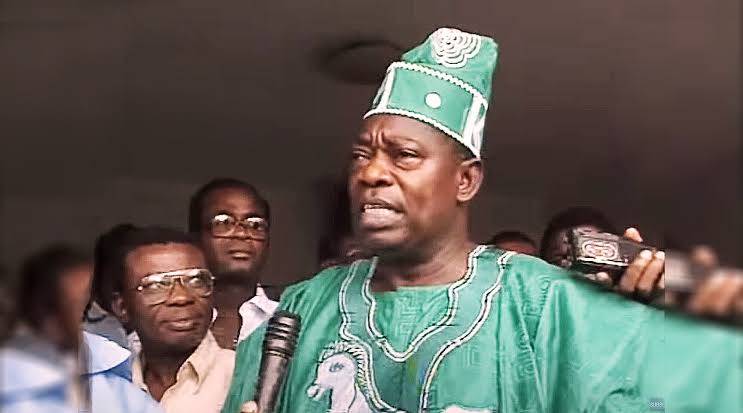
State police is coming when the genuine “June Twelvers” are in power. They fought for MKO Abiola’s presidential mandate of June12, 1993; and shut out the political soldiers.
Now, a caveat. The Nigerian power elite, since 1999, has remained the same. Only the core leadership changes — and each change chisels the ruling bloc in its core image.
Olusegun Obasanjo’s sterile centralism ruled the roost from 1999. His military command-and-control temper made his government blind, deaf and dumb to adjusting Nigeria’s unitary federalism — a dire oxymoron! — to tackle our pressing needs.
State police was the victim-in-chief. Today’s security meltdown is living proof. But no less battered were electricity and rail — key drivers of the economy, now adjusting to progressive federalization; and the putative higher value in citizens’ lives and living.
Just imagine what the economy would have been today, had the Obasanjo government not stubbornly frustrated Governor Bola Tinubu’s Enron Independent Power Project (IPP); and its wilful initial block of the Lagos urban rail, with the flagship Lagos Blue Rail, now delivering mass transit value, with its pioneering twin, the Lagos Red Rail?
Obasanjo’s successors, the ill-fated Umaru Musa Yar’Adua and President Goodluck Jonathan, rode out that sterile centrism, until power Siberia came calling in 2015.
President Muhammadu Buhari, another military centrist, was the closest to a Saul-turned-Paul in his Nigeria power evolution. As GMB and junta head, he subverted 2nd Republic Lagos Governor, Alhaji Lateef Jakande’s Lagos Metroline Project, at the overthrow of that Republic on 31 December 1983.
But as PMB, he not only federalized rail, he also backed, to the hilt, the Lagos Blue and Red rails, ensuring that the Lagos Red Rail shares tracks with the Nigeria Railway Corporation (NRC).
Aside from posting the most revolutionary rail upgrade in Nigerian history, PMB’s new-found federalization also touched power.
On 17 March 2023, he signed the Constitution Alteration Bill No. 33 into law. That tossed electricity into the concurrent, from the exclusive list. By that, Nigerian states can license firms to generate, transmit and distribute electricity within their territory.
That effectively ended the central grid monopoly. President Tinubu pushed that further with the Electricity Act, 2023, which he signed on 8 June 2023 — 10 days after he took power, clearly to stress his government’s seriousness on electricity reforms.
But not even PMB’s latter-day activism, on the federalist lane, could land state police. Even at the height of insecurity’s diffusion — not numerical “worsening”, mind you — the PMB government’s body language was to balk at the South West hysteria for Amotekun, as an integrated regional police service.
To be fair, many of those that pressed their democratic right to Amotekun picked no bones about their cocky Yoruba irredentism, if not outright supremacism, against a hated and formidable Fulani foe, real or imagined!
Yet, with the security meltdown, the time for an Amotekun had come! So, an abuse, however preening or annoying, hardly vitiates the inherent qualities of a concept!
That central anti-Amotekun tardiness, back then, may have enabled the tragic Orrire local government, Oyo State, teacher-pupil-tot kidnapping of May 15.
If sub-regional security corps, as Amotekun, had been trained and equipped well enough, they could have brought to heel the cowardly vermin that bully soft targets, as they flee from blazing fire in the terrorism-banditry hot theatres of the North East, the North West and some parts of the North Central.
What is more? With the prospects of rich intelligence-gathering by locals intimate with their locale; and the even richer chances of using the intel to smoke out most crimes, even before they are hatched, imagine the likely crime prevention!
Herein then, lies the double, if progressive symbolism! As the June 12 democracy forces decisioned the junta politicians — who nevertheless re-seized power in 1999 under Obasanjo — June Twelvers in power, under Tinubu, have junked the junta’s most visible security legacy — centralized policing — and right so, by the grim realities!
Yet, to be fair: unitary policing came to correct the thoroughly abused regional police in the 1st Republic. The old East made do with the central Police. But the North and the West pressed their rights to a regionalized Police — and thoroughly abused it.
The notorious Native Authority (local government, in today’s parlance) was the North’s crackling rod to crush the political opposition. When the hugely unpopular Demo order of the embattled Premier Samuel Ladoke Akintola felt trapped by its people’s scorn, it brutally leveraged the West Regional Police to strike back.
So, when things fell apart after the military ouster of the democratic order in 1966, federalized Police, as then practised and ruined, was an idea whose end had come!
But then, the unitary Police, of the military era too, suffered the wilful subversion of policing ethos. All through the military years, the Nigeria Police became the scorned son of a rich parent! It’s debatable if that situation has changed since 1999.
The political soldiers progressively destroyed the Police. They wouldn’t brook any licit security arm that could challenge their brazen control.
So, from 1966, the Nigeria Police that the soldiers imposed progressively became a caricature of the original. But it too has come full circle. It must give way to a re-federalized Police system, with robust checks and balances. Still here, clarity is key.
Powers and functions must be rigorously shared between the proposed Federal Police Service (FPS: the present Nigeria Police Force) and the incoming State Police corps.
Without luxuriating in needless legalism, the distinction between the FPS and State Police is clear. That’s the main thrust of the re-federalization.
But in altering Section 214 of the Nigerian Constitution 1999, the amendment defines “Community Police” as: “a policing approach in which law enforcement personnel work in close partnership with residents, community institutions and local stakeholders to prevent crime, maintain public safety and resolve security concerns through collaboration, problem-solving, trust-building and regular engagement with the community.”
These are the very canon of state Police. If that is trite, why this elaborate definition? The red light should blip because the central fixation with “community police” was used to stone-wall state Police for too long, even with dire and glaring insecurity!
Let it be clear: the FSP has little business with community policing, except in its core territory as the Federal Capital Territory (FCT). This distinction must be very clear.
State Police is a great goal for the restructuring lobby. But it’s also an ode to common sense — which most times is not common!
Still, federalizing does not equate willy-nilly uniformity. States that can’t afford own Police can use the FPS, though the transition from the present is a four-phase, five-year timeline.