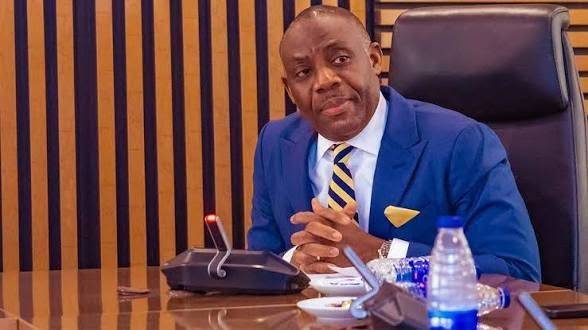

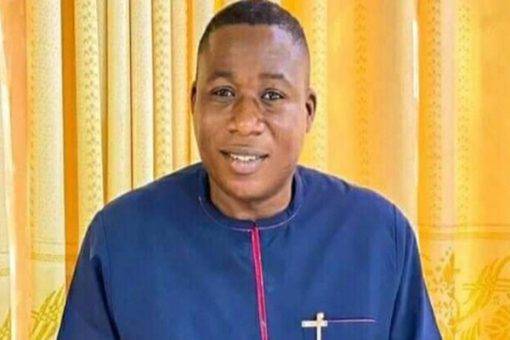

He has a history of bold security activism, championing initiatives to safeguard the South-West from external marauders. He also promotes the concept of an independent “Yoruba nation.”
His latest security initiative, the “Iru Ekun Security Network,” is currently awaiting authorisation from federal authorities, according to a statement he released.
Sunday Adeniyi Adeyemo, popularly known as Sunday Igboho, stated: “We have submitted all the required documents for our registered security firm, ‘Iru Ekun Security Network’, and are only waiting for the Federal Government’s approval, which will be granted soon.”
He added that the security organisation is “absolutely ready to collaborate with the Police, Department of State Services, Nigeria Army, Nigeria Security and Civil Defence Corps and other relevant stakeholders in the security sector to flush out terrorists, kidnappers, bandits, and other hoodlums, who are threatening the peace and safety of our people, most especially in the rural communities.”
It is unclear why he optimistically expects the Federal Government’s approval, considering the complications regarding his initiative.
However, a video clip circulating online tells a different story. Addressing operatives of the security outfit, he is captured saying: “We’ve started already; there’s no delay. Anyone found in any of our forests is a criminal… We will start work in all forests in the South-West including Kogi and Kwara states.”
If the security organisation is actually awaiting official approval, as he explained in the statement, how can he also claim that it had started operations? Operating without formal authorisation is unlawful.
He hit the headlines in January 2021 after issuing a controversial seven-day ultimatum to suspected criminal Fulani herdsmen to vacate the Ibarapa area of Oyo State. He accused them of orchestrating a wave of killings, kidnappings, and relentless attacks on local farmers.
When the ultimatum expired, he travelled to Ibarapa to enforce it personally. This extra-legal intervention, in the context of troubling insecurity, positioned him as a populist fighter and defender of Yoruba interests.
He subsequently collaborated with some groups to advocate for an independent Oduduwa Republic (Yoruba Nation), and organised rallies across the southwestern states.
The Federal Government under President Muhammadu Buhari considered his activities an explicit challenge to Nigeria’s sovereignty, moving swiftly to restrain him.
In a dramatic escalation on July 1, 2021, a joint team of security operatives raided his Soka residence in Ibadan, Oyo State, but the activist evaded arrest and escaped. The Department of State Services (DSS), in a statement, said the raid was “based on intelligence that he had stockpiled arms in the place.”
According to the security agency, “the team came under heavy gun attack by nine men, suspected to be Igboho’s guards. Six of them were armed with AK-47 guns and three others, with Pump-Action rifles.” The DSS said “two of Igboho’s armed men were gunned down while the rest were subdued and arrested.”
The team searched the house and, according to the DSS, recovered seven AK-47 assault rifles, three Pump Action guns, 30 fully charged AK-47 magazines, 5,000 rounds of 7.62mm ammunition, and 18 Walkie-Talkies, among others.
The DSS declared that Igboho and his group, “in the guise of campaign for self-determination, have become well-armed and determined to undermine public order.” It added that the arrests and seizures were “a confirmation of a grand plan by Igboho and his cohorts to wage a violent insurrection against the Nigerian State.”
Igboho vehemently denied these charges. He fled the country, and was arrested later that month at the Cardinal Bernardin International Airport in Cotonou, Benin Republic, while attempting to board a flight to Germany. Detained by Beninese authorities, he faced domestic legal hurdles, and extradition moves from the Nigerian authorities.
He regained full freedom in October 2023. In January 2026, following diplomatic interventions by prominent Yoruba traditional rulers (including the Ooni of Ife and the Olubadan of Ibadan), the Federal Government under President Bola Tinubu officially removed him from the state wanted list, freezing orders on his bank accounts were reviewed, and he returned to Nigeria from exile.
His current operations signal a shift from confrontational separatism toward regional defence collaboration. By publicly stating that his new grassroots security outfit seeks formal alignment and approval from the Federal Government and South-West governors to complement state-backed mechanisms like the Amotekun Corps, he indicated a fresh chapter in his security campaign in the geo-political zone.
This shift in his operational strategy carries complex socio-political, legal, and regional security implications. Triggered largely by renewed spikes in rural insecurity—such as the high-profile coordinated abductions of school pupils and teachers in the Oriire Local Government Area of Oyo State—the initiative moves his campaign from unstructured populism into a formalised structure.
A significant operational implication is the explicitly stated scope of the network. Igboho announced that Iru Ekun would not limit its forest sweeps to the core South-West states (Oyo, Osun, Ondo, Ogun, Ekiti, Lagos) but would actively extend into Yoruba-speaking pockets of Kogi and Kwara states (North-Central Nigeria).
This cross-regional boundary expansion introduces potential friction with local security architectures in the North-Central geo-political zone, which may view an external, ethnically aligned southern group operating in their forests as an overreach or an infraction on their territorial jurisdiction.
Even with official registration as a private firm, deploying a loyalist grassroots force into volatile forest reserves presents a delicate challenge for federal intelligence agencies. It risks normalising parallel enforcement structures that can easily bypass standard state accountability.
The introduction of Iru Ekun adds another layer to the regional security matrix, specifically regarding the Western Nigeria Security Network (Amotekun). While Amotekun is backed by state laws, funded by state governments, and formally integrated with state administrative machinery, Iru Ekun is structured as a voluntary network under private leadership.
If clear operational boundaries and command-and-control protocols are not established, their co-existence in forest intelligence gathering and tactical operations could lead to jurisdictional clashes, friendly fire, or conflicting intelligence management.
If the network successfully coordinates with state actors to flush out bandits from deep forest reserves, it could have a positive impact on the agro-economy and rural security.
Forest routes have long served as tactical launchpads for kidnappers, crippling local farming and worsening food inflation. A disciplined, localised presence that understands the terrain could yield tactical intelligence that conventional federal forces often struggle to access.
Igboho, 53, remains a case study in how local security concerns can propel a grassroots figure into a major actor in national political discourse.
Ultimately, the dangerous level of domestic insecurity, which inevitably encourages the formation and intervention of non-state security outfits, demands urgent remediation by the state authorities.