

“It’s surely our responsibility to do everything within our power to create a planet that provides a home not just for us, but for all life on Earth.” — Sir David Attenborough (A centenarian).
Who is in charge of solid waste collection and waste management in the Centre of Excellence and the erstwhile capital of the country? This question becomes pertinent on the heels of the recurring epileptic state of household refuse collection across Lagos by the body tasked with ridding the city of filth. More perturbing is the fact that as the Sallah festival approaches, when cattle, camels, and rams will be slaughtered as sacrifice to Almighty Allah, the surplus waste to be generated including organic or packaging wastes or market refuse, will further expose, expectedly, the flaws in the state’s current erratic waste disposal system. The consequences, in realistic terms, are easy to imagine, but very unpleasant to live through.
From a personal point of view as a victim of this avoidably inept waste management system and leadership, yours sincerely can attest to the fact that the growing delays in domestic refuse collection, if not addressed quickly, will worsen a crisis that is already creating a visual blight with serious health and adverse aesthetic implications for the state’s environment and its inhabitants. One is at a loss as to why refuse collections that ordinarily should be a routine service has become a cumbersome affair between inhabitants, the Private Sector Participation, PSP, operators, and that of a mismanaged collection system.
At the beginning of this democratic experiment, the inherited environmental conditions from the military were unimpressive but the then governor, Asíwájú Bola Ahmed Tinubu, now president of the country, was swift in addressing the heaps of refuse that daily surfaced on Lagos roads. What he did is better understood with a historical insight into the journey of rescuing the state from environmental catastrophe.
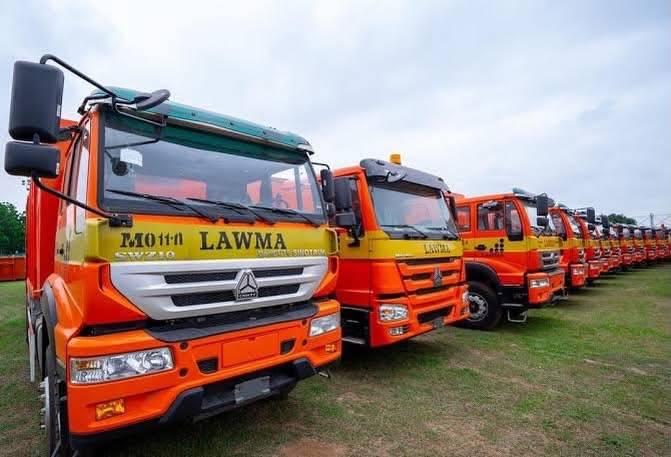
In hindsight, waste management in Lagos has evolved in fits and starts. In 1977, the state’s refuse disposal board was established. By 1991, it metamorphosed into the Lagos State Waste Management Authority (LAWMA). The turning point came under Asiwaju Bola Ahmed Tinubu, who, in response to the dire environmental situation of that period responded by breathing life into LAWMA that was barely existing only in name rather than in effective performance. Tinubu’s creative response led to the creation of the Private Sector Participation (PSP) initiative in early 2000: The objective was to improve neighborhood waste collection that was then in shambles. The modus of the idea was equally strategic: He decentralised refuse collection, empowered private investors, and made the system responsive.
It wasn’t just a paper idea since he needed human capital to drive the process. He searched around and on the recommendation of Tunji Bello, journalism pride, lawyer and high flying incumbent Executive Vice-Chairman/CEO of FCCPC who was then the pioneer Honourable Commissioner for the Ministry of Environment (now Ministry of the Environment and Water Resources), Tinubu appointed Dr Ola’ Oresanya, a resourceful technocrat as its pioneer managing director. For ten years of building on Tinubu’s environmental reforms, LAWMA made remarkable progress throughout then effective administration of Governor Babatunde Raji Fashola, SAN. Streets were cleaner, PSP operators were paid regularly, and enforcement had meaning, and with negligible hitches.
Sadly, the progress began to erode towards the end of Fashola’s successor, former governor Akinwunmi Ambode’s tenure, when the Visionscape experiment he introduced disrupted the PSP model, with unpalatable consequences on the environment. When Sanwo-Olu resumed as governor in Y2019, he reverted to the PSP model but failed to back it up with the creative determination of an Asiwaju and the boisterous focus of a Fashola. The result, under him is what we are witnessing in seven years of his governorship of the state: No place to dispose the wastes being collected from households by the PSP operators.
Now, outlawed cart pushers are enjoying uninhibited operations within the regulatory vacuum through undesirable household patronage and wanton collection of household waste for a fee, and dumping such in unauthorized places including drains, vacant plots, open spaces, road medians, and even canals that our government yearly budgets and spent hundreds of millions to desilt.
The harsh consequences of this on the environment include but are not limited to avoidable blockage of drainage channels originally designed to carry storm waters to prevent flash flooding whenever it rains. It may be partly true that poor environmental habits of our people should be condemned but what about the pretentious commitment disposition of those appointed by the government in LAWMA and the supervisory ministry of the environment and water resources to rectify these problems? We seem to be paying them to create our own environmental hazards as they are known to take delight in flying abroad to stay more outside the country than within to get the jobs they are employed to do done.
These Sanwo-Olu’s environment managers, most especially the managing director of LAWMA, often befudles us with excuses, including his routine allusions to the huge pressure of wastes generated through the daily influx of people into Lagos; and that the state generates 13,000 metric tonnes of wastes daily with only fifty percent of it being properly collected. While these might be true, it won’t be an overkill to point out that the current leadership of LAWMA and its supervisory ministry under Sanwo-Olu’s watch has not been inspiringly focused and disciplined enough in terms of its commitment to further actualising the objectives of LAWMA as envisioned by Tinubu and moderated at that early stage by Bello.
Again. Whatever environmental problems regarding refuse collection that the state may be facing today obviously have inherent physical planning components that must be strictly and promptly attended to. This is because a significant portion of Lagos state’s waste problem stems from poorly regulated commercial building approvals—hotels, apartments, lounges, and clubhouses with high waste outputs that were allowed in purely residential areas/neighbourhoods. Interestingly, many of these misplaced building approvals, granted out of sheer corruptive recklessness or due to senseless political interference, generate over tenfold, if not more, of the waste of a purely residential building; yet, misplaced commercial buildings waste upkeeps are assigned to the same low capacity PSP operator on streets with such physical planning infractions.
This cannot be a problem of daily influx of people into Lagos but sheer government’s condonation of indiscriminate building rascality; the result of which includes the assigned operator being overwhelmed while hundreds of residents go unserviced thereby making illegal dumping to be by default. The ministry saddled with the environment and LAWMA are obviously not doing enough to coordinate commercial waste evacuation permits that are tied to residential evacuation contracts and verified capacity of PSP operators.
Also added to this is the unpredictability surrounding the viability of existing dump sites. It is unfair to compound PSP operators’ logistics problems/expenses with the challenges of a dysfunctional dump sites that this government ought to have resolved in seven years of being at the saddle, and with barely a year to go. Under the prevailing economic conditions, it makes no official sense to overnight redirect operators to take collected wastes to faraway Badagry with no palliatives for them to absorb the unbudgeted cost of government’s inefficiency, the brunt of which residents might be compelled to bear by PSP operators.
This administration cannot afford to treat solid waste management as an afterthought, otherwise, the putrid stench on the streets of Abule-Egba, Egbeda, Oke-Odo, FESTAC Town, Amuwo, Apapa, Iponri, Ojuelegba, Oshodi, Ojodu-Berger, Oworonshoki, Ogudu, Agege, Ogba, Ikeja, Surulere, Ajah, and Mushin amongst others including the highways, will become its enduring legacy. A megacity deserves more than episodic and panic cleanups through the newly introduced monthly sanitation exercise. Whether now or in the future, Lagos deserves an environmental system that works every day for every resident. As a mega-city prospect, this Centre of Excellence deserves not a reactive approach to issues of its environment but must ensure the putting in place of a waste management strategy that matches its ambition.
Since the bulk stops on Sanwo-Olu’s table as the chief accounting officer of his state, he needs to exemplify the desired urgency of addressing these environmental problems that is currently far below the expectations of residents. Waste management is not something to be mouthed officially but an important subject since it relates to the core existence of our collective wellbeing. Environment is three things rolled into one: Public health, Public safety, and Public perception. The environment loudly tells who we are to our visitors and also tourists trooping to have a feel of Lagos lifestyle, every year.
Above cannot be achieved without the right leadership choice to man that environmental space. Dr Muyiwa Gbadegesin and his commissioner, Barr. Tokunbo Wahab are trying their best but obviously, to residents, their best in keeping our environment tidy falls short of our expectations as tax payers that desire a healthy environment to peacefully coexist with one another.
And a final important point to the governor; do the needful on waste management in our dear Lagos now because your government’s inability to effectively manage waste is capable of denying it the effrontery of laying claims to being sustainably safe and smart.
•Sanusi, former MD/CEO of Lagos State Signage & Advertisement Agency, is currently managing partner at AMS RELIABLE SOLICITORS.(WhatsApp Only-07011117777).