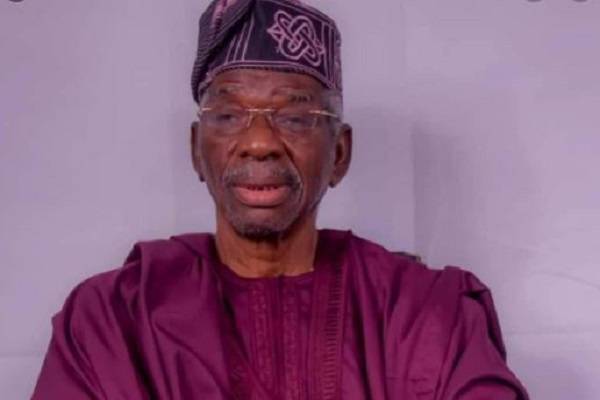

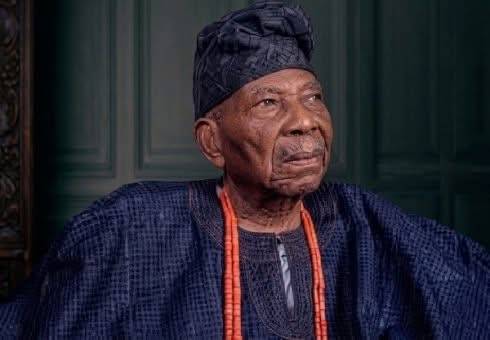

Rarely in history has age purified a personage like in the story of Pa Reuben Fasoranti. He is the wine that sweetens with time. He is the envy of all who covet old age. Even most aged men and women would cringe at his century. He is an oldster, an elder who subdues the oldies. Everyone pines for old age, except the suicides. So, no wonder the melodies from high and low as he became a centenarian.
Turning one hundred may be a factor of genetics. But only few genes outwalk the hundred mark. Many say it is care. In his Twelfth Night, Shakespeare says “care is an enemy to life.” Many believe it is the grace of God. Even for the righteous, God’s grace rarely counts a 100. He told Apostle Paul, “My grace is sufficient for thee.”
Fasoranti is the image of all who want to live long and end well. In his play, All is well that Ends Well, Shakespeare eulogises an ending after a turbulence. Some are rich in youth and paupers at the grey hair. The Bible says “better is the end than the beginning thereof.,” and that the day of one’s death is better than the day of one’s birth. After all, the great Sundiata of ancient Mali was born a cripple but died a hero and royal of consequence.
The image still lingers of late when Pa Fasoranti, on wheel chair, paid a visit to President Bola Tinubu. The president paid deference by vacating his presidential chair in the office. He walked over to sit near him.
But Fasoranti, an Awoist, was at one time, in this very generation, not at one with President Tinubu. He was on the other end of the Yoruba divide in the Afenifere politics. Some might even have called him a sellout to the progressives. This harks back to what was known as the Akure Declaration. Fasoranti backed the ascendancy of Mojisola Akinfenwa as the chairman of the Alliance for Democracy (AD) as against Chief Bisi Akande. Akinfenwa was Obasanjo’s cat among the pigeons in Afenifere and AD. He also coopted a northern politician Abdulkadir Ahmed. He was spry but a spy. They wanted to neutralise the progressives. It was part of Obasanjo’s plot against the present president and his colleague governors of the Southwest. He decimated his Western roots because he wanted to show, as I reflected in my upcoming book, that he was not a pariah in the West. He destroyed the party of the Yorubas using both Yorubas and outsiders. He is the Yoruba turncoat of the age. He rewarded Ahmed with a position as special adviser on manufacturing. Akinfenwa now split the ranks into two with men like Adebanjo and Olaniwun Ajayi on his side.
Tinubu, Akande, Segun Osoba and others moved against him. Fasoranti also pitched tent with Jonathan over his ruse of a national conference. But the irony is that Fasoranti is a sincere man. Sincere men are not always good for politics. In his book, Politics, Aristotle muses over the tension between a good man and a good citizen. A good man may not be a good citizen. A good man has a moral code. The citizen has a civic code. Moral excellence is good but does not help the civic progress always. This tension is inevitable because Aristotle believes everyone must participate, like Fasoranti, in the politics of the society. The only exempted classes are God and beast. “It is thus clear,” Aristotle writes, “that it is possible to be a good citizen without the excellence of which is the quality of a good man.” Without diminishing either, Aristotle says, “Though they differ; the end which they all serve is safety in the working of their association.” So those who always seek mister clean in public office miss the point. Hence William Hazzlit says, “It is well that there is no one without a fault; for he would not have a friend in the world.”
Fasoranti manifested himself as a man of virtue all his life, as teacher, a principal and school proprietor. He also was finance commissioner under the revered Adekunle Ajasin as governor of Ondo State. The story is told that when the state took over schools, he was the first to surrender his own without any financial reward.
Even in his dalliance with the conservatives of the Yoruba, he was not on the take. He was a good man in a bad crowd. He would later retreat from the group when he found out that they were on the wrong side of history. In Fasoranti, the good man conjoined with the good citizen. Men like Adebanjo became the cranky outflow of the Yoruba blood and brood.
Today he is an elite of the progressive arm. He does not fudge and he is not fuddy-duddy. People now agree that he is a true Yoruba leader, and he leads the authentic Afenifere. It is a gift of longevity. Some like Moses and Abraham were refined by time. Some have it early and even die early. Poet John Keats died in his early 20’s who beheld his looming death when he pondered “can death be sleep.”
Mandela did not need longevity. Robben Island bestowed it. Like Keats, some make their marks earlier and it shines with them long after they retire. German bard Goethe confirmed his genius when he was 80 with his play Faust. Hendrika Cantwell, my American mother, died last year at 100-years old. Her career as a medical doctor and crusader of children and their medical rights is in American lore. It is to her credit I survived a misdiagnosis from a prominent Nigerian hospital. A clap for her!
Fasoranti has lived long enough to outrun his bad chapter. Nobel Laureate Annie Ernaux wrote in The Years, “What really interests me about youth is that it is the only time you remember later. But I won’t be able to remember my old age.” If you live as long as Fasoranti, you can remember a lot of your old age. Some of these episodes happened when he was already an old man. His is a special grace of time.
Pa Fasoranti had a second moral wind and a second civic wind. Jimmy Carter was another man who turned hundred before he left office. He was regarded as weak and bumbling president in his life time, although historians are gradually revising that. The consensus, though, is that he is one of the greatest ex-presidents. He turned retirement into an august humanitarian example. He was a worker for the poor and needy around the word. He said in his memoirs, that “old age only sets in when despair takes over.”
Another old who turned hundred before passing was Henry Kissinger. He was national security adviser and secretary of state. He was one of America’s best, but a controversial one. Under Nixon, he made the world a theatre of American impunity, like the Allende ousting. But his old years were marked by wise interventions in world events in terms books of seminal brilliance. He even helped us clarify the fog of artificial intelligence.
Another centenarian who is alive today is David Attenborough, a writer, broadcaster and documentarian who has shown us the world of animals and nature and gulped as many awards as humans can envy.
Today Fasoranti can look back at the politics of his time, especially in Yorubaland. It is difficult to lead the Yoruba more than any other group in Nigeria. As this essayist reflected two weeks ago, it is a graveyard of principle as well as a forge of heroes. It bleeds shysters and breeds trojans. It gave us the great Awo and also the headstrong Akintola, who was abandoned by the same people with whom he betrayed his own people. He saw his killers, in my view, as his rescuers. How could he kneel to Awo and associates after all he did? He also split the Egbe Omo Oduduwa into two with Egbe Omo Olofin. We still have their inheritors today in various fields, including of the pen.
Sometimes a towering Yoruba leader comes across as weak because of the contending forces. Pa Fasoronti did not allow the Yoruba Council of Elders – a Bola Ige self-serving mischief – to rend the tribe apart. In his Kiss of Death, Wale Oshun relates the point of leadership fragility in regard to Pa Adesanya, who also ended up on the side of Adebanjo and company. He did not enjoy Fasoranti’s benevolence of time. Not many lead lives that matter. In his fascinating novel, Martyr!, by Kaveh Akbar, a man craved to die and be recognised as a martyr because his parents died for nothing.
There is no better inflexion point to a life of good breeding than the moment our centenarian wheeled through Aso Rock portal to see his “son.” His was a pirouette of return. As the poet, Wordsworth writes, “wisdom is oftentimes nearer when we stoop than when we soar.” Congratulations!