
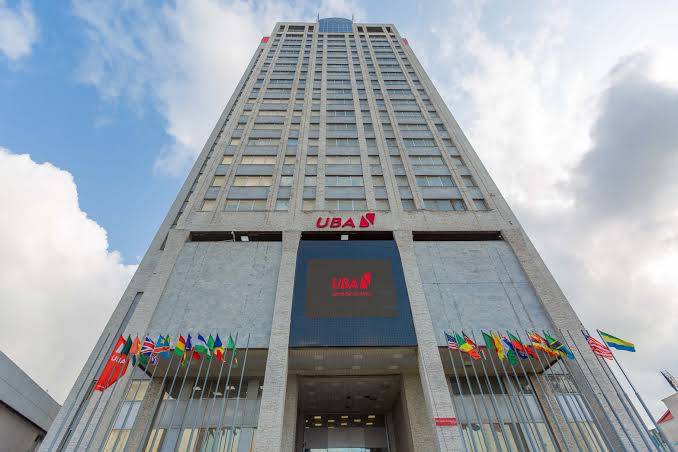

United Bank for Africa (UBA) Plc grew its balance sheet by 9.4 per cent to N33.13 trillion in 2025, adding to its assets after an impressive nearly 47 per cent surge in the previous financial year.
The details are contained in the bank’s audited financial report for the full year ending 2025, along with management’s promise to accelerate growth, potentially driving an expansion of over N1 trillion in 2026.
The main asset components include investment securities worth N14.43 trillion, cash and bank balances of N8.95 trillion, loans and advances exceeding N7 trillion, and other assets totaling N1.40 trillion. These assets are funded through customer deposits of nearly N24 trillion, amounts due to banks of N3.26 trillion, borrowings of N923.6 billion, and equity resources of N4.25 trillion.
Loans and advances to customers held steady at N7.02 trillion after several years of rapid growth. According to the bank’s management, this was a deliberate move to realign the balance sheet for long-term, sustainable growth. The strategy is to expand risk assets selectively in key sectors of the economy as macroeconomic conditions improve.
Growing earning assets is a major focus for the bank in 2026, aimed at increasing revenue and profit potential. With a fresh capital injection from shareholders, the bank is set for significant asset growth, boosting its equity cushion from N3.42 trillion in 2024 to N4.25 trillion by the end of 2025.
Diversification of operations across markets and geographies continues to impact group results positively by way of operating stability and consistency of results. The management is quite impressed with the operating results from the bank’s rest of Africa operations, which contributed in excess of 50 per cent of group assets, revenue and profit at the end of the 2025 financial year.
UBA’s West African operations reported 53 per cent profit growth in 2025, and East and Central Africa grew profit by 61 per cent, according to management’s report.
Group revenue for the year amounted to N3.09 trillion, slightly down from N3.19 trillion in the previous financial year. Two major income lines accounted for the slackened performance in earnings in the year: net trading/foreign exchange and fee/commission incomes.
Net trading and foreign exchange gains of N181.8 billion in 2024 reversed into a loss of N140.6 billion in 2025. Fee and commission income went down from N547.4 billion to less than N533 billion over the period.
The disappointment in non-interest earnings was largely compensated by an increase of roughly 10 percent in interest income to close at a new peak of N2.65 trillion for the year.
The bank faced upward pressure from costs in the year against the downward pressure on earnings. Cost increases were led by net impairment charges for credit losses that grew by 52.6 percent to stand at N331 billion.
This means additional credit loss expenses of N114 billion in the year, which claimed more than all the increase in net interest income and caused a drop in net interest income after impairment charges from N1.30 to less than N1.28 trillion over the review period.
The bank’s management said it has fortified its recovery team in aggressive pursuit of the loan losses and recoveries are expected to flow directly to swell the bottom line in 2026.
Another kink on the cost structure of the bank came from interest expenses, which grew by 20 percent to over N1 trillion in the year. This is twice ahead of the less than 10 percent increase in interest income, resulting in a moderate increase of 4.2 percent in net interest income at N1.62 trillion.
Revenue constraint against rising cost resulted in a profit drop for UBA group in 2025. After tax profit went down from N766.6 billion the previous year to N404.7 billion in 2025. The bank’s management said the cost pressure isn’t expected to sustain in the current financial year and would therefore not affect profit performance.
The bank ended the 2025 operations with earnings per share of N9.66, a drop from N21.73 per share in 2024. There will be no final dividend for the year apart from the interim cash dividend of 25 kobo paid to shareholders in the course of the year, according to the bank’s directors.