


By Abolaji Adebayo
The Lagos State University of Science and Technology (LASUSTECH) and Kumasi Technical University, Ghana, have moved to deepen academic collaboration under the theme “Nigeria-Ghana Partnership: Driving Technological Education and Innovation,” with the partnership focusing initially on engineering, staff capacity development, and joint research.
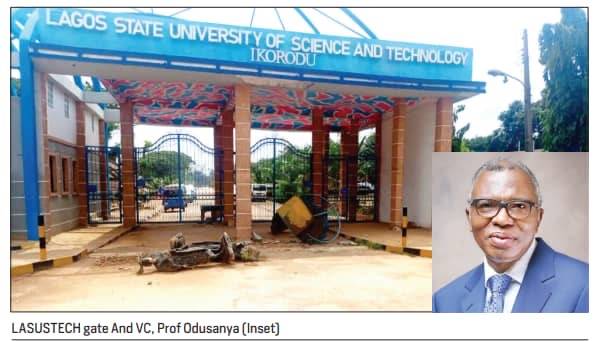
Speaking at the joint symposium held at the LASUSTECH Ikorodu Campus on Monday, October 19, 2026, LASUSTECH Vice-Chancellor Prof. Olumuyiwa Odusanya said the collaboration is designed to deliver tangible outcomes beyond paper qualifications, including curriculum development, postgraduate programmes, and problem-solving research.
“The focal point of this collaboration is first engineering. But I expect we’ll be doing something about helping our non-teaching staff develop capacity and competencies,” he said.
He added that the partnership would extend to academic growth, with both institutions working toward measurable milestones over the next 12 months.
“We also want to document it on paper. We want to see, in another 12 months, are we doing papers? Are we able to invite Ghana as master’s external examiners? Are we able to develop new programmes, new curriculum that starts at postgraduate and invites up to PhD, so that the people we can learn from want to do research and are able to support students?” he stated.
Odusanya said the institutions would explore staff exchanges, joint supervision, and research that produces solutions rather than just publications.
“May they build several products so that there are several things that make the difference. That is the vision of the government. There will be a university because the university of science is the place to go to, the place to support Lagos State and the state of Nigeria,” he said.
He said LASUSTECH is committed to the partnership and will commit resources to academic and financial aspects, including funding trips to Ghana to sustain collaboration.
Odusanya noted that the visit by the Ghanaian delegation followed earlier engagements, including meetings with management, deans, and directors, with further sessions scheduled for Wednesday and Thursday to agree on how to proceed.
In his keynote address, the Vice-Chancellor of Kumasi Technical University, Prof. Gabriel Dwomoh, called for deliberate investment in technical education, industry-aligned curricula and practice-oriented human capital as prerequisites for national innovation and economic growth.
Dwomoh said no country can progress without paying significant attention to technical education, which he described as the engine of innovation.
Citing American economist Evan Sapor, he said ideas only become marketable through technical skills and investment, noting that most countries with high innovation output have done so by investing heavily in technical education.
He identified curriculum alignment with industry needs, compulsory industrial internships through established industrial liaison offices, adequate laboratory and studio infrastructure, and human capital with requisite industrial experience as key drivers of technology education.
Dwomoh criticised the promotion criteria in Ghana and Nigeria, which he said prioritise PhD qualifications over practical industry experience, arguing that technical universities should cherish “professors of practice” who have spent decades in industry.
He also decried the low budgetary allocation to technical and vocational education, noting that Ghana and Nigeria devote between two and eight per cent of total education expenditure to TVET, far below the 15 to 30 per cent benchmark in developed countries.
Highlighting Kumasi Technical University’s response, he said the institution has established programme advisory committees comprising industry experts for all departments, an industrial attachment and career services directorate, a grants office to attract industry support for retooling laboratories and workshops, and a policy requiring teaching staff to undergo industrial attachment during vacations.
Comparing the technical education systems of Ghana and Nigeria, Dwomoh noted that both countries have established regulatory bodies — the Commission for Technical and Vocational Education and Training (CTVET) in Ghana and its Nigerian equivalent — to maintain standards, but questioned whether they are fully delivering on their mandates. He commended Nigeria’s national training fund, which supports industrial training for students, saying Ghana lacks a comparable scheme, and noted that maintenance of procured equipment remains a challenge in both countries.
On research and innovation, he said Ghana allocates about 1.1 per cent of GDP to research, while Nigeria’s allocation remains below the one per cent benchmark set by the African Union, adding that commercialisation of research stands at between 10 and 15 per cent in Ghana and five to 10 per cent in Algeria, with less than one per cent of university research in Ghana successfully commercialised.
Dwomoh showcased student innovations from Kumasi Technical University, including a driver drowsiness detection device, a smart smoke detector with automatic power cut-off, and a self-charging electric vehicle battery system designed to address the shortage of charging stations in Ghana and Africa. He said the university is in talks with industry partners to commercialise the inventions.
Proposing areas of collaboration between the two universities, he urged joint faculty initiatives, joint student innovation challenges, inclusion of faculty members in programme advisory committees, co-hosting of international conferences, sharing of faculty research profiles, and international industrial attachments for students in specialised fields such as industrial design.
He expressed confidence that the partnership would promote technical education, research and innovation in both institutions and countries.