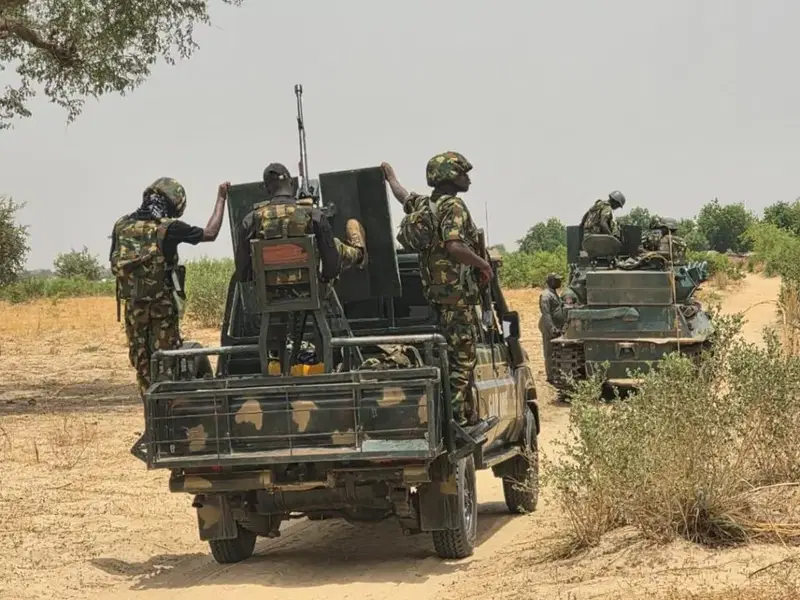


A Russian paramilitary launched air strikes against rebel forces near Mali’s capital Bamako, video footage shows, following a shock offensive against the ruling military government.
Jihadist and Tuareg separatist forces on Saturday carried out attacks across Mali and killed the country’s Defence Minister Sadio Camara. Russian forces claimed up to 12,000 fighters took part in the offensive.
The Kremlin-controlled Africa Corps, which supports Malian military operations, has posted several videos since Saturday showing air strikes and attack helicopters engaging with rebel troops. BBC Verify located the clips to the town of Kati, around 20km (12 miles) from Bamako.
Despite the show of force, the mercenaries confirmed that they have pulled out of Kidal in northern Mali, which housed significant numbers of troops and was at the core of the military’s operations in the region. Verified footage now shows rebels roaming the base.
Mali has fought a long-running conflict against a broad array of rebel groups for more than a decade. Military leaders seized power in 2020 after accusing the civilian administration of failing to properly manage the security situation.
Since then the military has had limited success targeting the al-Qaeda linked Jama’at Nusrat al-Islam wal-Muslimin (JNIM) group and the separatist Azawad Liberation Front (FLA), with Bamako coming under a blockade late last year.
But the latest attacks mark a “major escalation in the conflict” between the military government and the rebels, said Jean-Hervé Jezequel, Sahel director with the International Crisis Group. Fighting has been recorded across the country, with BBC Verify confirming 22 videos showing rebel movements in seven locations since Saturday.
“Whereas JNIM’s strategy initially relied primarily on conquering rural or peripheral areas, it now also targets major cities,” Jezequel said.
A satellite images showing the location of the defence minister’s home and showing the damage caused by the attack.
In Saturday’s attack, rebels targeted the defence minister’s residence in Kati. A government spokesperson said Camara was killed in a firefight after a suicide bomber drove an explosives-laden vehicle into his home.
Satellite images showed that the area was heavily damaged in the attack, with Camara’s property completely leveled in the explosion and extensive damage to the rest of the block.
The Africa Corps responded to the attacks on Kati with a series of airstrikes. Drone footage showed a dramatic missile attack on a convoy of rebel pick-up trucks as they sped along a highway on the outskirts of the town, with a fireball erupting as they were hit by the attack.
Another clip filmed from the cockpit of an attack helicopter showed missiles being launched at targets on the ground, while another from the outskirts of the town showed smoke rising after an attack by a Russian helicopter.
Russia’s Wagner Group mercenaries arrived in Mali in 2021 in the lead-up to the withdrawal of French troops amid a breakdown in relations between the ruling junta and the West. They were replaced by the Africa Corps, which is directly controlled by Moscow, amid Kremlin moves to curb the independence of Russian mercenary groups.
Dr Sorcha MacLeod, an ex-member of the UN’s working group on mercenaries and lecturer at the University of Copenhagen, said the group maintained Wagner’s arrangement with the Malian junta – providing security services in exchange for payments and “access to valuable natural resources”.
But the force, which a senior French military official told BBC Verify last year was limited to about 2,500 troops, has struggled to arrest the growing momentum of JNIM and the FLA.
The withdrawal from Kidal will also be a significant loss for the Malian government. The pivotal facility, which the Wagner Group and Malian forces seized after an extended, bloody battle at the end of 2023 was home to a large, heavily armed force.
But Russian and Malian personnel appear to have come under heavy attack in the lead-up to the withdrawal, with footage posted by JNIM militants showing a large group of soldiers fleeing from a truck ahead of a drone strike.
An image showing rebel fighters at a base in Kidal. One image shows fighters on a truck armed with rifles, while another shows a fighters carrying an RPG inside the base.
Before the withdrawal announcement was made, verified videos located to the base by BBC Verify showed military vehicles evacuating.
The Africa Corps claimed to have removed “heavy equipment” from the base ahead of its withdrawal, but clips shared by rebel troops in the aftermath showed that armoured personnel carriers, patrol vehicles and jeeps were left behind in the hasty retreat.
Charlie Werb, an analyst with Aldebaran Threat Consultants, noted that while the loss of such equipment will be keenly felt by the military, there is no guarantee that the rebels will be able to adapt heavy, armoured vehicles to “insurgent-style tactics that rely on speed, manoeuvrability, and concealment”.
A graphic showing the locations of rebel troops across Mali.
Malian troops have also pulled out of the town of Tessalit further north, while clashes took place near the main Africa Corps facility in Bamako. One clip showed a Russian mercenary firing an assault rifle from a guard post on the periphery of the compound.
“Other states that have hired Africa Corps will be watching very closely,” Dr MacLeod said, adding that some may question the paramilitary’s value-for-money in light of its struggles in the north.
“The model offered by Moscow isn’t working but at the same time is costing poor countries millions in natural resources. It’s unsustainable.”
BBC