
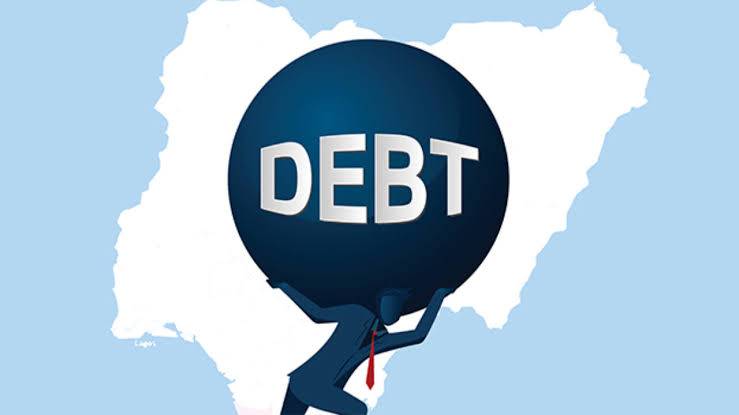

LNigeria’s total public debt rose to N159.28 trillion (approximately $110.97 billion) as of December 2025.
This is according to the latest figures released by the Debt Management Office (DMO).
The data shows that domestic debt accounted for the larger share, standing at N84.85 trillion ($59.11 billion), while external debt was recorded at N74.43 trillion ($51.86 billion).
This means local borrowing makes up about 53.27 percent of the country’s total debt profile, compared to 46.73 percent from foreign sources.
The DMO explained that the debt figure covers liabilities owed by the Federal Government, the 36 states, and the Federal Capital Territory (FCT).
A detailed breakdown indicates that the Federal Government holds the bulk of the debt, with N80.49 trillion in domestic obligations and N66.27 trillion in external borrowings.
In contrast, states and the FCT collectively account for N4.36 trillion in domestic debt and N8.16 trillion in external liabilities.
Further analysis shows that multilateral institutions remain Nigeria’s largest external creditors.
Loans from global financial institutions amount to $23.19 billion, representing about 45 percent of the country’s external debt stock.
The World Bank is the single largest lender, with approximately $18.3 billion in outstanding loans, making Nigeria one of the top borrowers from its International Development Association (IDA).
The African Development Bank (AfDB) follows with about $3.5 billion in credit facilities.
Bilateral loans—borrowings from individual countries—total around $6.20 billion, accounting for roughly 12 percent of external debt.
China’s Exim Bank dominates this category, contributing over 80 percent of bilateral loans with about $4.91 billion.
On the domestic front, Federal Government securities such as FGN bonds form the largest portion of local debt, accounting for nearly 80 percent.
Other instruments include Nigerian Treasury Bills, Sukuk bonds, and promissory notes, as well as securitised advances from the Central Bank of Nigeria.
Despite the rising debt figure, projections from the International Monetary Fund (IMF) suggest that Nigeria’s debt-to-GDP ratio could decline to 32.3 percent in 2026, down from 35.5 percent in 2025.
While this remains below the global benchmark of 60 percent, analysts continue to express concerns over the country’s high debt servicing costs relative to its revenue.
Experts warn that managing borrowing levels and improving revenue generation will be crucial to maintaining fiscal stability.