
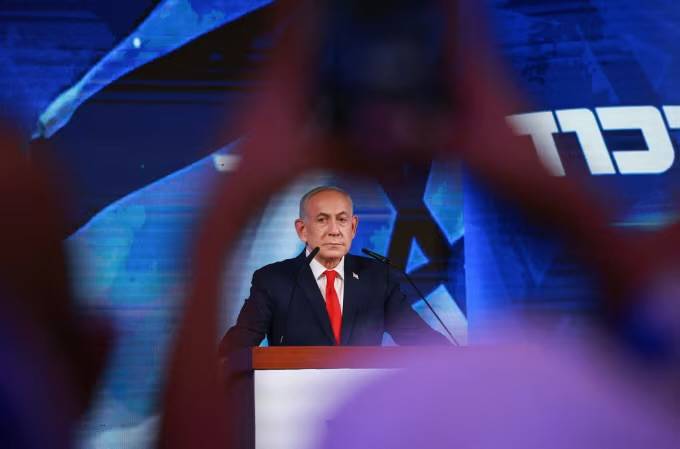

No clear winner has emerged from Israel’s election with all the votes counted, according to the Israeli Central Elections Committee.
Both major political blocs have fallen short of the 61 seats needed to form a majority government in Israel’s 120-seat parliament, called the Knesset, setting up the country for weeks of coalition talks or the possibility of a fresh vote.
Israel Prime Minister Benjamin Netanyahu’s Likud party and its far-right and ultra-Orthodox Jewish allies won 53 seats.
Main opposition candidate Gadi Eisenkot’s Yashar party and three other Jewish opposition parties in his bloc have secured 48 seats.
With an inconclusive result, it could be weeks — possibly months — in which Netanyahu’s survival remains on the line.
In a political career that has spanned more than three decades, Netanyahu has been written off too many times to count, only to prove the obituaries were penned prematurely.
Netanyahu hasn’t won. But he hasn’t lost, either — at least not yet. Now, he has to stop his rivals from building their own government, and he may survive again.
The Arab parties
Arab parties – consisting of the Joint List and Raam – won an unprecedented 19 seats.
Analysts say that record turnout by Arabs or Palestinian citizens of Israel was in part a backlash to four years of a far-right national security minister under whom crime in the Arab community soared, and members of the community have blamed the trend on negligent policing. They have also been affected by a rise in racism following October 7 and Israel’s war in Gaza — and have been highly critical of settler violence, all factors that could have mobilized them to vote.
This is where the math gets complicated. Raam is an Islamist party that draws heavily from Israel’s Bedouin community. Its leader, Mansour Abbas, became the first Arab politician to join an Israeli government following the country’s 2021 election. The Joint List, projected to be the bigger Arab party, combines several smaller parties: the Communist Hadash, secularist Taal and nationalist Balad factions.
On Wednesday, Yair Golan, leader of the left-wing Democrats party, called on his partners to count the Arab parties as part of the bloc, rejecting what he called Netanyahu’s “racist division between Jewish and Arab votes.” The following day, Golan met with Abbas. But two of Eisenkot’s right-wing allies, Naftali Bennett and Avigdor Liberman, have opposed any government that depends on the Arab parties. (They have not issued a statement on the issue since polls closed.)
The Joint List said Wednesday that it was ready for political cooperation and was willing to do “do everything in its power to bring Netanyahu’s rule to an end.”
On Thursday, Eisenkot held separate meetings with both Golan and Bennett, where they discussed “their shared commitment to giving effect to the voters’ mandate without delay,” according to Eisenkot’s party.
What will Netanyahu do?
A source close to Netanyahu said his main post-election goal is to delegitimize and therefore prevent the Jewish-Arab political cooperation that could send him home.
After campaigning against them throughout the election, Likud issued a statement on Thursday calling on the Shin Bet and the police to investigate what it described as “involvement of foreign elements who intervened and bribed voters in favor of the Arab parties.”
The statement came after the Central Elections Committee chair, Supreme Court Deputy Chief Justice Noam Solberg wrote to the Shin Bet director David Zini, requesting an inquiry into “serious suspicions” of foreign funding, adding he could not verify the seriousness of the evidence.
But the Central Elections Committee director general Dean Livne rejected the claims of widespread fraud as baseless, saying in a letter to an opposition lawmaker the vote was “conducted lawfully’ and “there is no basis for allegations of systematic violations of election integrity.”
Opposition parties broadly back an investigation but framed the allegations as an effort by Netanyahu to challenge and undermine the results. The Joint List and Raam rejected the claims as a “timed smear campaign.”
Qatar, meanwhile, which ministers named as the foreign power involved, called the allegations “ridiculous and dangerous.”
“He is very concerned about a minority government,” the source said. Netanyahu even plans to pressure individual opposition lawmakers not to cooperate with the Arab parties. After campaigning against them throughout the election, Likud issued a statement Wednesday accusing the Arab parties of “stealing the election” through bribery, threats, violence and forgery, echoing election fraud claims from his closest ally, US President Donald Trump. The Central Elections Committee said Wednesday it was examining the complaint, but the committee had already dismissed thousands of complaints from the different parties on election day.
Netanyahu plans to “neutralize this possibility by all means,” the source told CNN, “including launching an attack on Iran or enlisting President Trump to intervene in Israeli politics on his behalf.”
The opposition fears that Netanyahu could use a security crisis to stall or block a new government. Before the election, Netanyahu had pressed Trump to launch a joint attack on Iran, but Washington held off, partly because Israeli military chief of staff Eyal Zamir warned it could disrupt the vote. An Israeli security source told CNN the operational plans are ready and awaiting Trump’s approval, possibly after the US midterms.
“There is no way to know what Netanyahu will do,” an opposition source told CNN. “We are aware that he may try to push for another escalation.” Another source said that Netanyahu “will do everything he can not to leave the prime minister’s office, including domestic and external chaos.”
Eisenkot, a former Israel Defense Forces chief of staff, called on Israel’s security chiefs Tuesday night to remember that “Netanyahu is a caretaker prime minister, without a mandate and without public confidence.” Speaking to supporters shortly after exit polls were published, Eisenkot declared that the public “has chosen change.”
In his first reaction to the updated results since Tuesday night’s speech, Eisenkot said he remains committed to “bringing change to Israel.”
What comes next
The political maneuvering now begins in earnest.
The next step runs through President Isaac Herzog, whose post-election role is pivotal. His job here is to consult with all elected parties on the candidate they recommend as prime minister, before picking the one he believes is most likely to secure a 61-seat majority. This is not necessarily the leader of the largest party but the one with the most plausible path to a coalition.
Eisenkot is likely to collect more recommendations than Netanyahu, since the Arab parties are expected to back him.
Then the clock starts ticking.
The chosen candidate has 28 days — and a possible 14-day extension — to negotiate with other parties over cabinet posts, budgets and policies in order to form a government. If he fails, the mandate passes to another candidate for another four weeks. If he fails, too, the Knesset gets a short window to put forward an alternative candidate. If that fails, the country goes to automatic elections.
Netanyahu, as caretaker prime minister, has a built-in advantage. If Eisenkot receives the mandate first — and fails — all he needs to do is wait for his time to pass. And if Israel finds itself headed for new elections, Netanyahu will remain caretaker for months.
Eisenkot’s options
Eisenkot isn’t out of options entirely.
Even without forming a government, the opposition could still leverage its parliamentary majority to replace the Knesset speaker and other key positions. That could limit Netanyahu’s ability to govern and even enable the opposition to advance legislation.
But Eisenkot, a retired lieutenant general, isn’t on his preferred battlefield. Netanyahu’s coalition remains incredibly loyal, and he doesn’t have to worry in any real way about defections. The same cannot be said for Eisenkot. His diverse coalition is far less ideologically aligned, and even the tiniest step could splinter the bloc and send the country back to elections.
For now, the focus is on Herzog, whose role is even more important given the current deadlock. With neither bloc holding a clear majority, he may try to push Netanyahu and Eisenkot to form a unity government.
“We must do everything to avoid another round of elections,” Herzog said Wednesday. He called on party leaders to come to consultations with an “open mind.”
CNN