
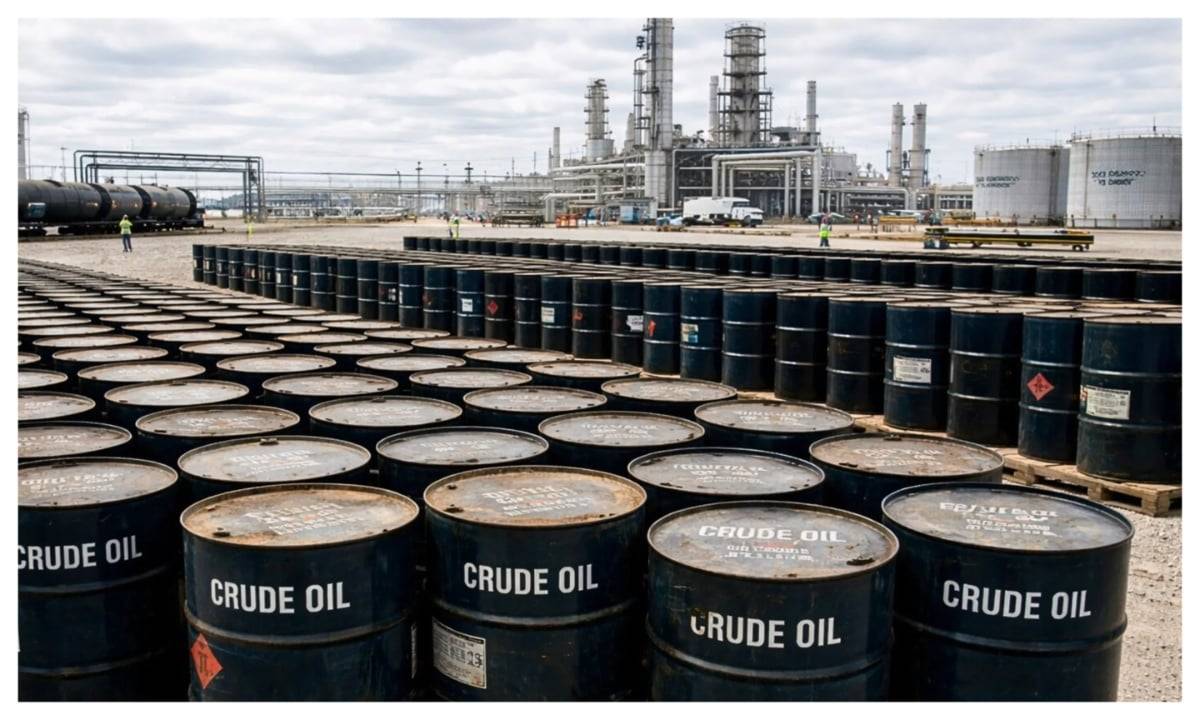

The Nigerian National Petroleum Company Limited (NNPC Ltd) has committed more than 186,000 barrels per day of future crude production to debt repayment under three crude-backed financing arrangements.
The commitments, captured in the newly released 2025 Audited Financial Statements (AFS) of the national oil company, involve Project Gazelle, Project Leopard and Project Leopard II, under which NNPC raised trillions of naira against future crude production.
The disclosure comes against the backdrop of another major financing arrangement involving Nigeria and the United Arab Emirates, as First Abu Dhabi Bank (FAB), the UAE’s largest lender, is seeking to spread its exposure to Nigeria’s $5 billion financing by bringing other international banks into the transaction.
The move would allow FAB to retain its role as the principal counterparty while sharing the economic exposure with other lenders, according to people familiar with the $5 billion transaction.
It was learnt that the three arrangements (projects) form part of NNPC’s wider financial obligations, with the company having settled only N2.886 trillion out of an aggregate N12.083 trillion commitment across crude oil forward-sale arrangements, gas supply agreements and upstream project funding obligations as of December 31, 2025. Newspapers
This left about N9.8 trillion in commitments outstanding, according to the financial statements, as NNPC continues to manage obligations entered into to provide liquidity for its operations and upstream investments.
The largest of the crude-backed arrangements are Project Gazelle and Project Leopard, which together account for about N8.13 trillion in financing.
Under Project Gazelle, NNPC entered into a five-year forward-sale agreement in December 2023, committing 90,000 barrels of crude oil per day. The company drew N4.9 trillion from the N5.1 trillion facility and had repaid N2.09 trillion in principal by the end of 2025, leaving N2.81 trillion outstanding.
Similarly, Project Leopard involved a N3.05 trillion facility, which was fully drawn by February 2025. NNPC had repaid only N420 billion in principal by the end of last year, leaving N2.47 trillion outstanding.
The repayment obligation is further compounded by Project Leopard II, under which NNPC obtained N3.03 trillion against a commitment of 61,250 barrels of crude oil per day.
The facility was fully drawn by December 31, 2025, but no principal had been repaid as of that date. Repayment was scheduled to commence in June 2026 after a six-month moratorium, leaving the entire N3.03 trillion principal outstanding at the reporting date.
Taken together, the three crude-backed arrangements commit more than 186,000 barrels of crude oil per day to debt repayment, effectively earmarking a portion of NNPC’s future crude receipts for servicing the facilities.
Beyond the crude-backed arrangements, NNPC’s financial statements showed significant commitments tied to gas supply and upstream asset development.
For instance, under an incremental gas agreement between NNPC Exploration and Production Limited and Nigeria LNG Limited, NNPC has drawn N535 billion from a N772 billion arrangement, while gas worth N312 billion has been recovered, representing 40.41 per cent.
The upstream portfolio also carries substantial funding commitments. Under the OML 42 arrangement, only N44.98 billion has been provided against an estimated N1.54 trillion funding commitment, leaving about N1.49 trillion to be funded.
For OML 65, N13.93 billion had been drawn from a N957.65 billion facility, leaving about N943.72 billion outstanding. Similarly, under OPL 809/810, NNPC has provided N88.16 billion out of a total commitment of about N430 billion, leaving approximately N341.85 billion yet to be funded.
NNPC also reported an uncalled capital commitment of N95.99 billion relating to its Class B shares in Afreximbank, after subscribing N159.98 billion and paying N63.99 billion, representing 40 per cent of the subscribed amount.
Despite the substantial commitments, during the period, NNPC reported a 33 per cent increase in Profit After Tax (PAT) to N7.2 trillion in 2025, from N5.4 trillion in 2024, while revenue stood at N34.5 trillion.
Remittances to the federal government through taxes, royalties and other statutory payments also increased by 39 per cent to N22.3 trillion. On the operational front, crude oil and condensate production reached a five-year peak of 1.77 million barrels per day, while natural gas supply rose to a three-year high of 7.2 billion standard cubic feet per day.
The disclosure comes as Nigeria is also seeking to raise dollar liquidity through structured sovereign financing, with First Abu Dhabi Bank (FAB), the United Arab Emirates’ largest lender, seeking to bring other international banks into its $5 billion financing arrangement with Nigeria.
People familiar with the matter told Bloomberg that FAB was sounding out potential lenders on their appetite to take portions of its economic exposure to the Nigerian deal, in a move that would spread its risk while allowing it to retain its position as the principal counterparty to the transaction.
The discussions are private and do not represent an intention by the Abu Dhabi-based bank to withdraw from the transaction, according to a source.
If concluded, the arrangement would enable FAB to distribute part of its financial exposure among other lenders, while potentially earning fees for arranging the syndication.
The development adds another dimension to Nigeria’s efforts to access dollar liquidity through structured financing rather than conventional external borrowing. The federal government accessed $1.5 billion of the $5 billion facility in June.
The transaction is structured as a total-return swap under which Nigeria provides naira-denominated government securities as collateral. The securities are valued at about 133 per cent of the amount financed, providing substantial collateral backing for the lender while giving Nigeria access to foreign currency.
The proposed syndication is expected to broaden the number of international financial institutions carrying exposure to the Nigerian government through the structure, while reducing the concentration of the transaction on FAB.
The transaction had earlier attracted scrutiny from credit analysts because of the complexity of derivative-based sovereign financing and questions about how such obligations could be treated in any future restructuring of Nigeria’s debt.
Fitch Ratings, while recognising that such instruments could provide sovereigns with greater financing flexibility and access to hard-currency liquidity, warned in June that the arrangement could make Nigeria’s debt risks less transparent and potentially complicate any future restructuring.
The development comes against the backdrop of rising public debt and the government’s continued search for funding to meet expenditure and refinance existing obligations.
Nigeria’s public debt stood at N166.79 trillion at the end of June, comprising N91.59 trillion in domestic debt and N75.20 trillion in external obligations. External debt rose from about $43.1 billion when President Bola Tinubu assumed office to roughly $54.5 billion in June, while domestic debt increased from about N59.1 trillion to N91.5 trillion.
Credit: ThisDay