
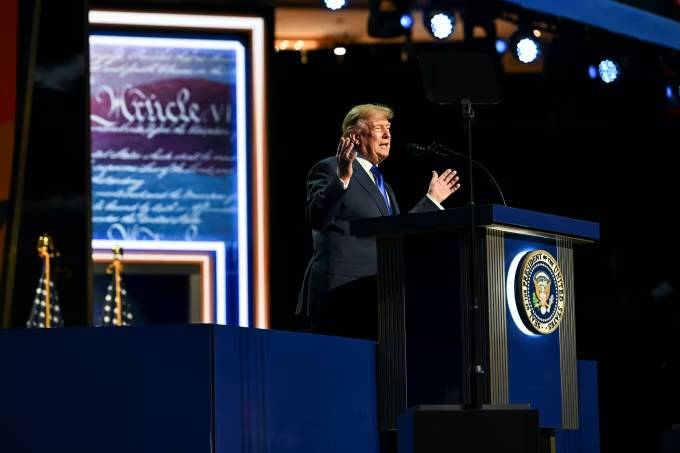

When President Donald Trump said he would give adult US citizens $5,000 each if they reelected Republican majorities in the 2026 midterm elections, Sen. Roger Marshall was one of the first lawmakers to tout the idea.
“Comment how you will spend your $5,000 Trump Dividend when Republicans win in November,” the Kansas Republican posted late Wednesday night on X.
By Saturday, though, Marshall sounded a much more skeptical note during a debate at the Kansas State Fair.
“I’m going to bring in all the information, and then make a decision,” said Marshall, who faces a surprisingly competitive reelection race. “But look, this is not the first time I’ve disagreed with President Trump, and it probably won’t be the last.”
It was like a slow-motion backflip — from apparent enthusiastic support, to undecided, to Marshall apparently distancing himself.
But it’s hardly the only example of Trump allies’ rhetorical gymnastics in recent days.
THE ROAD TO THE 2026 MIDTERMS STARTS NOW
Each week, Aaron Blake cuts through the political noise with sharp analysis of the races, candidates and trends that could decide control of Congress. Sign up for 20/26 Vision, a weekly newsletter focusing on this year’s midterms.
Sometimes it seems like Trump almost enjoys making allies squirm with proposals like this — and squirm they have.
Many Republicans are clearly uncomfortable with the idea of Trump unilaterally shelling out more than $1 trillion when the national debt just crossed $40 trillion, and doing so as part of a readily apparent quid pro quo. But it’s not fun to actually say that. So they’ve tried to dress it up.
On CNN’s “State of the Union” on Sunday, House Speaker Mike Johnson told host Jake Tapper that it was a “creative idea.” He signaled Congress would be needed, even though Trump has cast doubt on that.
Then Johnson put on his Trump translator cap — talking as if this very specific proposal was just Trump making a broader point.
“But I think what he was articulating there, Jake, is that he’s saying that, if you want more money in your pocket, you have to keep Republicans in charge,” Johnson said.
Also on Sunday, NBC’s Kristen Welker noted on “Meet the Press” that Republican Sen. Susan Collins of Maine — who like Marshall is up for reelection — said that the checks “should not appear to be tied to election results.”
Johnson responded by citing “the Democrats who are making that claim.” But Welker noted three times that she was citing a Republican.
“Yes, I understand that. I understand,” Johnson said. “Sure, sure.”
(Indeed, Collins isn’t the only one raising that concern on the right. Some conservatives have even labeled the checks a bribe.)
GOP Rep. Pat Fallon of Texas also tried to tone down the bribe-y nature of the arrangement Thursday on Fox News.
“President Trump isn’t saying that, if we win, we’ll do this,” Fallon claimed. “He’s saying we’ll be in a position to do this because we’ll have the votes to do it.”
But Trump said explicitly that he would do it if Republicans won, without qualification and apparently without Congress. Then he added Sunday, “The $5,000 is gonna happen, 100%.”
New York Rep. Mike Lawler on ABC’s “This Week” strained on Sunday to avoid being pinned down on the issue. He said he supported “putting money back in the pockets of hard-working Americans,” but when pressed on the $5,000 checks, maintained that it was “not a yes-or-no” question.
“We certainly see in states like New York, they mail out refund checks all the time right before election time,” Lawler told CNN’s Kasie Hunt in another interview Thursday. “So, I don’t think it’s a new idea that’s been issued last night.”
But those refund checks Lawler was talking about weren’t being offered only if voters delivered a specific outcome — that’s the part that’s so problematic here.
But Fallon isn’t the only Trump ally to offer a novel take on that subject.
When Newsmax asked Rep. Andrew Clyde of Georgia if the plan was a bribe, he didn’t disagree but instead called it “an interesting plan.”
Fox News host Greg Gutfeld maintained that it wasn’t a bribe “because it’s not done in secret” and “it’s your money.”
Fellow Fox host Jesse Watters said it was “not a bribe; we’re calling it an enticement.” He also suggested the payments might never materialize — comparing it to a woman who “lowers her brassiere” to tease and flirt with a man she has no intention of getting romantic with.
When Watters asked Sen. Ted Cruz about the idea, the Texas Republican said he wanted to see it “structured as a tax refund” to incentivize work and not give it to people who aren’t working. But Trump made no such distinction in his proposal.
Similarly, Vice President JD Vance told Fox’s wealthy hosts late Wednesday night, “You guys don’t need it; this is for the American middle class.” But Trump said the money would go to “every adult citizen.”
Then Vance, like others, claimed the administration was just sharing all the wealth generated by tariffs.
“I don’t think it’s a controversial idea,” Vance said of an idea that even many Republicans have come to oppose. “It’s actually the president of the United States saying … if we continue to create wealth, that wealth is going to go back to the American people.”
But so far, the tariffs haven’t generated nearly enough money. Tariff revenue in 2025 was $264 billion, according to the Treasury Department. (The Supreme Court struck down many of Trump’s tariffs and forced the government to refund them.) And the right-leaning think tank the Tax Foundation estimates it would take the tariffs nearly a decade to generate the $1 trillion-plus in revenue required to cover Trump’s proposal.
All of that’s to say nothing of the fact that the checks would likely exacerbate already persistent inflation — an issue many Trump allies say they care about.
Oh, and that setting this precedent — if Trump could make it pass legal muster — is something that a Democratic president could exploit to redistribute wealth.
In other words, there’s plenty for the GOP to hate about this proposal. So they just keep dancing around it and talking about it as if it’s something that it’s not.
CNN