
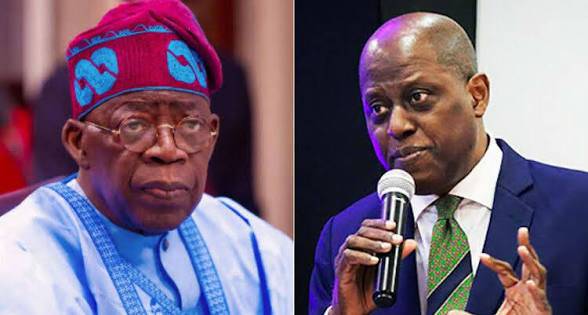

Jim Obazee, President Bola Tinubu’s Special Investigator, has accused the Central Bank of Nigeria (CBN) Governor Olayemi Cardoso, of deceiving both the President and the National Assembly in presenting the bank’s 2025 audited financial statement.
Obazee further claimed that, in an eight-page analysis, the apex bank effectively dismissed all Nigerians as “financial reporting illiterate” while sharply criticising the bank’s disclosures.
Obazee, appointed by President Tinubu in 2023 to investigate the CBN, its related entities, and Key Government Business Entities (GBEs) for malfeasance and to recover looted assets, made these allegations on Tuesday at the official commissioning of the new Lagos headquarters of the Financial Reporting Council (FRC), where he once served as the founding Chief Executive Officer.
The Special Investigator, in whose honour a section of the new building was designated as the “Jim Obazee Inspections and Investigations Meeting Room,” asserted that the summary consolidated and separate financial statements for the year ended 31 December 2025—released by the CBN on 29 July 2026—contained “questionable issues that are shocking, brazen and vexatious.” He noted that these concerns echoed similar issues about the CBN’s 2024 accounts summary published the previous year.
Obazee questioned why the CBN has withheld fully audited financial statements for both 2024 and 2025, instead publishing only summaries. He argued that these summaries, on their own, do not justify withholding the complete statements, especially when the law and financial reporting standards—specifically Section 50 of the CBN Act, 2007—require a full set of financial statements.
He cited several questionable practices in the 2024 summary, including withholding of the full financial statement; using ₦4.898 trillion to generate ₦4.205 trillion, creating a misleading impression of the bank’s performance by reporting other operating income of ₦12.176 trillion, of which ₦11.602 trillion was a net unrealised gain on foreign exchange revaluation; and deferring ₦11.884 trillion in interest and cost, as noted on page 54 of the published summary.
Regarding the 2025 summary of consolidated and separate financial statements published in July, Obazee alleged fraudulent financial reporting, with figures that are not comparable year-on-year.
He also criticised the document, which the joint auditors—Ernst & Young and KPMG—had warned lacked the full disclosures required by International Financial Reporting Standards (IFRS) Accounting Standards, the CBN Financial Reporting Manual (2025), the CBN Act 2007, and the FRC Act 2011 (as amended).
The Special Investigator described the published summary, which the auditors said is not a substitute for fully audited financial statements, as riddled with confusing financial reporting directions, earnings management, deceptive accounting practices, and issues related to auditor independence.
According to the auditors’ warning on page 145 of the document, the full financial statements received an “unmodified opinion with Emphasis of Matter relating to non-compliance with section 38 of the CBN Act and the basis of accounting.”
Both EY and KPMG stated that the full report included Key Audit Matters (KAM) that were most significant in their audit—matters that were omitted from the summary released by the CBN.
“If these are the financial statements that the CBN transmitted to the President and the National Assembly in compliance with Section 50 (1) of the CBN Act, 2007, the CBN has deceived the President and the National Assembly. They certainly have called every Nigerian a “financial reporting illiterate” since they released the said financial statements on the World Wide Web for the entire world to see. If the CBN gave the President and the National Assembly a different set of Financial Statements from what they released on the internet, it would still have the same deceptive effect as seen on Page 145”, stated Obazee.
Obazee’s critique raises questions about transparency and accountability in the CBN’s financial disclosures and calls for greater scrutiny by lawmakers, policymakers, and adherence to statutory and professional standards in the preparation and publication of the bank’s financial statements.
SOURCE: Inside Business