
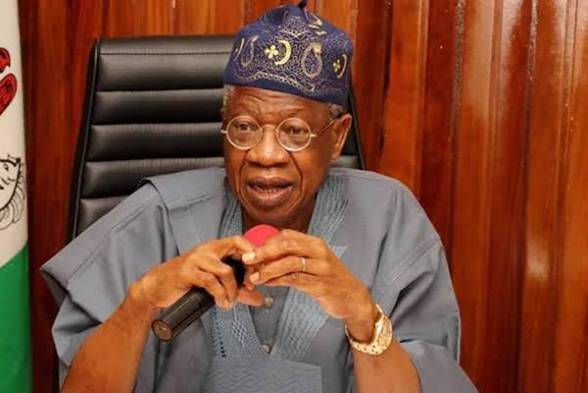

Alhaji Lai Mohammed, former Minister of Information and Culture, has dismissed insinuations that he has abandoned President Bola Ahmed Tinubu, insisting that nothing can come between him and the President, irrespective of his absence from the current administration.
Mohammed declared his continued loyalty to Tinubu on Wednesday while delivering the maiden public lecture of Caleb University, Imota, Lagos State.
Speaking against the backdrop of speculations about his political relationship with the President, the former minister said Tinubu played a pivotal role in his political journey, giving him his first opportunity in government and laying the foundation for his career in public service.
“Asiwaju gave me my very first opportunity in government and built my foundation in politics. He made me Chief of Staff in Lagos, an indigene of Kwara.
“All my years in government, I never left him for one day. There is nothing that can separate me from Asiwaju, not even the fact that I am not part of the current government,” he said.
He also dismissed suggestions that his absence from the Tinubu administration amounted to political marginalisation, asking rhetorically: “Why would I want to be part of the government? Am I the only one?”
Responding to criticism that he had allegedly served as a government mouthpiece, misleading Nigerians with false claims during his time as minister, Mohammed dismissed the accusations as unsubstantiated, challenging his critics to identify specific instances in which he had lied.
“Those who say I lied, nobody has come out to tell me precisely one lie that I told,” he said.
He attributed some of the criticisms against him to what he described as a lack of understanding of how government operates, particularly the complexities involved in managing a large ministry.
To illustrate his point, Mohammed disclosed that the Ministry of Information and Culture had about 21 parastatals under its supervision during his tenure, making delegation of responsibilities and reliance on other officials inevitable.
He explained that, having limited personal knowledge of individuals outside Kwara and Lagos, he often had to depend on trusted contacts to recommend qualified persons from other geopolitical zones for appointments.
According to him, however, the process was not always straightforward, as recommendations submitted to the President did not necessarily translate into final appointments.
He recalled an instance in which he forwarded the names of four individuals he considered qualified for certain positions, believing they would receive presidential approval, only to discover that just one of the nominees was eventually appointed.
Mohammed said it took him some time to realise that changes were being made to some of the names along the approval process. He added that achieving equitable representation in government appointments was often complicated by several factors, including the limitations of individual knowledge and the realities of the political and administrative system.
“For the first time, I realised how little I knew about Nigeria,” he said.
The former minister delivered the lecture under the theme: “Fake News, Disinformation And Artificial Intelligence: Defending Truth and Public Interest in The Digital Age.”