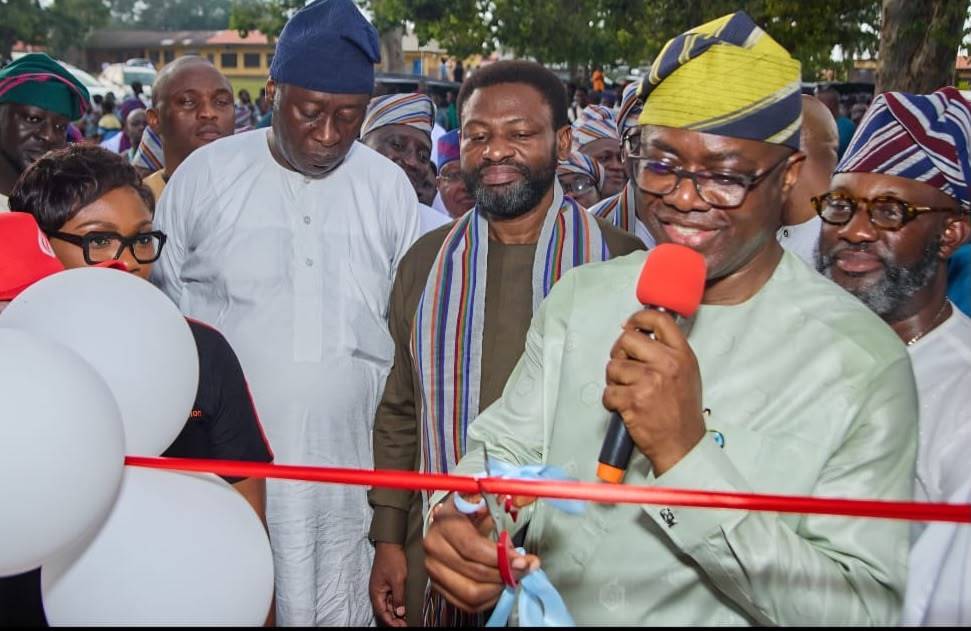



Joseph Tegbe arrived at the Ministry of Power with an unusual combination of credentials. A first-class degree in civil engineering. More than three decades in consulting and public-sector reform. A professional life spent largely in finance, taxation, institutional transformation and advisory services.
That makes for an impressive CV. It also raises a legitimate question.
Is this the background Nigeria needs in the man occupying one of the most technically demanding and politically exposed offices in government?
The question is worth asking without any theatrics. The country’s power problem has defeated engineers, economists, politicians, administrators and technocrats of various descriptions. The ministry is where good intentions encounter bad infrastructure, weak balance sheets, regulatory complexity, political expectations and the unforgiving arithmetic of an electricity market that must somehow generate enough money to sustain itself.
Tegbe, who was sworn in as Minister of Power on June 8 following the resignation of Adebayo Adelabu, is not a career power-sector operator. His professional record is principally in fiscal and economic reform, institutional transformation and consulting. He was a Senior Partner and Head of Advisory Services at KPMG Africa and has advised governments and major corporations on regulatory frameworks, public-sector reform and investment structuring. His first degree, however, is in civil engineering, and his previous engagements included the Nigerian Electricity Regulatory Commission and the Nigerian Bulk Electricity Trading Company.
There is therefore both a question and an answer in his background.
He may not have spent his career running power stations or managing transmission lines. But he has spent much of it studying complicated systems, following the money through them, identifying where they leak and working out how institutions can be made to perform.
That distinction is important.
To be clear, the Ministry of Power is not simply an engineering workshop. It sits at the intersection of infrastructure, regulation, finance, gas, investment, consumer protection and politics. Electricity must be generated, transmitted and distributed, certainly. But somebody must also pay for it. Somebody must account for it. Somebody must maintain the equipment. And somebody must take responsibility when the system fails.
The question, then, is less whether Tegbe looks like a conventional power minister than whether he understands the peculiar machine he has been handed.
After his first 100 days in office, there are some clues.
—Diagnosis Before Prescription—
Tegbe has described his opening months as a period of “diagnosis and stabilisation”. His stated approach has been to repair existing infrastructure, recover stranded assets and restore discipline before embarking on the construction of new structures.
This is a striking managerial approach of looking at a problem that is often presented to Nigerians simply as a shortage of megawatts.
The numbers tell a less convenient story.
The minister says the power sector carries a debt burden of about ₦3.3 trillion, against which the government has mobilised approximately ₦1.23 trillion. He has also drawn attention to revenue losses along the Ikorodu-Sagamu industrial corridor estimated at about ₦120 billion annually, where discrepancies of up to 100MW between electricity transmitted and electricity accounted for prompted a technical and forensic investigation.
There is something revealing about the choice of problems.
A politician looking for easy applause might naturally reach for the generation number. Tegbe keeps returning to the less glamorous questions. Where did the money go? Who was billed? Who paid? Who collected? What happened to the equipment? Where is the electricity disappearing? Who is responsible?
It is here that the taxman in his CV begins to make sense.
—What Does He Want?—
A tax administrator does not ordinarily concern himself with producing the thing being taxed. He concerns himself with creating a system in which transactions can be measured, obligations established and revenues collected.
Tegbe appears to be bringing that instinct into the power sector.
His emphasis on metering is revealing. About 350,000 meters were installed during his first 100 days, taking cumulative installations to more than one million by August. The resolution of litigation surrounding the AMMON metering programme has also, according to the minister, unlocked procurement of about 1.4 million smart meters.
Meters may sound like the sort of administrative detail that should never make it into a minister’s speech. In Nigeria, that is simply not the case.
You cannot build a credible electricity market around estimates. You cannot expect consumers to accept bills they cannot verify. And you cannot properly measure the financial health of a distribution company if you do not know how much electricity its customers actually consumed.
This explains another of Tegbe’s priorities: market discipline.
His intervention on the Ikorodu-Sagamu corridor was not merely about theft. It was about accounting for electricity from the point at which it enters the corridor to the point at which it is billed and paid for. Technology detected discrepancies. The ministry ordered an investigation. The point was to establish where the missing electricity was going and what was compromising the chain of accountability.
This is not particularly exciting politics. It may, however, be important economics.
A power sector in which electricity is generated but not paid for eventually runs into the same wall. Gas suppliers are not charitable institutions. Generating companies need to maintain their plants. Distribution companies need working capital. Transmission infrastructure requires investment. The financial weakness of one part of the chain eventually infects another.
Tegbe has described that cycle in almost clinical terms. Unpaid bills weaken gas supply and maintenance. Unreliable supply depresses collections. Poor collections deepen debt.
What, then, does the minister want?
Perhaps the simplest answer is that he wants to make the power sector financially legible.
He wants to know what is produced, what is transmitted, what is consumed, what is billed, what is collected and where the losses occur.
That is a rather different ambition from simply announcing another target for megawatts.
—The Consumer Is Still Waiting—
There is, however, a danger in admiring the architecture of reform from the comfort of an office.
Electricity is experienced at the end of the wire.
A minister can announce a higher national peak, a restored transformer, a recovered power plant or a new metering programme. The consumer’s question remains brutally simple. When will the light come on, and how long will it stay on?
Tegbe appears to understand this distinction.
At his recent media engagement, he acknowledged that national progress could coexist with an unreliable feeder in an individual community. An improvement in aggregate statistics does not invalidate the experience of a household still living with poor supply.
That admission matters because the power sector has a long history of national statistics and local frustrations travelling on separate tracks.
A national peak of 5,330MW may represent progress. It does not illuminate a dark street.
The minister has also said there is no plan to increase electricity tariffs, while stressing that the ministry’s immediate concern is improving liquidity, billing, collections, metering and system performance. Whether that position remains sustainable as the reform proceeds is a question for the future. For now, it places the burden on the ministry to demonstrate that efficiency and revenue recovery can improve the system without simply transferring every cost to the consumer.
That will be one of the harder tests of the Tegbe experiment.
—The Benefit of the Doubt—
There is another reason not to dismiss the minister’s approach too quickly.
In a little more than three months, the ministry says it has restored the 375MW Alaoji power plant after three years offline. New transformers at Apapa, Ijora, Alausa and Lekki reportedly unlocked 672MW of transmission capacity. A 300MVA transformer at Katampe unlocked another 240MW. More than 300 containers of previously stranded power equipment have been released for deployment.
These are tangible interventions. They are not, by themselves, proof that the power problem has been solved. They are evidence, however, of a minister concentrating some of his early attention on assets and capacity already sitting within the system rather than assuming that every solution must begin with another grand project.
That instinct is worth watching.
So is his insistence on measurement. The minister has talked about publishing performance information, clearer accountability and technical audits of key transmission corridors. The next phase is expected to include stabilising the Lagos, Enugu-Port Harcourt and Abuja-Kaduna-Kano corridors, alongside work towards a Transmission Super Grid.
Whether all this amounts to a coherent transformation, rather than another catalogue of government initiatives, will depend on execution.
And execution is where Nigerian reform programmes have often gone to die.
The power sector is particularly unforgiving because its problems are interconnected. Fixing generation without fixing gas supply is insufficient. Fixing transmission without fixing distribution is insufficient. Installing meters without improving billing and collection is insufficient. Raising revenue without restoring consumer confidence is insufficient.
The minister therefore has a difficult assignment. He has to make several parts of a broken machine work together, while Nigerians quite reasonably ask why the machine has taken so long to work in the first place.
For now, Tegbe’s own words suggest that he is not approaching the ministry as a man searching for a spectacular victory. He appears to be approaching it as a systems problem. Diagnose the failures. Recover what can be recovered. Establish accountability. Restore liquidity. Then build.
That may prove to be the right instinct. It may also prove insufficient. Only time will tell.
For the moment, the fairest assessment is neither applause nor dismissal. Tegbe has inherited a sector whose problems are considerably larger than the credentials of any individual minister. His background is unconventional for the job, but it is not irrelevant to it. The very qualities that initially made his appointment seem curious are now visible in the way he has chosen to describe and attempt to solve the problem.
The coming months will reveal whether his approach can survive the reality of Nigerian power.
The minister has said he wants to replace guesswork with measurement, leakage with accountability and stranded capacity with usable power. Those are sensible objectives. For now, the reasonable thing is to wish him well.
The harder question is whether he can overcome a system that has humbled many before him.
That is the question Nigerians will keep asking, even as many hope that, for all our sakes, he succeeds.
NOTE: Views expressed by contributors are strictly personal and not of Theliberationnews