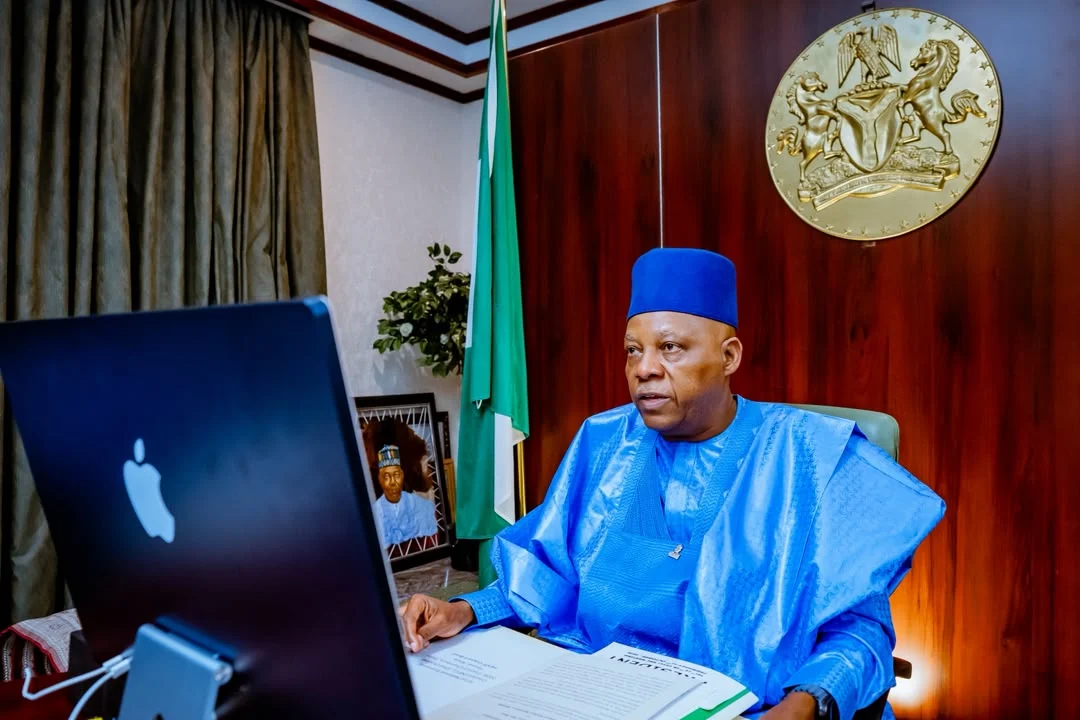

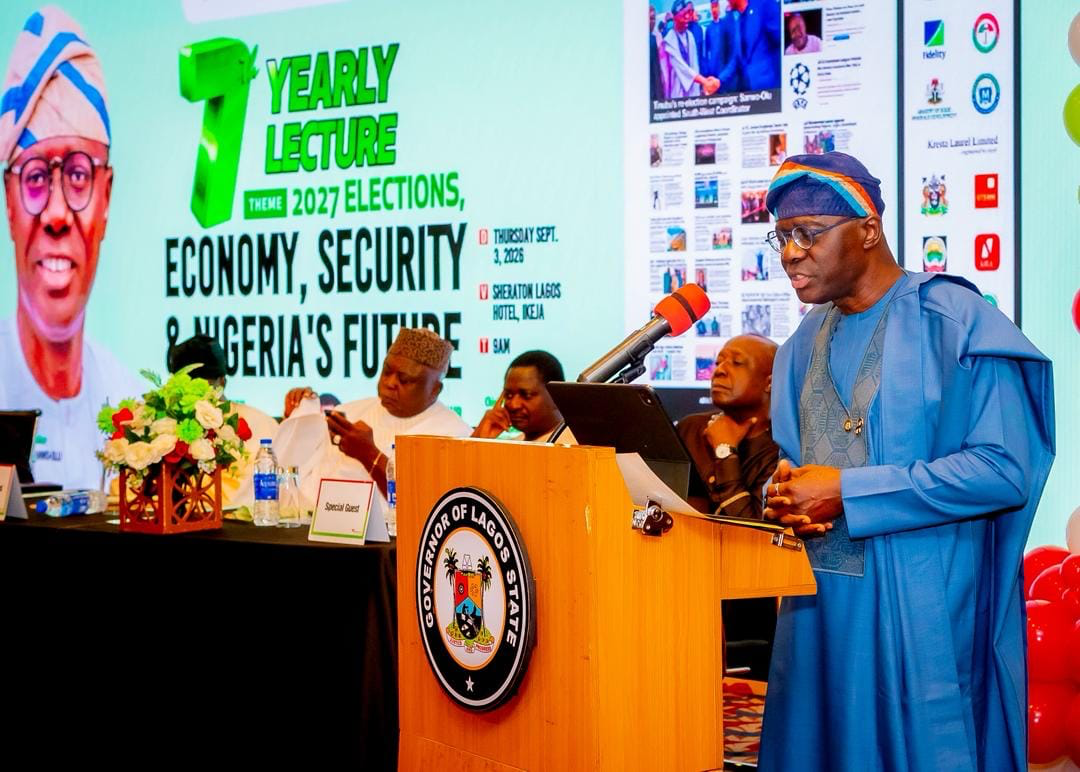

Lagos State Governor, Babajide Sanwo-Olu, has said the economy and security will be two of the major issues that shape Nigeria’s 2027 general elections, urging Nigerians and political actors to approach the poll with the seriousness required to protect the country’s democratic progress.
Sanwo-Olu spoke on Thursday at the 7th Freedom Online Yearly Lecture held at the Sheraton Lagos Hotel, Ikeja, with the theme, “2027 Elections: Economy, Security and Nigeria’s Future.”
The governor, who is serving his second and final term and will not be on the ballot in 2027, said his position gave him “a certain freedom” to speak about the country’s political future.
“I am not here to ask for your vote. I am here to ask for your attention and, before I finish, for something a little harder than that,” he said.
Sanwo-Olu, however, acknowledged that he was not politically neutral, declaring his support for the All Progressives Congress and President Bola Tinubu’s reforms.
“I am a proud member of the All-Progressives Congress. I believe in the reforms of President Bola Ahmed Tinubu, and I will say so plainly,” he said.
“But I will try to speak first as a Nigerian and only then as a partisan, because I think that is what the theme deserves and what this audience expects.”
Addressing the controversy surrounding the removal of fuel subsidy, Sanwo-Olu said the policy was necessary despite the hardship it initially imposed on Nigerians.
“The subsidy was not removed because anybody enjoyed removing it. It was removed because it had become a hole in the national purse through which the money for roads, schools and hospitals was draining away,” he said.
The governor admitted that the policy had imposed difficulties on citizens, particularly through higher transportation and food costs.
“I will not stand here and tell you that it has been painless. It has not,” he said. Lagosians have felt it at the pump, at the market, and in the price of a bag of rice, and any governor who tells you otherwise has not been listening to his own people.”
He, however, argued that the success of a reform should ultimately be measured by its long-term impact.
“But the measure of a reform is not whether it hurts. It is whether it heals,” Sanwo-Olu said.
Citing economic figures, he said Nigeria’s economy grew by 4.43 per cent in the second quarter of 2026, compared with 3.89 per cent in the first quarter and 4.23 per cent in the corresponding quarter of 2025.
He also cited growth in agriculture and services, rising foreign reserves, lower inflation and increased remittances as evidence of improvement in the economy.
“These are not my numbers. They belong to the National Bureau of Statistics and the Central Bank of Nigeria, and every journalist in this hall can check them. I invite you to,” he said.
“That, in the end, is the difference between a case built on facts and a campaign built on fear.”
He said the APC would seek to consolidate the reforms and ensure that their benefits reached Nigerians who had borne the cost.
“For us in the All Progressives Congress, the position that follows is a simple one. We intend to stay the course, to deepen the reforms, and to make sure that the benefits reach, quickly and visibly, the people who bore the cost,” he said.
On security, Sanwo-Olu said the issue would affect the 2027 elections both directly and indirectly.
He said insecurity could determine whether candidates were able to campaign, whether electoral materials could be moved safely and whether voters would feel confident enough to participate.
“In the communities where banditry and insurgency persist, insecurity touches everything: whether candidates can campaign, whether INEC can move its materials and its people safely, whether voters will come out at all,” he said.
The governor said security agencies and the Independent National Electoral Commission must begin preparations early rather than wait until the eve of the election.
He also backed the proposed establishment of state police, describing it as potentially “one of the most consequential reforms in the history of this country.”
Speaking from Lagos’ experience, Sanwo-Olu cited the Lagos State Security Trust Fund and the Neighbourhood Safety Corps as examples of community-based approaches to security.
“The lesson of two decades is not complicated,” he said.
“Security works best when the people who pay for it and the people who depend on it can see, and hold to account, the people who provide it. That is the whole argument for State Policing in a single sentence.”
He urged members of the next National Assembly and state Houses of Assembly to complete the constitutional process required to establish state policing.
Sanwo-Olu argued that economic development and security were inseparable, saying poverty could fuel insecurity while insecurity could undermine economic growth.
“We speak of the economy and security as though they were two subjects. They are one,” he said.
“Poverty feeds insecurity, and insecurity strangles the very economy that would cure poverty.”
According to him, the inability of farmers to access their farms, unsafe schools and insecurity affecting businesses all had economic consequences.
“The most effective security policy is a job, and the surest guarantee of a job is a country safe enough to invest in,” he said.
The governor also cited Lagos as an example of the relationship between security, infrastructure and investment.
“Every business that opens in this city is a vote of confidence in the safety of this city,” he said.
“We did not attract the Lekki Deep Sea Port, or build the blue and red rail lines, or draw the investment that has made Lagos the technology capital of Africa, by accident.”
He said Nigeria’s large youth population could either become a major economic advantage or a source of social instability, depending on government policies.
“That is either the greatest dividend in our history or the greatest danger to it, depending entirely on what we do in the next ten years,” he said.
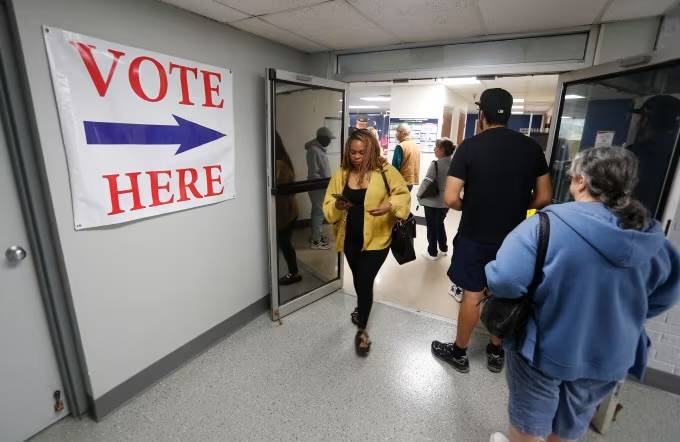
The governor said that the progress made in Nigeria’s electoral system must not be taken for granted, insisting that the credibility of the 2027 elections would be as important as the issues being debated during the campaign.
“We can argue about the economy and about security from now until January. None of it will matter if the election itself is not credible,” he said.
He commended electoral reforms, including the Electoral Act of 2022, the new Electoral Act of 2026 and the use of technology in voter verification and transmission of results.
Sanwo-Olu also cited the August 15 Osun governorship election as evidence, in his view, that Nigeria’s democracy was maturing.
He noted that the APC candidate lost the election to incumbent Governor Ademola Adeleke of another party, who won by more than 60,000 votes.
“The President did not sulk and he did not equivocate. He picked up the telephone the following day, congratulated the winner, urged him to unite the State, and thanked INEC and the security agencies for a peaceful and transparent election,” Sanwo-Olu said.
He added: “A mandate is only as strong as the process that produced it. No office in this land is worth the life of a single Nigerian, and no victory won by the wrong means is a victory at all.”
Sanwo-Olu also urged Nigerians to pay attention to the performance of state governments ahead of the elections, arguing that the 36 governors and the Federal Capital Territory would play important roles in determining the country’s economic and political direction.
“Voters may not be economists, but they are excellent accountants,” he said.
“They know whether their State built the road it promised. They know whether the primary health centre has a nurse in it. They will bring that ledger with them to the polling unit.”
He said increased allocations to states and local governments following the removal of subsidy had placed greater responsibility on state governments to demonstrate how public resources were being used.
“The President has done his part; the money is arriving. What is done with it is on us. The excuses have been removed, and the electorate knows it,” he said.
The governor called on the media to play a rigorous role in the 2027 elections, particularly in countering misinformation and disinformation.
“I am not asking for a compliant press. A compliant press is of no use to a democracy; it flatters the powerful and abandons the public,” he said.
“I am asking for a rigorous press. Check the facts, mine included. Call out disinformation wherever it comes from, including from my own side.”
He warned that anonymous social media accounts and doctored videos could become major sources of misinformation during the election season.
“In the weeks ahead, the most dangerous lies will not come from newspapers. They will come from anonymous accounts and doctored videos, and you are the institution best placed to answer them,” he said.
Sanwo-Olu also urged journalists to give greater attention to women and young people participating in politics, saying both groups remained under-represented.
“Women remain badly under-represented in our politics; cover the women who are running. Young people are trying to break in; cover them too,” he said.
He further appealed to journalists to report not only the country’s challenges but also developments that demonstrate progress.
“I am not asking you to hide this country’s problems. I am asking you to give the same energy to what is working,” he said.
“There is a place for patriotism in journalism. Patriotism is not propaganda; it is the refusal to let those who wish this country ill have the last word about it.”
Looking beyond the 2027 election, Sanwo-Olu said Nigeria should focus on building a stable democratic system in which elections were no longer viewed as existential battles.
He said the country had moved beyond the period when every election was regarded as one that could end the democratic system.
“I will not disguise my hope for the outcome. I expect my party to win, and I expect a second term for President Tinubu to consolidate the Renewed Hope agenda, because an unfinished reform is the most expensive kind,” he said.
He nevertheless called for peaceful elections and acceptance of the results.
“But whatever the outcome, I expect the election to be peaceful, I expect the loser to concede, and I expect Nigeria to add one more milestone to its record,” he said.
Sanwo-Olu concluded by urging the Federal Government, states, INEC and the media to work together to strengthen the democratic process.
“Let us lift this load together, and let 2027 be remembered not as the election Nigeria survived, but as the election at which Nigeria came of age,” he said.