
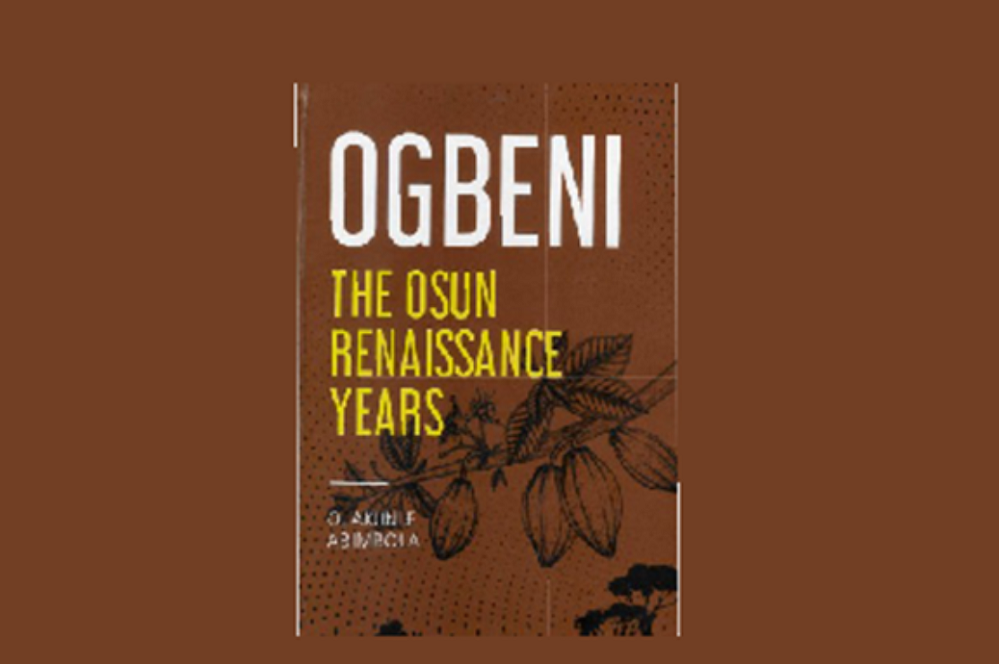

Across 411 pages, including the afterword and appendices, bifurcated into two broad sections comprising 15 chapters in all, seasoned journalist, author, incisive columnist with The Nation newspaper and outstanding student of Classical Studies, Mr Olakunle Abimbola, beams a reflective mirror over Ogbeni Raufu Aregbesola’s eight years as governor of Osun State in his book titled ‘Ogbeni: The Renaissance Years’. Published by Safari Books Ltd, Ibadan, this exhaustive narrative bears all the trademarks of Abimbola’s compelling columns: a meticulous eye for detail, a customary mastery of language, an arresting elegance of style, a facility for rigorous research, a striking clarity of thought, a fluent lucidity of expression and an unceasing effort to establish clear linkages between cause and effect.
The first part of the book traces, in painstaking detail, Ogbeni ‘s trajectory from a high-flying Lagos politician and performing Commissioner of Works and Infrastructure in the Cabinet of Governor Bola Tinubu in Lagos State to governor of Osun State, also in the Southwest of Nigeria, between 2010 and 2018. In gripping prose and vivid imagery, the author captures the collapse of the progressives, as symbolised by the defunct Alliance for Democracy (AD) in Osun State and the Southwest following the electoral Tsunami of the then ruling Peoples Democratic Party (PDP) in five of the six states of the region in the 2003 elections.
Leaving Asiwaju Bola Tinubu, Lagos State governor, as the only State Chief Executive standing on the platform of the AD in the Southwest, the PDP’s earthquake did not spare Osun State’s Chief Bisi Akande, who was also swept out of office despite his widely perceived impressive, disciplined, ascetic governance and impressive record of infrastructural development in the face of acute paucity of resources, and General Olagunsoye Oyinlola was elected as his successor in the ‘State of the Living Spring’.
Thereafter, Abimbola depicts the gloom and doom that descended on the scattered sheep of the AD in Osun, the widespread feeling of loss and despair among the rank and file of the party’s members in sharp contrast to the understandable exuberance, excitement and enthusiasm of the ascendant PDP cadres in that core Yoruba State. He records for posterity the beginnings of Aregbesola’s increasing emergence, with the support of his boss in Lagos, Asiwaju Tinubu, as the symbol to lead the resurrection of the progressives’ political family in Osun.
From the turbanning of Aregbesola, an Ijesha indigene from Osun as the Balogun Muslumi of Ijesaland to the audacious adoption of the Oranmiyan traditional and historical legacy as the symbol and sobriquet both of the aspiring governor and his emergent group, to the formation and nurturing of associations such as the Friends of Aregbesola (FoRA) and later the People-Friendly Government (PFG) group, Abimbola clinically details the coalescing of individuals, groups and social forces that catalyzed Ogbeni’s ultimate ascension to the apex of political authority in Osun State.
The support base of the Ogbeni for Osun governor movement had a pan-Yoruba and cosmopolitan outlook, as several individuals from Lagos and other parts of the Southwest, including Ekiti, Ogun and Ondo, joined in the effort to mobilise grassroots support for the aspiring governor in Osun. Fervent support from a financially buoyant Lagos, enthusiastic moral and logistics support both from a gradually reawakening progressive fold within Osun and across the Southwest, combined with the charisma and organisational skills of Ogbeni, to begin to destabilise the confidence of the incumbent Oyinlola administration.
It was thus not surprising, especially with Aregbesola’s emergence as the governorship candidate of the Action Congress (AC) for the 2007 elections, that tensions arose around such communal ceremonies as the Olojo Festival in Ile-Ife in 2005 or the Oroki Day commemoration in Osogbo in 2006, events to which both Oyinlola and Aregbesola were invited and attended. Indeed, the confrontation between the two sides at the latter event only narrowly avoided ending in tragic circumstances, as bullets were allegedly fired at Aregbesola’s convoy of vehicles, although both sides blame the other for the degeneration to anarchy.
Events later deteriorated as the elections drew nearer and the campaigns became more unruly, disruptive and violent, with several loss of lives.
Abimbola’s account creates the impression that the Aregbesola group was largely at the receiving end of the violence perpetrated by a jittery incumbent PDP administration that uncharacteristically was confronted by a well-organised and cohesive campaign and political machine and there is no reason to doubt the credibility of this narrative.
The violent attack on Ayinke Towers, Ogbeni ‘s campaign headquarters on 7 April 2007, a week before the governorship election, was no doubt perpetrated with murderous intent. It was thus not unexpected that the election in which Oyinlola was declared winner was characterised by large-scale violence and unprecedented vote manipulation.
In the longest chapter in the book, ‘The Mandate and the Limbo,’ the author paints in graphic detail Ogbeni’s three-year battle in the courts to retrieve a mandate that was widely perceived as stolen in the 2007 general elections, condemned as the worst ever in this political dispensation. The petition was heard by two tribunals during the period until the Court of Appeal gave its final verdict in favour of Aregbesola on 26 November 2010. Here, however, there is an uncharacteristic lapse in research, which is surprising given the author’s trademark rigour and high standards in this regard.
Although he refers extensively to the presentations of Adrian Forty, the lead forensic analyst and his team, whose forensic ballot analysis was critical to Aregbesola winning the case, Abimbola is silent on who suggested the idea of forensic analysis of the ballot in the first place, who was instrumental, along with Professor Yemi Osinbajo to getting Adrian Forty to handle the case and travelled to London to influence the release of a large number of Scotland Yard detectives to come to Nigeria to undertake the exercise, which incidentally was the first time that forensic evidence was being adduced in court in election petition cases in Nigeria. Professor Osinbajo’s revelations in this regard are in the public domain and widely disseminated online.
The central thrust of the book is Aregbesola’s policy imprints as governor of Osun State between 2010 and 2018, which is why it is subtitled ‘An African Guide to Grassroots Politics and Development’. It is the focus of part two of the book. As Abimbola writes, the policy blueprint of the Ogbeni administration had its roots in the deliberations of the FoRA/PFG group mentioned earlier, ideas which were later codified and expatiated upon in Aregbesola’s Green Book, which he described as ‘My Pact with the People of Osun State’.
The Green Book itemised a ‘Six-point Integral Action Plan’, which encompassed banishing poverty, banishing hunger, banishing unemployment, restoring healthy living, promoting functional education and enhancing communal peace and progress. To his credit, Ogbeni was impassioned and single-minded in the pursuit of this ambitious vision for the State. But was it inevitable that actualising such an expansive social programme would generate inherent problems of its own in the context of a resource-lean State like Osun? We will consider Abimbola’s take on this critical issue in the concluding part of this piece.
• To be concluded.