
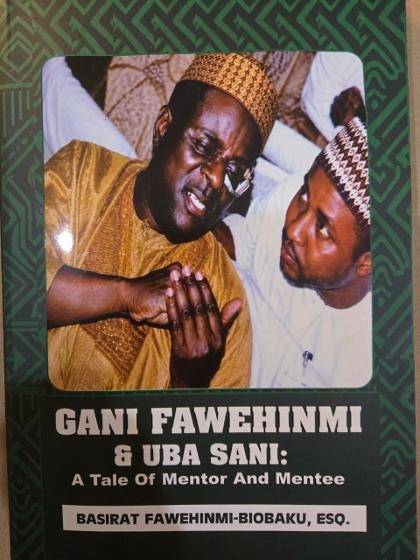
A daughter remembers.
That is the picture in the book, Gani Fawehinmi and Uba Sani: A tale of Mentor and Mentee. It is written by Basirat Fawehinmi-Biobaku, the daughter of the pugilist for human rights and justice, Chief Gani Fawehinmi.
It is a book that draws on memory, relishes a father’s example and ruminates over a young man he took under his arm. This is a book that has touched on an important element of leadership. That is, the power of mentorship.
This mentor was a sheltered boy before his father died. Gani could not preen in luxury, even if he wanted to. He had been pruned. He now worked as a petrol attendant among other odd jobs in order to scale through school. He learned a lesson in reality. Adversity chiselled him to learn empathy for the poor. Once he graduated, he knew he was not going to be a lawyer who strode to court so the world could courtesy to his class. The court became a battlefield. Students would later garland him with a unique and defiant title: senior advocate of the masses. The legal establishment could bask in their Olympian Senior Advocate of Nigeria, although they would not begrudge him that honour for too long. He clutched it before an illness ambushed him to death.
The mentee comes from an impoverished environment. The mentor, a Yoruba and Southerner from the Southwest. The mentee, a Fulani, a northerner from the Northwest. To parody poet Rudyard Kipling, north was not just north. It met with the south. They met in two men. It was not just north that met south, not just Fulani that met Yoruba. It was a coincidence of nationalist sentiment. Both men were fighters. One was an older lion used to growling and duelling and crunching preys. The other was a young cat eager for the hunt. Both were at one in one thing: the nation’s leadership was not only astray. It was diabolical. What brought them together was an ominous hour of our history.
Fawehinmi-Biobaku relates that the meeting of both mentor and mentee happened in the tempest of the June 12 struggle. “I found in Chief Gani Fawehinmi not just a comrade but a mentor who treated me with the warmth of a father and the wisdom of a seasoned general,” reflected Sani in the book.
They were fighting against a time of tyranny. The dictator, first Ibrahim Babangida and later Sani Abacha, were exhibiting the vegetative stress of despots who would not exit the throne. A stress that meant, as the author puts it, “security agencies intensified their efforts against pro-democratic activists, particularly those capable of mobilising resistance beyond the Southwest.
Uba Sani became a marked man. His movements were monitored. His activities were scrutinised. Harassment became routine. Arrest was no longer a possibility but an expectation.” The now governor of Kaduna State was picked up at night and whisked in his underwear into an unknown vehicle to an unknown place by unknown men – my words.
That story is a familiar Gani chronicle. Mentor transmitted heroic adversity to mentee. The struggle visited the pain of the father upon the son.
Gani saw Sani along with others in the brood of angry young men against the military. Sani stood out for his dynamic energy. He belonged to that cream of northerners who believed, like Karl Marx and a few other philosophers of the 19th century like Kant and Hegel, that consciousness precedes being. It is not you who makes your identity but the world you live in. Like philosopher Martin Buber, the I – that is the self – must make sense in the context of thou – that is, the world. The thou is the suffering, the inequality, the injustice. Empathy conquers tribe or region.
Empathy empowers the human cooperative spirit.
So, Sani frustrated the divisive rhetoric of Abacha and IBB men who wanted to turn the resistance into a tribal matter. Sani had lived in north and south, schooled in the Kaduna Polytechnic but had his degrees in Calabar and later in Abuja. He grew up a northerner but lived among southerners. As a Kaduna native, he also was a student activist, an experience that generated a passion for the non-Fulani in Southern Kaduna. No wonder as governor, he has blended without pretension. Sani became the national vice chairman of Gani’s mobilisation arm known as the Joint Action Committee of Nigeria (JACON). Sani was not only a mentee. He lived in his home, and in the room of his mother.
Before he met Gani, Sani already had the spark. Under Gani’s tutelage, he became a bonfire of desire for change. The book blossoms with many pages of Gani-Sani photos. In court, in office, in meeting, in play, in mini-rallies, either before fights or after.
Gani floated a party but he was not an electoral score with the masses. Popularity does not always translate to victory at the polls. But his National Conscience Party did not have to win a vote or a million. It already performed for democracy. It peppered the conscience of the day.
Gani knew that. His followers knew that.
But his mentee’s destiny would build on that. Sani would later be a presidential adviser, lawmaker and governor, and work as though under the spell of his mentor. But both mentor and mentee have certain practical qualities. They were comrades. But neither is doctrinaire. Gani was not a working Marxist, or even a socialist. But he worked with them. Gani was at peace with despots of history.
I had discussions with him over Stalin, who lived for 20 million people to die. He thought I was a sentimentalist. He reminded me that with his collectivisation and mechanisation policies he transformed the Soviet Union. I was grieving for the dead. He was applauding the economic development for the poor who survived. He also loved Kemal Ataturk and even Bismarck. one day i walked into his office with a book about Edmund Burke and he asked, with boyish glee, ‘‘Is it about the French Revolution?’’. He asked based on the pictures on the cover.
Are systems better than people or vice versa? So, Gani was not a democrat. Yet, he fought for it. As Sani often reminds us, but for Gani and his court triumph, we may not have party choices today. Peter Obi would not be jumping from party to party, and Atiku might have tried to defect to PDP from PDP.
Most of those who flocked around him were socialists or those with its sympathies. I recall one day when a rally took place in front of Gani’s office. I had just written a cover story for the African Concord. It told the story of the rumbles in eastern Europe as one socialist republic fell after another. I chronicled the ideological quicksand with the title, The last Days of Socialism. I was bombarded by my colleagues and activists for writing a heresy. Gani was mute to the scene. Tony Iyare – I wonder if he is a Marxist today – predicted that when the revolution came, I would be one of the avid frontliners. But I turned out to be prophetic.
Sani has remained a pragmatic comrade. Hence, he was able to join the bourgeois parties. He knows that fanciful ideologizing would not save the masses. Yet, I have always admired Marx for his diagnosis. He knew the problem of economic inequality. He just erred in its solution. However, it is because of him that we have the welfare state today. It is the reason, for instance, we have intervention programmes in the face of hardship.
We can say that Sani did not veer from his conviction decades after. He is not like the words of the Poet Emily Dickinson: “The abdication of belief/makes Behaviour small/ better an ignis fatuus/ than no illume at all.” Sani is still bearing the light. We can see it in his grassroots empowerment programmes for the poor, transportation and skills acquisition hub, etc. The author confirms the story of how Sani compelled his mentor to expand his scholarship programme to northern Nigeria.
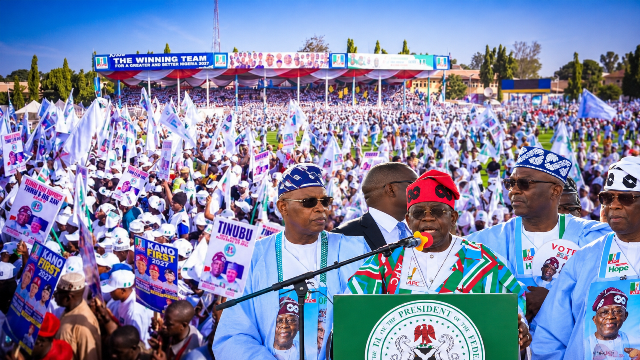
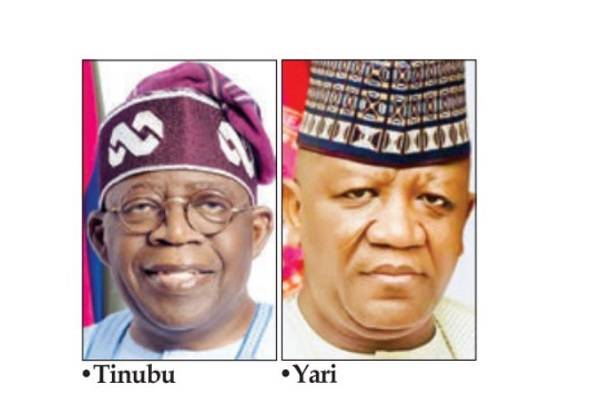
The Gani-Sani duo is not only about generational conjuncture. It is about the value of mentorship. We have seen this with President Bola Tinubu and the suite of men he has raised, although some fell by the wayside. We must ask: since Awo, have we seen any statesman who has kept by his side for over 20 years the people who began with him? In most cases, they have been with him in heady days. Nixon said, “the test of a leader is a man who can take tough decisions and take his associates with him along those tough decisions.”
We know of Mahatma Ghandi and Jawaharlal Nehru of India. Both men are now icons, although Ghandi, who loved to fast, was more of a humanist than a nationalist while his mentee was the opposite. So, we can say that Prime Minister Narendra Modi would see Nehru as his ancestor, and most Indians love him more. The world loves Ghandi more, though. Awo leaned more towards Nehru, less for his nationalist temper than his development work for India.
Yet, mentors are not only in the political arena. Madman philosopher Friedrich Nietzsche was a protégé of the great music star Wagner until he disavowed him. Aristotle mentored Alexander the Great, an example that mentees do not have to be carbon copies, just as Aristotle was a different philosopher from his master Plato. Sometimes mentors may want to destroy their mentees like the eponymous story of the origin of Macedonia and the family of Alexander the Great. The founding brothers settled with a kind family. But when the wife served them bread, their loaves grew bigger than others. Rather than embrace the miracle, the man sent them out of his home and rallied militias after them. Some mentors are afar like Bill Clinton and John F. Kennedy.
Fawehinmi-Biobaku writes with a unique style, full of pithy phrases and observations. She pens a story like an essayist and essay like story teller. The writer would benefit, though, from a lot more anecdotal riches. It is cheering that Gani is not the mentor in the Nobel Prize-winning novel, Santantango, in which a man promises a distraught group an island they call paradise. He never leads them there. Rather than a new beginning, they end up like beggars. But Gani the rebel gave us Sani the doer.
NOTE: Views expressed by contributors are strictly personal and not of Theliberationnews