

It was a cool evening, after a late August rainy day, that K1 de Ultimate had to change his rhythm as he wept for Ogogo. The man who had spent decades reciting prayers for others, who had led the èwì, the poetic chant, the dirge, at Hubert Ogunde’s funeral procession—the man who had invoked his ancestors with his voice at the National Theatre and elsewhere—now needed another’s voice to guide him home. And so, the king of Fuji music, a man who hardly strays from joviality, wept when he heard of the death of the younger man. He turned to wéré, the precursor of Fuji music, a sound often reserved for philosophical reflection, and wept for the actor.
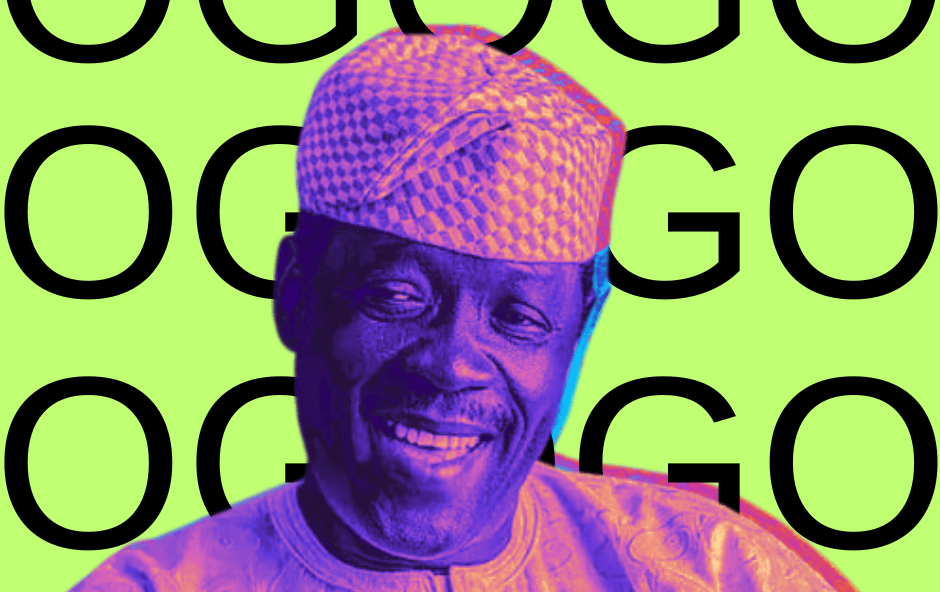
Death serves kings and commoners alike. It doesn’t send private messages before arriving. It doesn’t care about your filmography or your stage four diagnosis, or that your daughters spent the previous week on Instagram begging hospitals to treat you. Death simply arrives, and when it arrived for Taiwo Babatunde Hassan (Ogogo) on 23 August 2026, it took a man who had spent 45 years refusing to be reduced to just one thing.
***
To understand Ogogo, you have to understand the journey before Nollywood. You have to go back to Yoruba traveling theatre, with practitioners like Kola Ogunmola, Duro Ladipo, Adeyemi Afolayan, Moses Olaiya, and Hubert Ogunde. These men typically loaded their theatre companies onto trucks and drove across West Africa, from Accra to Kano, presenting plays like Yoruba Ronu and Oba Kòso in makeshift theatres, building the infrastructure for part of what would become one of the world’s most prolific film industry. They were the then modern take on the art of travelling griots, who went from town to town in Yorubaland before colonial rule by the British and the French.
By the time Taiwo Hassan was born on 31 October, 1959, in Ilaro, Ogun State into a rich family tradition of twins (even his father and grandfather were twins like he was), traveling theatre had begun to transform. Television arrived that same year, diverting talent from the stage—and the economic crisis of the 1980s made celluloid extremely expensive. So, the Yoruba film tradition did what the Yorubas have always done: adapt. They turned to video.
The video revolution of the late 1980s and early 1990s democratized storytelling. Suddenly, the Ogunde Film Centre in Ososa was no longer necessary to make a film. All it took was a video camera, a script on loose sheets of paper, and actors who understood that Yoruba drama wasn’t just about reality or mysticism, but also about exuding a presence from which values and virtues could be projected, even when those actors were simply saying “good morning”.
This is the world Taiwo Hassan entered in 1981, while still working as a mechanic for Lagos State Water Corporation. He was 22, a graduate of a technical school who had been forced to drop out of Gaskiya College in Lagos due to lack of funds, a young man with a face that could shift from menacing to friendly in an instant. In 1994, he left his job in the civil service, where he had worked for 13 years.
He was about to dedicate himself entirely to acting.
In Yoruba theatre tradition, actors often inherit the names of their breakout characters as lifelong nicknames. Ogogo was not his birth name; it was a nickname from his time as a mechanic apprentice that stuck to him like a second skin, a persona so potent that it swallowed the man and became the man. It was a name lifted from the oríkì of his hometown, Ilaro. Under the brutal Abacha regime, when the country was suffocating under the boot of military dictatorship and moral clarity was in short supply, Ogogo’s on-screen archetype became a compass for boys growing into men. He was the hero who stood by what was right, who defended the weak, who looked tyranny in the eye and refused to blink. And when his characters swore (and boy did they swear with gravity), “Mo fi títóbi Ọlọ́run Ọba búra.” [I swear by the greatness of God Almighty], it was a saying that carried the weight of covenant, a phrase boys would mutter under their breath in schoolyards, trying to summon the same moral authority that Ogogo exuded effortlessly. He made righteousness look cool. He made integrity look like something you could wear.
For millennial men growing up in South West Nigeria, there was a specific, quiet resentment, a jealousy that lived in our chest whenever Ogogo appeared on screen with Ireti (the late Bimpe Adekola) in the mid-90s to early 2000s. She was comely in a way that felt both attainable and impossibly distant, and there he was, our Ogogo, with his fine-boy bone structure and his easy charm, much like Damson Idris, winning her heart scene after scene. We wanted to be him. We wanted to be the man who got the girl, who stood tall, who faced down odds. He made adulthood look like a promise worth keeping.
But no hero exists without a villain, and in the mythology of Yoruba video film, Ogogo’s counterweight was Yinka Quadri, known on screen as Kura. Their bromance off-screen was the engine of a thousand plots, but on-screen they were locked in an eternal dance with Ogogo the hero, married to or in love with Ireti, and Kura the schemer, the villain, the man who would stop at nothing to steal what wasn’t his. It was a formula, yes, but like all great formulas, it worked because it spoke to something true about the world, that the belief in goodness must always be tested, love must always be defended, and the man who swears by God must always be ready to fight for what he believes. We watched them clash and we chose sides, and of course we chose Ogogo, because who wouldn’t want to be the man who gets to go home to Ireti?
***
Performing in the Yoruba tradition has never been a solitary activity. It is a society, a group, and a learning system rooted in pre-colonial àlárìnjó (traveling masquerade theatre troupe) practice, where artists studied under the tutelage of masters. And in 1987, four experienced men came together to formalize what had been an informal group, as an answer to perceived domination of the industry by legends like Oyin Adejobi and Ade Love. They were Yinka Quadri, Abbey Lanre, Rasaq Ajao (Araosan), and Taiwo Hassan.
They called it the Odunfa Caucus, after the street in Lagos where they held their meetings. In the nineties, they held rehearsals at 40, Odunfa Street in Ebute Metta on Mondays, Wednesdays, and Fridays—from 7 to 9 in the evening. They taught acting, chanting, directing, producing, and screenplay writing, along with every other aspect of production.
If you’re familiar with Yoruba cinema, you’ll recognize this name. Formed to train newcomers and bring order to an industry that was growing faster than it could self-regulate, the group was also a pact between four men who understood that Yoruba cinema wouldn’t survive on talent alone. It needed discipline. It needed elders to remember that before you can play a king, you have to learn to bow.
That meeting gave rise to a plethora of stars. Funke Akindele attended Odunfa. Iyabo Ojo attended Odunfa. Fathia Balogun, Bimbo Oshin, Wunmi Toriola, Mustapha Sholagbade, Yomi Fabiyi, Kemi Afolabi, Dayo Amusa, Opeyemi Aiyeola populate a list which reads like a directory of the Yoruba film elite. In the midst of all this, still teaching, still chanting, still acting in his sixties, was Taiwo Hassan.
He acted in over three hundred films spanning four decades, each a testament to the tireless work of an actor who never ceased to be capable of making a bad script tolerable with the sheer authority of his performance. And what an impressive filmography he has: from Owo Blow to Omo Ghetto to Anikulapo, where he played Alaafin Ademuyiwa in the Kunle Afolayan epic, earning an AMVCA nomination for Best Supporting Actor in 2023).
But to reduce him to his filmography is to miss his essence. Taiwo Hassan was singer, poet, and boxer. His anchoring of the chants at Ogunde’s funeral was a passing of the torch from the father of Nigerian theatre to the next generation. He was a prominent figure not only for his acting talent, but also because he embodied the art of oríkì and ewì chanting, performing the poems of praise, eulogies, and record-keeping that are a core essence of the Yoruba theatrical tradition, one that predates cinema and will endure for millennia.
Off-screen, he navigated the complexities of a polygamous household with a Muslim wife and a Christian wife, a balancing act that one assumes required the same diplomacy and presence he brought to his roles. It was a life lived in full, with all the contradictions and textures that make a man whole.
***
In February 2025, The Guardian Nigeria published an article on sampling in Nigerian music, noting how Burna Boy’s Last Last (which the pop act himself described as the most representative of his career) sampled Toni Braxton’s 2000 hit, He Wasn’t Man Enough. The article traced the tradition of Nigerian sampling from Fela Kuti to Wizkid and Davido, showing how Afrobeats established its global dominance by remixing sounds from across the African diaspora. The article also mentioned, almost in passing, the presence of Nollywood actor Taiwo Hassan, popularly known as Ogogo, within this ecosystem of cultural borrowing.
At that point, Ogogo had become part of our cultural furniture. His voice, expressions, and archetypes travelled into music, comedy, memes, and everyday language—rapper Olamide referenced him on 2016’s Owo Blow with the line “Action pọ bí Ogogo” (Action as abundant as Ogogo’s). Many Yoruba children named Owolabi automatically inherit the nickname “Owo Blow” from the 1990s movie he acted in.
This is why Burna Boy, Olamide, and maybe even Toni Braxton, should write his family a cheque, outside of royalties. It’s a cultural invoice, even as it is not legally binding. That we can do the right thing by everyone and the culture as a whole, even when we can get away with doing nothing was a prime motivator of Ogogo’s most memorable characters. The man himself made sure, as he explained in interviews about the Odunfa Caucus in recent years, that people who understand that culture is a common good must also acknowledge that a common good needs guardians. And he was among the best.
The Yoruba film industry is often misunderstood by those who judge it by other standards. It is not Bollywood, with its industrial scale. It is not Hollywood, with its obsession with individual directors. It is something ancient and something new at the same time. It is a continuation of itinerant theatre by other means, a form of communal storytelling captured on video, a tradition in which the actors are not stars, but vehicles, a medium through which the culture expresses itself.
Taiwo Hassan seems to have understood this. He knew that chanting ewì isn’t just about acting, but about channelling the energy and mysticism of generations of griots. He understood that the Odunfa Group wasn’t just a training ground, but a temple in which the sacred art of entertainment as a device for social commentary and historical archive was preserved and renewed. Listening to his interviews and watching the movies he was involved in either as an actor, producer, director, or screenwriter, you always understood that he didn’t believe in art for art’s sake.
Ogogo’s legacy isn’t limited to his over 300 films, his AMVCA nominations, or the fact that he’s one of few names mentioned when discussing Yoruba chanting. His legacy is larger; it’s the Odunfa group’s. It is the Funke Akindele empire, built on the foundations he helped lay. It is Iyabo Ojo’s dominance on TikTok. It is the fact that when a young actor in Ebute Metta wants to learn acting today, he asks for Odunfa, knowing that in Yoruba cinema, you don’t just stumble into the industry. You are initiated.
***
In 1996, after the huge success of his hit album Consolidation, K1 de Ultimate, then known as King Wasiu Ayinde Marshall, released an album titled Legacy, in which he asked established individuals to always mentor young ones.
Thus, when K1 de Ultimate cried that evening in August, segueing from fast-paced Fuji to wéré minutes after hearing of Ogogo’s passing, it was perhaps the weight of legacy that overwhelmed him. He wept not just for Ogogo, but for the generation that helped carry a great tradition from travelling theatre to television, celluloid, VHS, VCD, YouTube, and streaming. Ogogo stood in a river that began long before him, with the great Yoruba theatre pioneers, but he became one of its strongest currents.
And now the river has taken him.
Like his “Gbogbo wa la ma je breakfast” (“Everybody go chop breakfast” in Nigerian pidgin, meaning everyone will get heartbreak or disappointment), a saying that travelled from WhatsApp statuses to Twitter memes to a generation’s lingo to a hit Burna Boy record, Ogogo has now eaten the ultimate breakfast, while the rest of us are still seated at the table, pretending we have all the time in the world.
On that cool afternoon, after the late August rain, the man who spent 45 years refusing to be reduced to just one thing was reduced, finally, to the one thing we all become: memory. E