


In the heart of Abuja’s Federal Secretariat Complex, where the air is often thick with the silent language of files, memos, and deferred decisions, a quiet but consequential reordering is underway. It is a reordering not of personnel, but of principle.
On a February morning in 2026, senior procurement officers from across the Federal Public Service gathered for what sounded, on paper, like a meeting designed by bureaucrats for bureaucrats to exclude non-bureaucrats. Its title was quite the eyebrow-raiser: Meeting with Procurement Officers of the Directorate Cadre, Salary Grade Levels 14 to 17, in the Pool of the Bureau. A string of bureaucratic nouns promising more bureaucracy and more deferred decisions.
Yet the session was neither ceremonial nor routine. It was a deliberate moment of reckoning.
The message from the centre of government was unambiguous, delivered with a quiet force that left little room for the old evasions. Public procurement, once treated as a dreary clerical afterthought, had been decisively recast. It was now, officially, one of the primary engines of the Renewed Hope Agenda. In a country where public spending runs into trillions of naira, a simple equation was being etched into policy consciousness: how the state buys is inseparable from what the state builds.
The presence of the Head of the Civil Service, the Chairman, Federal Civil Service Commission, the Permanent Secretary of the Federal Ministry of Education, and the Director General of the Bureau of Public Service Reform gave the gathering a whole-of-government gravitas.
Their collective attendance was a signal, and perhaps a tacit admission, that many of the leaks in the national vessel are sprung at the point of purchase. They were there to underscore a shared understanding that procurement governance sits at the core of transparency, accountability, and the elusive ideal of extracting full value from every kobo spent.
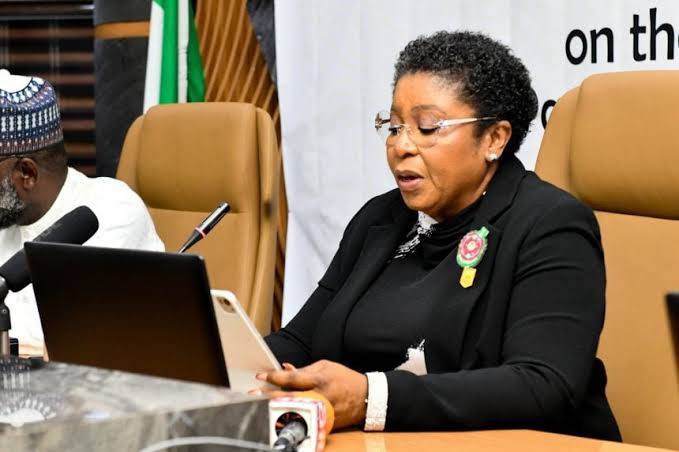
At the centre of this reform push is the Nigeria First Policy. The Head of the Civil Service, Mrs Didi Esther Walson-Jack, described it as a critical instrument for efficiency and accountability. But it is more than a directive.
To be clear, the Nigeria First Policy represents a philosophical shift. Procurement is no longer treated merely as an administrative obligation, a procedural box to be ticked before the real work begins. It is now framed as a strategic lever for national development, a concept so expansive it might once have sounded fanciful until it was patiently explained.
Engineer Eugenia Esso Ojeah, Director of Energy Infrastructure at the Bureau of Public Procurement, articulated this shift with a clarity that cut through the formal air. Public procurement, she said, “is being deployed as a strategic policy instrument. Its purpose is to stimulate domestic capacity building and industrial development, not simply to process transactions.” In this framing, the state’s purchasing power is transformed from a blunt instrument into a surgical tool, deliberately aligned with industrial policy, job creation, and wealth retention.
This is nation-building through the power of purchase. Every contract awarded is reimagined not merely as expenditure, but as an investment in Nigerian enterprise, innovation, and a stubborn, necessary self-reliance.
● The new custodians of public value
The officials gathered were not junior functionaries. They were directorate cadre officers on salary grade levels 14 to 17, the institutional fulcrum of the entire procurement system. As noted in a goodwill message, these officers occupy strategic positions in policy interpretation, advisory responsibility, and decision-making across ministries, departments, and agencies. Their daily judgements, made in offices lined with filing cabinets and haunted by the ghosts of past projects, shape timelines, fiscal discipline, and the very texture of service delivery. They determine, through a thousand quiet decisions, whether procurement strengthens public confidence or corrodes it.
In his welcome address, Dr Adebowale Adedokun, Director General of the Bureau of Public Procurement, was frank about the weight of responsibility before them. The effectiveness of Nigeria’s procurement system, he observed, depends fundamentally on their professionalism, integrity, and capacity to adapt. He did not invoke patriotism by name, but the word lingered unmistakably in the space between his sentences.
Dr. Adedokun outlined the new mechanics of responsibility. Comprehensive procurement planning is now mandatory through the NOCOPO platform. Revised standard bidding documents are steadily closing familiar and once comfortable loopholes. Contract awards are to be published monthly, normalising transparency rather than treating it as a rare and applause-worthy exception.
Equally significant is the steady expansion of digital tools. Virtual bid openings and tender board meetings are increasingly integrated with physical oversight, creating an auditable trail, a persistent digital scent for regulators and auditors to follow. The objective is not spectacle, but system integrity.
Yet even the most transparent systems falter in the absence of consequences. This reality framed the meeting’s most sobering conversations.
● Enforcement, reform, and the long view
A central focus of the session was the BPP’s Debarment Policy, presented by Mrs Rabiat Ozigis, Head of the Legal Services Unit. For the first time, Nigeria’s procurement framework now provides a clear and enforceable mechanism for excluding fraudulent or persistently non-performing contractors from public business. The exclusion lasts for periods ranging from three to five years, a commercial lifetime in a competitive and unforgiving economy.
The grounds for debarment were explicit, read out with the precision of a charge sheet: bribery, fraud convictions, wilful failure to perform, falsification of documents. The process allows for a fair hearing and the right of reply, but the sanctions are deliberately consequential.
A debarred entity is excluded from procurement processes across all ministries, departments, and agencies. Its name is entered into a central database and published, converting reputational damage into a measurable commercial cost.
As Mrs Ozigis stated clearly, leaving no room for ambiguity, procurement malpractice does not begin and end with public officials. For too long, firms that enable corruption, the suppliers of scarcity, and the architects of cost overruns, have escaped proportionate accountability. The new policy seeks to correct that imbalance, introducing a long overdue symmetry of consequence.
These enforcement tools sit within a broader reform architecture anchored on four pillars: efficiency, transparency, accountability, and innovation. They are being operationalised through a suite of initiatives with their own acronyms and workflows, including the Nigeria Procurement Certification Programme, the National Procurement Officers Management System, community-based procurement models, and price intelligence mechanisms. The steady rollout of end-to-end digital procurement platforms continues, a determined war against the problematic paper trail.
Challenges remain, of course. Capacity gaps persist. Budgetary constraints will not disappear overnight. Resistance to change exerts a gravitational pull. Familiar malpractices still surface: manipulated bid evaluations, the creative abuse of emergency procurement, the misapplication of the lowest evaluated responsive bid principle. What distinguishes this moment is not denial, but an emerging institutional candour and a resolve that feels less like a slogan and more like a slowly turning key.
The Abuja meeting, then, was more than a technical clinic. It was a strategic alignment. A reaffirmation that procurement reform is not an isolated bureaucratic exercise, but a cornerstone of governance reform itself.
Nigeria’s procurement officers are being asked to assume a historic role. To become stewards of economic patriotism. To ensure that every purchase order advances a national priority, and that every contract, whether for cement or software, strengthens a domestic muscle.
The legal frameworks are tightening. The digital infrastructure is advancing. Professional expectations are rising. Quietly and methodically, Nigeria is attempting to rewire its procurement system to serve a higher purpose.
In this emerging paradigm, the procurement officer stands as both guardian and catalyst, protecting public value while enabling private sector growth. Their success will not be measured only in contracts completed, but it will also be interrogated in the industries strengthened and in the new opportunities created.
This then is the business case for bureaucrats conducting bureaucracy with the utmost efficiency. Not as a sacred ceremony excluding non-bureaucrats. Not to mystify governance. But to make the machinery of the state work, deliberately and effectively, for the country and her people.
■ Sufuyan Ojeifo is a journalist, publisher of THE CONCLAVE, and communications consultant.