
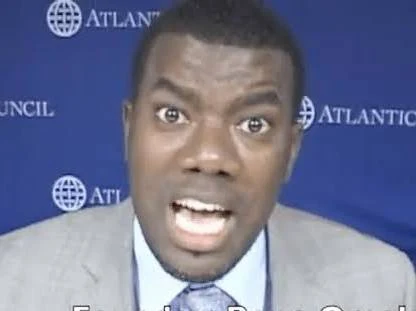

Sadly, Ambassador-designate Mr. Reno Omokri has refused to find a modicum of dignity from somewhere, anywhere, with which to cover himself. I don’t quarrel with his avowed duty of defending Mr. President from any and every attack, real or imaginary, though President Bola Ahmed Tinubu has designated spokesmen aplenty. That is a personal choice and any man can be a fool, those who will be will still be despite the non-foolish capabilities and intelligence the almighty God endowed them with.
Yet, the gutter he threw himself into when he equated the recent power outage affecting some states in the United States of America with Nigeria’s scandalous electricity supply is worrisome. Nigeria’s shameful electricity generation and distribution low indices did not begin with President Bola Ahmed Tinubu’s administration. It might not even have become worse under Tinubu. That problem has bedevilled Nigeria since the 1980s when heavy industries began to die because they lacked adequate power supply. That was why the Dunlop tyre company relocated from Nigeria to Ghana in the 1980s/90s. That was why the heavy textile mills across Nigeria almost died out entirely.
Omokri advertised his senselessness or insensitivity in that post where he thought he was attacking Mr. Peter Obi and this Ambassador-designate thus served notice that he will be a useless Ambassador. That brings us back to the question of why and how President Tinubu nominated him, when it has been most obvious that the poor man actually wants to remain a social media warrior. Which characteristics threw him up? What in him showed that he had the promise of representing Nigeria’s interests well in a foreign country?
The doubts resonate further when it is remembered that what drew the attention of the Tinubu administration to him, as Mr. Omoyele Sowore recently recounted in court, is nothing more dignified than that he had accused Tinubu of narcotics-related crimes.
Before we interrogate Mr. Omokri’s claims about power outage in the US which he favourably compared to Nigeria’s, may we please check the effect of low electricity supply in Nigeria. Several heavy industries and multinational corporations have either completely exited Nigeria, shut down manufacturing plants, or scaled back operations, not since the years of yore but between 2020 and 2025, with high energy costs, unreliable power, and foreign exchange volatility cited as primary drivers, according to internet sources. Please, remember that the first APC administration, headed by President Muhammadu Buhari, began in May 2015 and started its second tenure in 2019.
In 2023–2025, over 60% of manufacturing firms were forced to abandon the national grid for self-generation due to poor, unreliable service. The effect of such is that the price of their products or services would have increased, causing a hike in the inflation rate, reducing the people’s purchasing power and their quality of life.
The heavy industries and major firms that have departed or scaled down, heavily impacted by the energy crisis as tossed up by the internet checks include: Procter & Gamble (P&G): Ceased manufacturing operations in Nigeria in December 2023, shifting to an import-only model, partly due to the difficulty of operating in a challenging business climate with high energy costs. Effect; the Nigerians that had been employed in its manufacturing facilities lost their jobs and the economy lost their taxes. And those unfortunates had no safety net to break their falls. They and the members of their families were left all alone to suffer their sad fates.
GlaxoSmithKline Consumer Nigeria PLC (GSK): Announced plans to exit Nigeria in 2023 after 51 years, ceasing manufacturing in 2021 and moving to a third-party distribution model.
Unilever Nigeria PLC: Stopped the production of its home care and skin-cleansing products in 2023 to reduce exposure to foreign exchange and energy challenges.
Diageo PLC: Sold its majority stake in Guinness Nigeria PLC in 2024, shifting from direct management.
Kimberly-Clark Nigeria: Closed its production plant in 2024 due to economic challenges.
PZ Cussons Nigeria PLC: Experienced significant disruptions and began restructuring, citing economic volatility.
Microsoft Nigeria: Impacted by layoffs in 2024, closing its African Development Centre as it realigned its local operations.
Tower Aluminium Nigeria PLC: Shut down operations in 2020 after decades in the country.
Manufacturing & Other Firms that Closed/Left: Framan Industries Ltd, Stone Industries Ltd, Mufex Nigeria Company Ltd, and Surest Foam Ltd: These firms shut down operations in 2021.
Universal Rubber Company Ltd, Mother’s Pride Ventures Ltd, Errand Products Nigeria Ltd, and Gorgeous Metal Makers Ltd: These brands ceased operations in 2022. Deli Foods Nigeria Ltd and Standard Biscuits Nigeria Ltd: Closed around 2020–2021. Equinor Nigeria Energy Company: Sold its 54% stake in Nigerian oil assets to Chappal Energies in 2024, exiting after 30 years.
Now, who has kept tab of the number of jobs Nigerians lost when those outfits shut down? Who has tracked the quality of life among the former employees of those companies?
The Key Factors Driving the Exodus:
Low Electricity and High Energy Costs: Manufacturers are spending billions on diesel generators to keep machines running, making production costs uncompetitive.
Grid Collapses: The national grid recorded over 12 collapses in 2024 and several in early 2025/2026, forcing a shift to “captive” (self-generated) power, with over 60% of companies now off-grid.
Foreign Exchange Volatility: The devaluation of the naira has made importing raw materials and machinery for heavy manufacturing unsustainable. That does not mean that the companies that have not shut down production in Nigeria are having it good. For instance, in 2025 alone, over 20 additional firms (including large manufacturing entities) were reported to have received licenses for independent, captive power generation, indicating a mass movement away from the national grid. The direct result of this is that such firms have left their core businesses to begin to hunt for electricity self-sufficiency simply because Nigeria has failed to provide the needed electricity for them.
It is in that milieu that Omokri made his unfortunate post that power outage is not such a sign of national failure because it happened recently in the US. So, it is a disaster foretold when a person of Mr. Omokri’s standing begins to commit fallacies of the most basic kind, shamelessly. He is an Ambassador designate, for crying out loud.
So, does it mean that if President Tinubu asked his Ambassador-designate if there was any need to upgrade Nigeria’s electricity generation, transmission and distribution system to match USA’s, that Omokri would tell him that there was no difference between them? And that his answer would remain so even if an earthquake had caused the USA outage?
Please, read Mr. Reno Omokri’s self-mockery; “The United States has suffered several major power grid failures, resulting in widespread outages, including a blackout that left 55 million people without electricity. As you read this, the United States is experiencing blackouts across multiple states as its power grid nears collapse.
These things happen in every country on Earth. It is not limited to Nigeria, and it is a pity that Peter Obi, who last year lied that Tanzania had solved its power problem and asked Nigeria to learn from that nation, is up to his old tricks by de-marketing Nigeria over the recent power grid collapse”.
I don’t know exactly what Mr. Peter Obi said about Tanzania, but I am not about to take whatever Mr. Omokri attributed to Obi as anything near the truth because of his antecedents. He once made sundry accusations about President Tinubu, calling him all sorts of names except a child of God, only to recant. But then, if for his efforts he emerged an Ambassador-designate, why would he stop lying when lying could be a highly remunerated “job” in Nigeria? For instance, I keyed in “Peter Obi on Tanzania’s electricity supply” and guess what popped out? “In April 2024, Peter Obi lauded Tanzania for its improved electricity supply, noting its ability to power major cities and achieve high, stable access. He highlighted the country’s reported, though debated, surplus power generation, urging Nigeria to emulate such progress.
Key details of his statements regarding Tanzania include:
Observations: Obi claimed Tanzania achieved such high energy output that it was able to temporarily shut down some hydroelectric stations due to excess in the national grid, as seen in (an) Arise News report.
Comparison: He expressed frustration that Nigeria, “the giant of Africa,” cannot adequately power its cities while Tanzania, has made, according to his X post, significant progress in its power sector.
Call to Action: Obi urged the Nigerian government to learn from Tanzania’s approach to enhance electricity accessibility and stability….” So, did Omokri lie against Obi? You and God be the judge!
Tanzania produces about 3, 000 to 4,000 megawatts of electricity for her 70.1 million people.
Omokri gloried in this claim: “Under Tinubu, Nigeria broke its power generation record with a peak generation of 5,801.84MW and maximum daily energy output of 128,370.75 megawatt-hours (MWh), the highest ever attained in the history of the electricity industry in Nigeria”. But with Nigeria’s population of approximately 237.5 million people, Nigeria actually has a lot to learn from Tanzania. Ever worrisome is the reliability of power supply in Nigeria because the national grid is prone to frequent failures, with over 140 instances of collapse recorded in recent years. Recent major collapses occurred in October 2024, November 2024, December 2025, and over two times in January 2026.
Now back to Omokri’s insinuations about electricity supply in the USA; the US occupies the second position in the world in electricity supply, after China (please remember the populations of the two countries. Now tried as I did, I couldn’t find the percentage of homes that do not have electricity in the US. It was like I was asking a stupid question. I stopped that stupid quest when this popped up: “Can you legally live off the grid in the US?”. What a question? And the answer: “Yes — you can legally live off the grid in the United States, but success depends on compliance with local zoning, building codes, water and waste regulations, and power system requirements.” Where I come from, there are no building codes, no water and waste regulations, no power system requirements and whole towns and villages live off the national grid not out of choice but because the country has failed to extend that amenity to them.
Actually it appears that in Nigeria, the reason why governments exist has not been found… and that is why Tinubu’s administration has spent two years in office without appointing Ambassadors.
And to tell us that Ambassadors may not be important, he appointed Reno Mocking Omokri as an Ambassador-designate. This motor-mouth self-mockery mocker Omokri may even advise Tinubu that the New York World Trade Centre’s collapse in the terrorist attack of 9/11 was proof positive that building collapse abounds in New York City just as in Lagos. He could fire off a memo in a diplomatic pouch that an earthquake in USA that tore up a road shows that leprous roads are not Nigeria’s preserve. Otherwise, how a non-diseased mind could have dreamt up the asinine illogicality that a storm-related power failure anywhere equals the inexcusable incessant power failure that shames Nigeria, including the Presidential office, daily, is a cause for worry.
But then, such a person with such a mind has become Nigeria’s Ambassador-designate. This is one great “feat” Tinubu will be remembered for – even as the world laughs at us.