
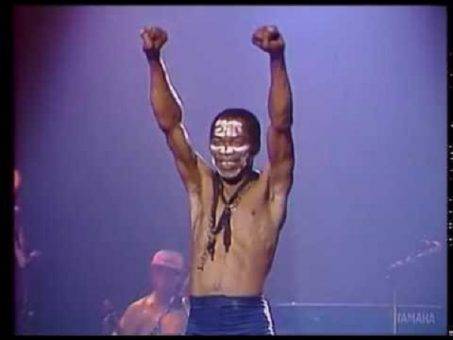

In what proved to be his last major interview, in December 1996, Afrobeat pioneer and music idol Fela Anikulapo Kuti, known mononymously as Fela, claimed to be “a very important god.” It was a hubristic self-characterisation. However, it highlighted his stature in global music at the time, coming just seven months before his death at the age of 58 on August 2, 1997.
Nearly three decades after his departure, being honoured with the Grammy Lifetime Achievement Award on January 31, at a ceremony in Los Angeles, USA, further cemented his place in the pantheon of music greats. He became the first African musician to receive this honour since its inception in 1963. He is recognised for “his revolutionary fusion of jazz, funk, and traditional Nigerian rhythms.”
The Grammy Lifetime Achievement Award is awarded by the Recording Academy, a US-based organisation formed in 1957, to “performers who, during their lifetimes, have made creative contributions of outstanding artistic significance to the field of recording.” It is described as a “learned academy of musicians, producers, recording engineers, and other music professionals.”
This special award is determined by the Recording Academy’s National Trustees, unlike the standard Grammy categories, which involve a multi-stage peer-voting process including submissions and nominations. The Grammy Awards are not only internationally prestigious; they are also universally respected.
There is no question about the significance of this recognition. Reacting to the posthumous global garland, the legend’s son and Afrobeat musician, Seun Kuti, was quoted as saying, “Fela has been in the hearts of the people for such a long time. Now the Grammys have acknowledged it, and it’s a double victory. It’s bringing balance to a Fela story.”
Although his remains lie in an inventive tomb on the grounds of his former residence on Gbemisola Street, Ikeja, Lagos, which is now Kalakuta Museum, Fela’s spirit soars beyond the restriction of the grave.
His death from AIDS-related complications silenced a critical progressive voice. In an era of military rule in Nigeria, he consistently sang against authoritarianism and bad governance; his discography served as a relentless assault on state corruption and religious fraud. Songs like “Zombie,” “Water No Get Enemy,” and “Coffin for Head of State” are not merely hits; they are considered timeless political and cultural classics.
He was not just a musician but a musical icon with a sense of mission. His unapologetic pro-people activism was daring and defiant; and he was willing to pay the price for his anti-establishment crusade. He saw music as a weapon, and used it against the enemies of progress with the potency of a visionary iconoclast. His fight for pro-people governance got him into trouble; he was arrested several times. His former residence at Agege Motor Road in Lagos, known as Kalakuta Republic, was burned by hostile soldiers in February 1977.
That 1996 interview ranks among the high points of my journalism career. How did I get to interview the great one? I was Features Editor, Today’s News Today (TNT), an ambitious Lagos-based evening newspaper, and the organisers of a series of Fela renaissance concerts tagged Fela Don Come O had chosen the medium for publicity purposes ahead of a planned show on Boxing Day at Lekki, Lagos. The first show at Water Parks, Ikeja, Lagos, was not adequately publicised, the organisers had reasoned. So, they came to TNT’s Oregun office to arrange an exclusive interview with Fela that would run for two days as a publicity stunt to draw a crowd.
Naturally, I was over the moon about the job. I had a partner for the interview in the person of Akintunde Ojo, now deceased, who was the paper’s entertainment expert at the time. For several days before the interview, we prepared and kept reviewing our preparation. On the eve of the date, we had to consult one of Fela’s aides for some guidance on the kind of questions that would hold his interest.
We watched Fela’s pulsating performance at his club, the Afrika Shrine, on Pepple Street, Ikeja, till the show ended just before dawn; and then the maestro sat down with us for an interview that lasted about three hours. If there were signs that he was battling with symptoms of a grave illness, we didn’t notice. He had stopped playing the saxophone on account of some challenges, but he boasted to us that he would one day start playing the instrument again. He made us laugh, he made us think, he made us wonder, and he made us feel we were capable of great things.
After the session, he left the club in a waiting taxi, which was a thought-provoking statement about his diminished financial resources despite his undiminished stardom. The interviewers went away inspired by the magical meeting and the unforgettable encounter.
Thanks to the Felabration festival, organised yearly in October by his children since 1998, he remains relevant and influential. The power of Felabration is its focus on Fela’s fight for sociopolitical change using the power of his internationally acclaimed music. Indeed, his work has not only created a new generation of Afrobeat artists worldwide; it has also inspired a new form called Afrobeats.
The yearly celebration of Fela’s legacy is applaudable. At the Felabration 2021 symposium, human rights lawyer and activist Femi Falana (SAN) noted his contribution to reforms in the country. He said: “Fela sang about ‘Sorrow, Tears and Blood,’ which spoke about torture by the police and the military. It was not until 2017 that the Anti-Torture Act was enacted by the National Assembly. Under that law, a police officer who tortures anybody shall be prosecuted and the penalty is 25 years in prison. We must thank Fela for that.”
Falana also observed: “Under the 1963 constitution, the government was not liable for any atrocity it committed against the Kuti family. However, that is no longer the rule.
Under section six of the 1999 constitution, the government, whether federal, state or local, can be brought to book and taken to court. I want us to realise that these are reforms instigated by Fela and other forces in Nigeria.”
Fela’s Grammy honour serves as a signal to the country that he is long overdue for national honours and the naming of a major facility after him.
Culled from The Nation