
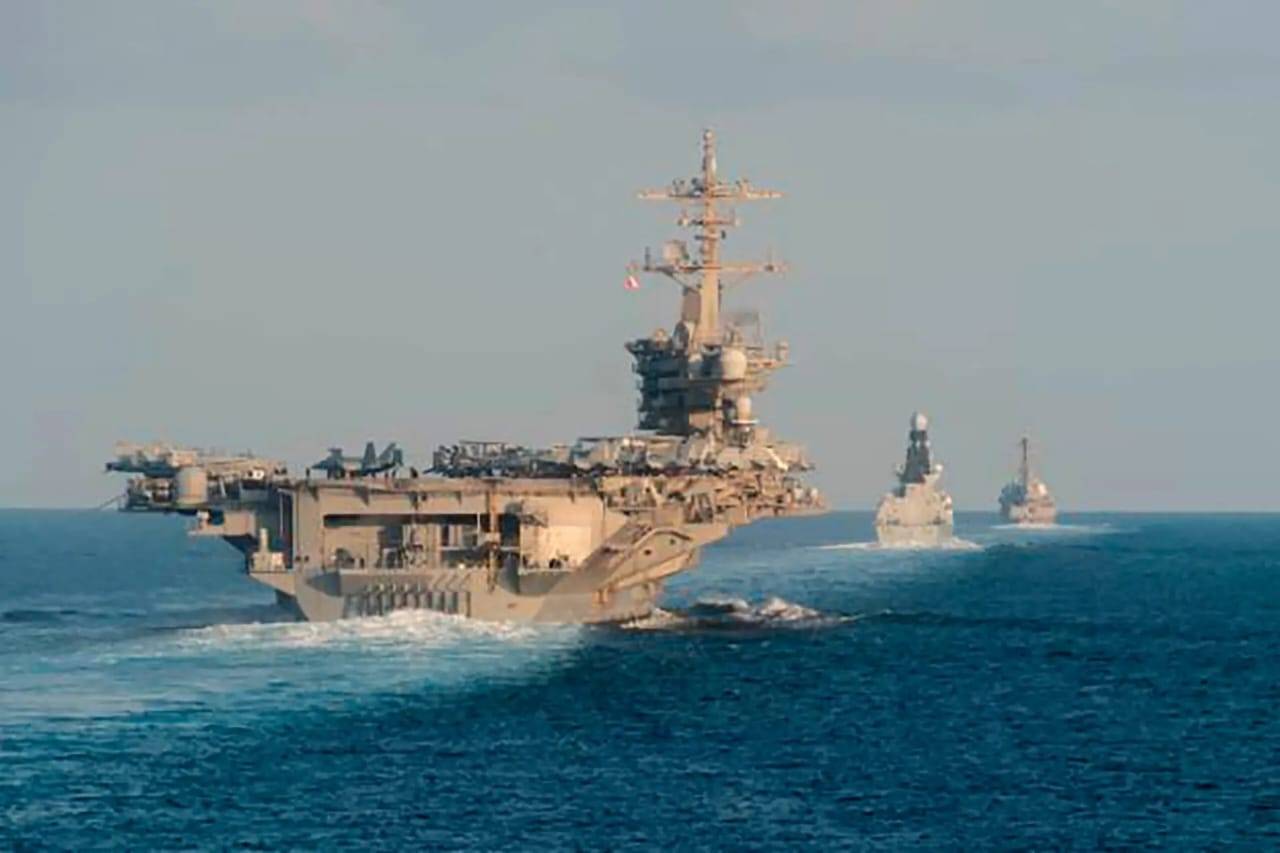

In this Nov. 19, 2019, photo made available by U.S. Navy, the aircraft carrier USS Abraham Lincoln, left, the air-defence destroyer HMS Defender and the guided-missile destroyer USS Farragut transit the Strait of Hormuz with the guided-missile cruiser USS Leyte Gulf. Mass Communication Specialist 3rd Class Zachary Pearson—U.S. Navy via Associated Press
In this Nov. 19, 2019, photo made available by U.S. Navy, the aircraft carrier USS Abraham Lincoln, left, the air-defence destroyer HMS Defender and the guided-missile destroyer USS Farragut transit the Strait of Hormuz with the guided-missile cruiser USS Leyte Gulf. Mass Communication Specialist 3rd Class Zachary Pearson—U.S. Navy via Associated Press
President Donald Trump threatened on Saturday to destroy Iran’s power plants within 48 hours if it did not fully open the Strait of Hormuz, the narrow waterway in the Persian Gulf that has been effectively closed to shipping by Iranian strikes since Feb. 28.
“If Iran doesn’t FULLY OPEN, WITHOUT THREAT, the Strait of Hormuz, within 48 HOURS from this exact point in time, the United States of America will hit and obliterate their various POWER PLANTS, STARTING WITH THE BIGGEST ONE FIRST!” Trump wrote on Truth Social Saturday night.
Peter Obi, Rabiu Kwankwaso electrify Kano [+video]
Under the Geneva Conventions, attacks on “objects indispensable to the survival of the civilian population” are prohibited. International Humanitarian Law also stipulates that collateral civilian harm from strikes not be “excessive in relation to the concrete and direct military advantage anticipated.”
The destruction of power plants could lead to widespread blackouts and impact hospitals, water treatment facilities, and food supply chains.
An Iranian military spokesperson responded to Trump’s threat on Sunday by saying that Iran would retaliate against any attack on its power plants by targeting U.S.-linked energy facilities in the region.
Iran’s Parliament Speaker Mohammad Baqer Qalibaf wrote in a post on X on Sunday that following an attack on Iran’s power plants, the “critical infrastructure, energy infrastructure, and oil facilities” throughout the region would be “destroyed in an irreversible manner.”
Iran’s Islamic Revolutionary Guard Corps (IRGC) warned that the Strait would be “completely closed” in the event of an attack on the country’s energy grid, and would not be opened until Iran’s power plants are rebuilt.
Iran had previously threatened to attack the energy infrastructure of Gulf countries if its own facilities were attacked. Iran’s semi-official Tasnim News Agency, which is linked to the IRGC, also released a list of major U.S. tech companies in Israel and the Gulf that it said would be targeted in the event of an infrastructure war, including offices of Google, Microsoft, Palantir, IBM, Nvidia, and Oracle.
● An energy war in the Gulf
Trump’s threat to expand attacks to target Iran’s civilian infrastructure comes just two days after he declared victory in the war against Iran, which began on Feb. 28 with a barrage of U.S.-Israeli airstrikes across the country.
“I think we’ve won,” he told reporters outside the White House on March 20. “We’ve knocked out their navy, their air force. We’ve knocked out their anti-aircraft, we’ve knocked out everything. We’re roaming free…From a military standpoint, they’re finished.”
The potential tit-for-tat attacks on energy infrastructure in the region threaten to dramatically worsen what the International Energy Agency has called “the largest supply disruption in the history of the global oil market.” The national average gas price in the U.S. reached $3.942 over the weekend, according to AAA. Brent crude has surged nearly 50% to $112 a barrel since the start of the war.
In recent days, President Trump vacillated between calling for an international coalition to open the Strait of Hormuz, declaring that the U.S. would open it, and announcing that it would “open itself.”
The narrow sea passage in the Persian Gulf funnels nearly a fifth of the world’s oil to market, but it has been effectively closed to tanker traffic since Iran began targeting shipping at the outbreak of the war.
The Strait of Hormuz has become a key strategic battleground in the Iran war. Blocking vast amounts of oil from passing through the narrow maritime corridor has allowed Iran to impose a financial cost on the U.S. and its oil-producing Gulf allies—and the global market—giving it leverage in a war in which it has been outgunned militarily.
[time.com]