


By Mobolaji Sanusi
“We do not need to get good laws to restrain bad people. We need to get good people to restrain us from bad laws.” —Gilbert K. Chesterton
Nigeria, my beloved country, has been gripped by the eerie turbulence of electioneering fever. The battle during the week shifted briefly from the political turf to the hallowed chambers/precinct of the National Assembly complex. The people as ‘advocates’ seeking ‘acceptable’ amendments to the Electoral Act 2022 said no to a particular provision in the bill purporting to amend the Act.
Snippets from the nooks and crannies of states across the country, including the Federal Capital Territory, FCT, Abuja, as projected in media reports, bore the imprimatur of electoral malcontents. This amply signifies that the approaching 2027 general elections are not going to be a tea party due to contemporary political reawakening in Nigerians.
The unrepentant demands for making mandatory, real-time transmission of election results in the country is the fact-in-issue of the moment. And the cacophony of murmurings trailing the ongoing Electoral Act amendments, especially by the opposition politicians, and other political birds, clearly underscores the fact that the issue has quickly assumed a larger than life image until the senate through an emergency session, rephrased the controversial provision in the bill to give e-transmission of election results a compulsory conditional nod.
The controversial issue is the demand that there should be ‘mandatory’ electronic transmission of election results from polling units to the Independent National Electoral Commission Results Viewing Portal (IReV). But does the emergency session convoked by the Senate on Tuesday have any implication or impact? Candidly, it does have because it clearly shows that democracy requires eternal vigilance and for whatever reasons, the wishes of the people and not only those in power must be accorded prominence in the legislative process.
For instance, but for the public outcries and the siege by protesters on the National Assembly complex, the Upper Chamber would not have convoked an emergency meeting to approve, even though with a caveat, an electronic transmission of election results to IReV. Now, the contentious Clause 60(3) has been rephrased/amended to mandate electronic transmission of results from polling units to IReV but with a proviso that it be done after EC8A forms might have been signed and stamped by the presiding officer and party agents at the polling units.
Again, does Godswill Akpabio panicked? Despite his stance of pushing back the negative narratives being sold to the public by advocates of real-time transmission of election results, and the sudden reconvening of his colleagues, this may not necessarily connote his being panicky but rather it could be seen as his people-compelled manifestation of responsive legislative leadership. After all, of what essence is a legislature whose lawmaking prowess is in contempt of the people’s wishes?
The senate-president had sometime last week explained also at a public event the thought process of his fellow senators regarding why real-time electronic transmission of results of elections was not initially made mandatory when he said: “Real-time transmission means that in over nine states where networks are not working because of insecurity, there will be no election results. Nationally, it means that if the national grid collapses and no network is working, no election results will be valid….” He equally cited their consideration of infrastructure challenges and potential legal disputes as likely impediments for e-transmission of results of elections in the country. In practical terms, it would not be awkward to truthfully add avoidable poor network, cybersecurity issues which as Nigeria stands today, possibly could overshadow the advantages of e-transmission of election results including improved accuracy, reduced risk of manipulation and cost efficiency. We are avoidably going to be denied the benefits of mandatory e-transmission of election results because one Bosun Tijani, the Minister of Communications and Digital Economy is a misnomer for the position and one of the presidential cabinet mistakes waiting to be corrected by Asiwaju. That sector he presides over has not witnessed anything new but remains in a debilitating state which is why what the senate is saying cannot be completely wished away, easily.
Although some observers may view Akpabio’s stance as excessively dwelling on negative aspects, it more accurately reflects his attempt to capture the empirical realities of the contemporary Nigerian state. Some might also argue that the legislative institution that he leads is also part of the problem stagnating the actual growth of the country through budget padding for individual/committee members’ benefits, and inept discharge of their oversight functions by these various committees.
Several other pundits have equally argued that if banks can implement real-time electronic money transfer to several millions of customers, same as the Central Bank of Nigeria’s supervision of over 5.9million PoS terminals across the country, nothing stops the INEC, backed by this public-induced ‘mandatory’ provision from doing same in transmitting results of elections. The bitter truth of the matter, notwithstanding, is that the two issues are not the same thing. The network failures, fraudulent complaints and allied attacks witnessed in e-money transfers cannot be condoned by mostly desperate politicians and their intemperate supporters if and when they occur in e-transmission of results of elections due to the sensitive and timeous nature of elections’ expectations and demands. Again. Akpabio and his fellow lawmakers should have amended the Electoral Act over a year ago to give room for INEC to seek for means of addressing these impediments but himself and lawmaker colleagues were busy chasing inanities meant to benefit, not Nigerians, but their cronies and family members.
Additionally, many also expectedly ignore Akpabio’s explanations because of his antecedent and his roundly chastised executive-patronising conduct in the discharge of his legislative leadership duties. He has, alongside Speaker Tajudeen Abass of the House of Representatives, allowed partisan and undue eye-service to the presidency overshadow their altruistic legislative decisions. This, yours sincerely, will dwell upon later.
The identified impediments of e-transmission of election results being rejected by antagonists are justifiable except that it’s coming from a crassly partisan Akpabio in the handling of legislative matters. It is simply not that they don’t know that in an infrastructure-deficient country like ours with 176,800 polling units, it will be difficult to effectively deploy real-time election results without encountering server breakdowns, network congestion/failures, and possibly insider compromise. And if truly we desire electoral accountability and transparency in reviving the country’s tottering electioneering process through real-time election results transmission, it then makes sense that the impediments on the path to achieving this goal must be considered for removal. Yours sincerely believes this is what the lawmakers did, without holding brief for the Senate or the House of Representatives that deserved what the oppositional agitators that are necessary complement in any viable democracy is inflicting on them, just to let them know that they are being monitored.
The way and manner of compromise that the federal legislature has conducted itself is giving the people, especially the opposition politicians, the leeway to doubt their leadership’s sincerity of purpose in this regard. Clearly, the ongoing hues and cries are avoidable if two things were firmly in place: Trust in the federal legislature by the public and: A good understanding of the constitutional law-making/amendment process by majority of our people.
The reality being rejected because of an Akpabio considered to have thrown the doctrine of separation of powers to the winds is that any effective tackling of identified challenges will take time and that ready-made alternatives must be worked out even though most protagonists of ‘mandatory’ e-transmission won’t take this from the National Assembly leadership.
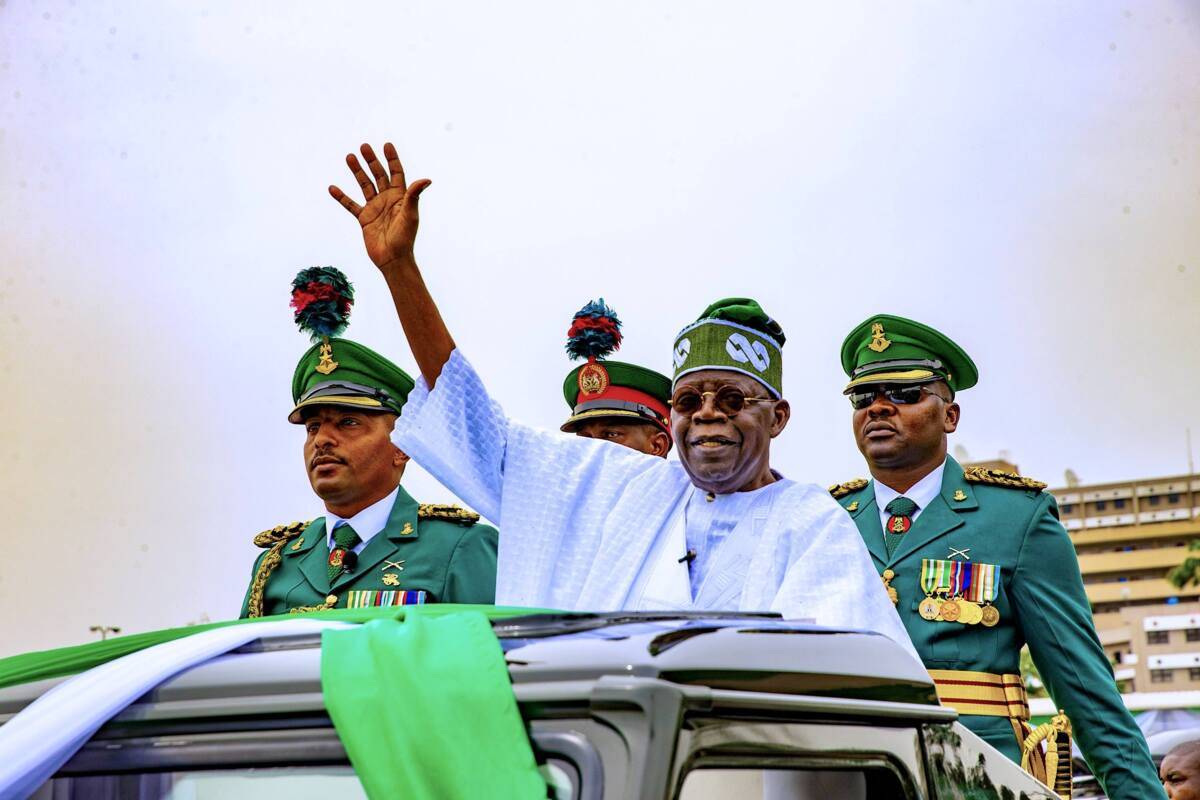
Foregoing disposition is understandable in view of Senate-President Akpabio and Speaker Abass’ hypocritically demeaning ways of conducting themselves as if they are the only ones who supported President Bola Tinubu, GCFR, to the presidential throne. The duo cannot convince anyone that they love the president more than yours sincerely does, but one’s preferences must be decorously pursued without jeopardizing professional/national duties. The apogee of Akpabio/Abass hypocritical eye-service that is certainly devoid of the president’s endorsement was their being recorded wearing Tinubu’s trademark infinity cap to the plenary. This is hypocrisy personified and politics carried too far in the hallowed lawmaking chambers.
Again. What has happened to the doctrine of separation of powers and the principle of checks and balances when the legislative gatekeepers like Akpabio/Abass conduct their legislative duties in such professionally denigrative and insensitive manners? The long-run repercussions of such needlessly insensitive behaviour are their not being trusted by the public, even when they are empirically correct on the taken steps regarding the Electoral bill’s contentious provision.
Akpabio and Abass can be the president’s political confidantes and still be respectable in the discharge of their official duties. This would have been the best approach to really help the president and pursue without outcries, whatever decisions they adopt to help him and which must be in a believable manner as well. If they have done this, it would have been difficult for any reasonable politicians or Nigerians to doubt their empirically correct position on the technological alternatives of real-time transmission of results being inserted into the bill.
Again, the legislative process of law-making/amendments needs a better understanding by the Nigerian public. Despite the fact that some public officials in high positions irresponsibly conduct themselves, we should endeavour to refrain from reading ulterior motives into their sometimes altruistic actions, be it bill amendments or in other spheres/areas. Nigerians need to know that until this bill is harmonized by the two chambers of the National Assembly – the Senate and the House of Representatives – it remains inchoate.
The 1999 Constitution (as amended), in section 47 clearly enunciates the bicameral nature of our federal legislature to wit: “There shall be a National Assembly for the Federation which shall consist of a Senate and a House of Representatives.”
Moving forward, the grundnorm provides that no bill can be passed into law except with the concurrence of both chambers’ designated committees as provided for in its Section 58 highlighting the compelling need for both Houses of the National Assembly to pass any bill before it can be presented to the President for his assent.
Equally, section 58(1) provides: “The power of the National Assembly to make laws shall be exercised by bills passed by both the Senate and the House of Representatives and, except as otherwise provided by this section, assented to by the President.”
After this, the President’s signature is necessary, as stated in Section 58(3), through which he may withhold assent or veto the bill. Despite this, the National Assembly is also constitutionally empowered under section 58(5) of the grundnorm to override such a veto if the President withholds assent and the bill is again passed by each House by a two-thirds majority; “the bill shall become law and the assent of the President shall not be required.”
With the foregoing, agitators need to know that the amendment process is yet-to-be-completed and even far from being over. The aggrieved stakeholders should wait till next week when the Joint National Assembly Conference Committee will be sitting to Harmonise the bills passed by both chambers of the Senate and the House of Representatives. When forwarded to and it eventually becomes law after presidential assent, the opposition and other agitated parties need to change our oftentimes needlessly skeptical attitudes. After all, merely written provisions of any law cannot stop election rigging-only right attitude does. However, the current agitations could be avoided but for the existing distrust between the National Assembly leadership and Nigeria’s enlightened public leading to the virulent views against the contentious provision in the Electoral bill.
The lessons for the National Assembly leadership: Despite being members of the president’s political party, never must they falter in their commitment to the president’s vision but be henceforth seen to be respectable in their conduct of official duties. Finally, they should know that the people’s power is evolving in the politics of this country, and to underestimate it is nothing but a deliberate contemplation of political suicide as politicians.
•Sanusi, former MD/CEO of Lagos State Signage & Advertisement Agency is currently managing partner at AMS RELIABLE SOLICITORS.(sms/whatsapp-07011117777).