

In a story possibly apocryphal, it was said that when a British politician of remote antiquity was informed of the death and immediate interment of his bitterest political adversary, he had yawned and grunted that he hoped it was not another smart career move. Death does not bring charity in gladiatorial politics and neither does it remove bile and bitterness. The greatest tragedy that can befall the political elite of a developing nation is irreversible disunity. If we add disorientation and sheer enervation and exhaustion to the combo, the tragedy can be overwhelming indeed. It has been quite amusing watching members of the Nigerian political class bicker and scuffle so openly about the electronic transmission of results in real time. It is as if they have finally discovered an unanswerable silver bullet to the electoral redemption of the nation. A sure fireproof and yawning path to the presidency has finally opened up.
After publicly claiming that it had passed the bill as it was, the senate, in a bizarre act of self-reversal, claimed that it has given its assent to electronic transmission of results all in a matter of twenty four hours. Yet the devil is in the details. Senate should not give the impression that it is either being remotely guided or that it has succumbed to public pressure. It is not a reputation-burnishing or credibility-boosting development. What has not occurred to all parties concerned is that the biggest elephant in the room which is a lack of fundamental elite unanimity about the political destiny of the nation is relentlessly stalking.
We have been up this route several times before and it always ends in tears and tragedy. This is the fate that befalls all political classes suffering from a lack or loss of institutional memory. It is noteworthy that about the same time, Isa Pantami, the former minister of Communications and a man who should know, has let it be known that within twenty four hours of the opening of its portals for transmission of results in the last election, INEC had suffered over nine million attempts to hack into its server. Surely, some sections of the political class cannot expect their rivals to lie quietly down to be annihilated by the electronic guillotine.
It should be obvious that no section of the elite can muscle its way to electoral dominion over the nation through Artificial Intelligence and high-tech sabotage without inviting grave repercussions for the nation. This is authoritarian fascism buoyed by modern technology. This is not a path to the presidency of a multi-ethnic and multi-religious nation unless it suffers a massive paradigm rupture and revolutionary fissure of the extant order in which case we are on the road to Khartoum or Kinshasa.
Several times in this column, we have had cause to dwell on the issue of memory as it affects political praxis. In human societies, politics takes place under the heavy overhang of recent and remote memory. In the remorselessly transactional politics of the Fourth Republic which the military bequeathed to the nation, cartels are much more important than crowds. Cartels are the ultimate minders and choreographers of crowds. This is part of the subsisting clause of our manumission from military bondage. In their authoritarian mindset, the military believe that elections are too important to be left to the electorate. Until we have enough courage to face the constitutional aporia confronting the nation, all piecemeal protests and crowd eruptions about electronic transmission of election results will come to naught.
The politics of revolving mirrors depends more on appearances and perception than actual reality. It is called impression management. If a particular politician spends all his time at the barricades crowd-hugging, fist-pumping, haranguing and delivering fiery speeches, his public image and perception may solidify as a protest leader and fringe political figure. In conservative cartel politics this display of public indecorum and lack of political judgment and wisdom will block further progress of such a politician. Unless there is a rupture of paradigm, this off message bravura will be diagnosed as a clinical evidence of lack of seriousness and even instability which foreclose any credible path to the highest office in the land.
On the other hand, if a rival political figure manages to stay calm and focused in spite of all provocations, if he continues to forge incredible alliances and keep existing political friendships and associations in a state of constant repairs and by so doing add invincible strength and sinews to the backbone of his organization turning it to an all- conquering political machine in the process, his victory at the polls may have a ring of inevitability to it. This prefabricated possibility is all that the politics of revolving mirrors needs to validate and routinize its subsequent victory. In 1999, General Obasanjo disdainfully declined to appear in a television debate with Olu Falae, his most formidable opponent.
The Owu born warrior knew that in militarized postcolonial nations dominion at the polls is not often televised. Having shrewdly sown up victory through a capillary network of military patrons, civilian satraps and sundry former subordinates, he could afford to sit back and watch the AD/ APP alliance succumb to the PDP juggernaut in its rampaging momentum. Perhaps, we should leave the last words once again to Umaru Shinkafi who, upon noticing that the top military officers with whom he had formed the APP began deserting their post one by one, famously asked one of them: “Oga, is your posting out?”
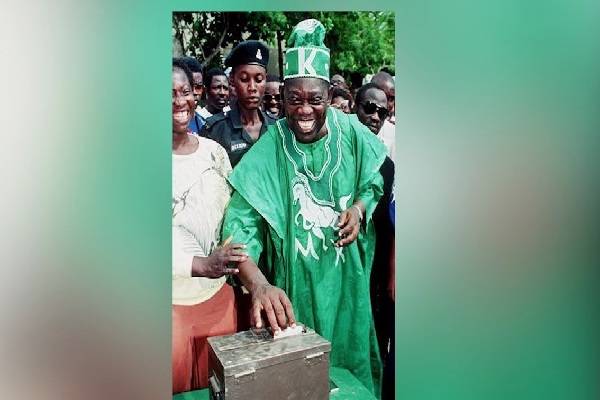
Politics as military posting is perhaps the most acute and most devastating characterization of military subordination of Nigeria and its dire consequences with regards to patterns of leadership recruitment and succession politics. In the case of MKO Abiola in 1993, he knew precisely what to do. Although he had enjoyed quality friendship and fraternity with the highest echelons of the military aristocracy since the advent of General Murtala Mohammed, Abiola was a gifted political manipulator in his own right and master of high-wire politics who could not afford to leave anything to chance. Abiola was a sterling product of empire politics and he knew that cartel politics was empire politics in denial: full of Byzantine intrigues, treachery, cloak and dagger deception and brazen-faced villainy.
Abiola kept his cool and never lost focus, saying all the right things at the right time, busily forging new alliances and traversing the length and breadth of the entire country in search of new friends and converts, oiling the patronage system with his immense personal resources and seemingly inexhaustible munificence. On getting to the home of a prospective supporter, a former warlord, Abiola was so scandalized by the huge pile of rare and expensive caviar straddling the dining table that he quipped privately later: “that is what he wants to do with my money, but Allah dey!”
Not for once was the Gbagura-born plutocrat caught off-guard lampooning the military. Neither was he interested in offering a trenchant critique of military rule. On the contrary, Abiola managed to outgame the games master by sending out feelers to him that he was facing a ruinous electoral debacle. This was said to have warmed the heart of the old fox since this was the outcome he was expecting because it would have made the business of cancelling the election a routine exercise. Abiola was a precocious toddler at the feet of grizzled elders. His bucolic savvy is encapsulated in the time tested wise saying: You must keep the name you are going to give an unborn child close to your heart.
In the event, Abiola romped home to a historic and landmark victory, the like of which has never been seen in the electoral annals of the nation. So comprehensive was Abiola’s victory that he even managed to eviscerate his opponent in his ethnic stronghold. But this is where the contradiction bubbling just below the surface came to the fore with perilous consequences for the nation. Cartel politics is nothing but a byword or shorthand for feudalized democracy.
In feudal politics, blood is thicker than water and consanguinity reigns supreme. The Brahmins of the feudal caste will always prefer one of their own to be in the driving seat rather than an outsider however well comported. If they cannot have their way, then let the country go to blazes. This is the mindset that produced the annulment of the freest and fairest election in the history of the country and it has ominous portents for developments in the current conjuncture. We must leave it at that for now.