
When the Grammy news came, some wondered with reason why we did not honour Fela Anikulapo Kuti before the West did. Few have taken the time to ponder whether Fela would not have turned it down. It is easy to imagine his dramatics of rejection. His rhetoric of contempt. Sneer in his face. The headlines around the world. The abami eda throwing invectives at the West. Spewing out epithets at the imperialist temerity.
Or he might accept it and save the theatre from the stage of the Grammy, half-clad, or showing up in tight trousers and the sartorial iconography of the shrine, his girls of subversion twittering around him. Then he would tell them to keep their neo-colonial bauble. Maybe. Maybe not. A keen possibility.
Is it not the same Fela, who disdained the Pope and Rome in “my people go dey follow pop-u…” or is it not the same Fela, who would not yield his excrement to a doctor in “expensive shit”?
Nor is it new that great men have rejected honours. Here Chinua Achebe rejected a national award. Jean Paul Sartre rejected the Nobel Prize in Literature because he did not want to be turned into an institution. Some had said, though, that he was not happy that rival Albert Camus won it before him. Sinclair Lewis rejected the Pulitzer Prize because it was presumptuous for a coterie of self-inflated judges – not his words – to adjudicate on the best work in a year.
Fela performed in the West, from New York to Berlin, and he was received with awe and applause. He also craved the attention and the filthy lucre. But unlike Sunny Ade, who played his songs to match their rhythm, Fela would not compromise his beats and thrusts. Sunny raised his tempo, which was like corrupting it. If Fela performed in the West, he did not perform for them.
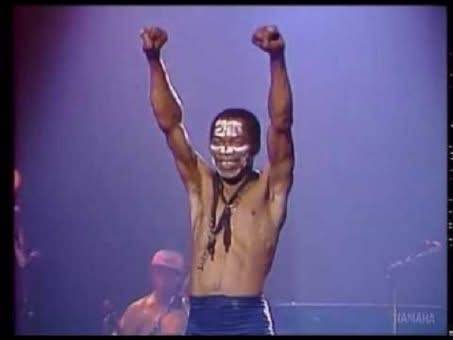
But shall we say it was wrong the Grammy committee gave a post-humous award? Not for this essayist. I would say it is welcome, but they are late to the party. It took them about two decades after his passing for them to do it. When he died at 58, I read a tribute of ambiguous praise in the New York Times. It described him as “a showy, insolent, marijuana-smoking icon, who often made appearances wearing only bikini underwear.”
So Fela knew the West. He did not bow to its culture. The same Times characterized his music as “influenced by James Brown, and fused American funk and jazz with traditional African music.”
Westernized. They colonized their perception of his tropes. Fela turned the Western features into a uniquely African vibe. He did violence to their music by making it African. It is what the West does to African oeuvre. They turn our genius into their own. So they can own it. It is no longer ours. It happens in Literature. In Bound to Violence, Yambo Ouologuem was accused of plagiarism and lifting from Western works. Of course, until Wole Soyinka rescued the Malian writer with the contention that he had to do violence to Western works by lifting them in order to make a point about colonial violence.
The Western street preceded official West in appreciating the Abami eda. We thank them for fidelity. On the opposite end, the Nigerian, nay African, street endorsed Fela but not official Nigeria. Nor did he need them. Prizes do not and ought not validate talent. Some Grammy winners and Nobel Prize laureates are less remembered than some who were not so lucky. It would be nice if we named something for Fela though, like we did with the National Theatre for W.S. It will never be too late for Fela. It might have been for Soyinka if we waited for him to expire from this earth. Fela has all the patience of the dead.
Maybe the Grammy did not come Fela’s way while he lived because he railed against power. He ribbed Obasanjo. They probably did not want to rub the army the wrong way. Fela was also perceived as too original to be an acceptable genius for the Grammy in his lifetime. Fela did not pander. In spite of the New York Times characterization, they had not come to accept the man as worthy of the club. But to be fair to them, they had given it multiple times to Angelique Kidjo perhaps because she is a tamer impresario.
With music, you do not have to understand the lyrics to enjoy it. Nigeria has had quite a few geniuses, including from Fela’s generation like I.K. Dairo, Bobby Benson, Victor Uwaifo, Omokomoko, Dan Maraya Jos, Sunny Ade, Ebenezer Obey, Oliver de Coque, et al. For me, our greatest is Rex Lawson. I do not understand a word of his Calabari or Ijaw. I wonder if the West understands much of Fela’s lyrics and its inventiveness. They embraced him for half of what they grasp. Its beats, its syncopating power. That is enough, though.
For some, Fela was nothing if not political. He graced the jail, rattled the army while entertaining soldiers in their closets. He inspired the radicals. He was no doctrinaire ideologue, no Marxist. He knew enough to bemoan water, lightie, foodu, housee. His was a natural dissent. He was an icon for being an iconoclast. His greatest endowment was fortitude, which led to his creative breadth, his attack on injustice and his impulse to bond with the people.
We must say that some present artistes have lost their power for wanting to ape the West. Some of our musicians today, just as some writers, croon for Western ears. The other day, I heard a Nigerian song occupying the interval of a tennis match in Europe. At the Olympics in Russia, our music was also throbbing the international ear. Yet, the flowering of some of our best today owe their leverage for the works of persons like Fela. Stars like Burna Boy, Davido, Teni, Tems, Wizkid hatched out of his egg. It is funny that Wizkid thinks himself greater than the abami eda. Some humour, maybe he believes it more as an aspiration than a fact. He has time to rise. He must understand that part of Fela’s mystique transcends the stage. He performed in the smoke and blood of social and political activism. Wizkid is as yet too cosy in the studio.
Perhaps it is because of them that the Grammy elite remembered their father and gave him a post-humous nod. Time has liberalised the awards. I watched with gratitude Barack Obama’s tribute to him. Before him, Emmanuel Macron had given him a presidential rostrum, and we may not err if we gave the French President some kudos for helping with the committee’s decision to give him the award.
By the way, few have noted that no cousins won both Grammy and Nobel Prize. An understated feat for a bloodline. A medal for Fela and Soyinka!