
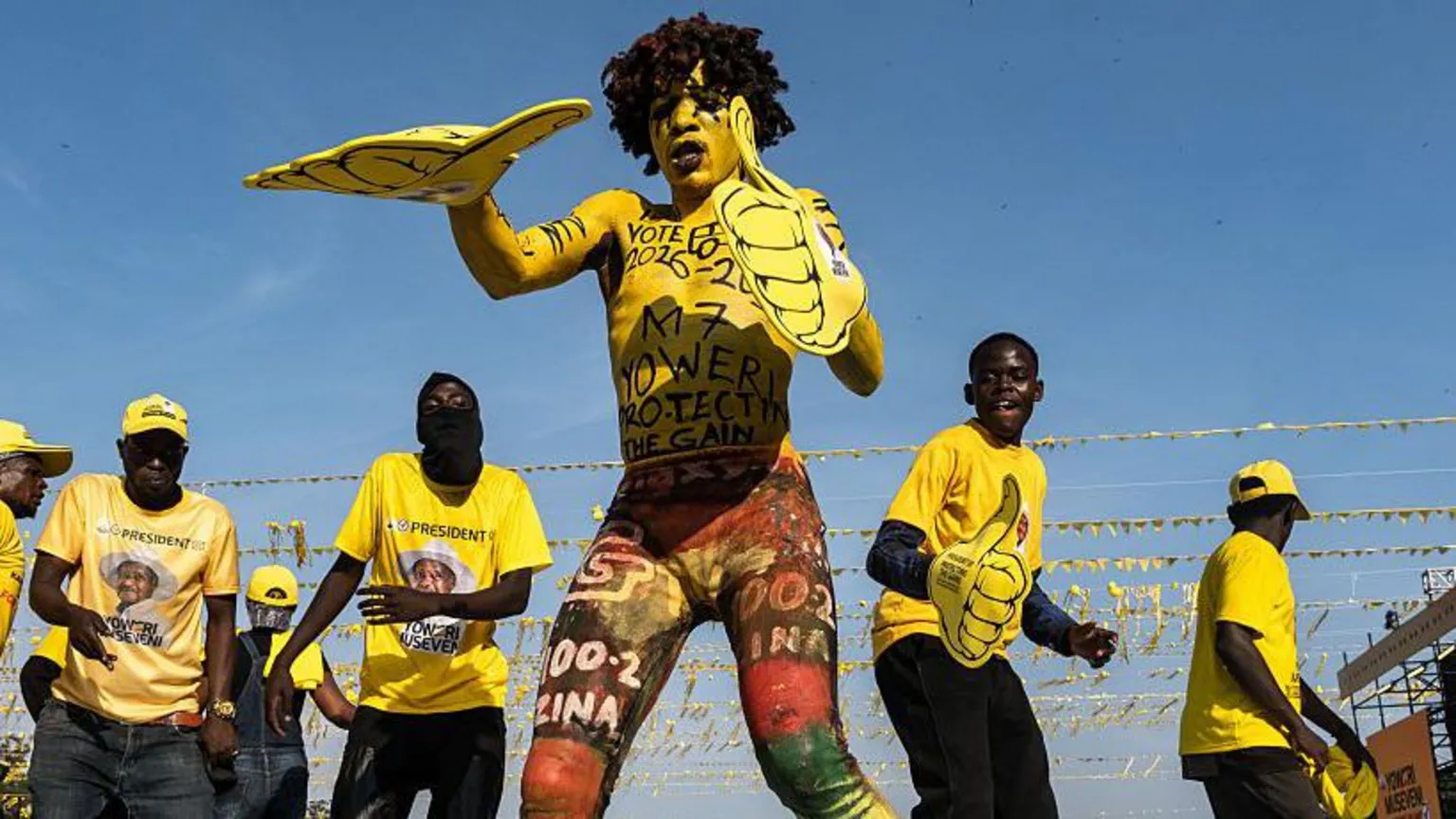

For supporters of Uganda’s President Yoweri Museveni, his resounding victory in the just-concluded election is a vindication of his 40-year-long rule.
He won with 72% of the vote, close to his highest-ever tally of 74% in Uganda’s first direct presidential election in 1996.
It reinforces the 81-year-old’s claim that he still commands the support of the overwhelming majority of Ugandans, after seizing power as a rebel commander in 1986 ending the rule of the Milton Obote regime.
But Museveni’s main election rival – the charismatic former pop star Bobi Wine – dismissed the result as “fake” and said he had gone into hiding following a raid on his home by the security forces.
Museveni campaigned largely on his track-record, arguing that he has delivered political and economic stability in an era of global uncertainty.
He pledged to steer Uganda towards achieving the status of a middle-income country by 2030, a milestone his supporters have framed as a fitting legacy for a man who will finish his seventh – and possibly final – term the following year.
Museveni sees Uganda’s nascent oil industry as a central pillar towards achieving that goal.
On the campaign trail, he repeatedly told voters that once exports commence, the economy would grow at double-digit rates.
Museveni has set October as the target date for the first crude oil exports, via a 1,443 km pipeline to the Indian Ocean port of Tanga in Tanzania.
Despite his age, the president has sought to project vitality and control. At one of his final campaign rallies, he told supporters that he had visited all of Uganda’s more than 140 electoral constituencies.
Yet in early October, his team abruptly cancelled several campaign events, citing unspecified “state duties” – an explanation many found unconvincing, fuelling speculation about the octogenarian’s health.
Subsequent pauses in his schedule only deepened speculation about fatigue and declining health.
For Wine, the result was a massive blow. His share of the vote slumped from 35% in 2021 to 25% this time round, despite Uganda’s overwhelmingly young population – a demographic long viewed as the 43-year-old’s natural base.
From Wine’s perspective, the election was neither credible nor legitimate.
He maintains that the campaign was far from free and fair, pointing to repeated disruptions of his rallies by security forces, including the use of tear gas and live ammunition to intimidate supporters, some of whom were killed.
He also alleged ballot stuffing but has not provided any evidence to back his claims. The authorities have not commented on the claims.
After two unsuccessful presidential bids, questions now hang over his political future.
There is a growing risk that he could follow the path of many opposition figures across Africa – politicians whose popular appeal was steadily eroded by sustained repression, leaving them permanently excluded from power.
During the campaign, Wine embodied the energy and impatience of Uganda’s youth, while Museveni cast himself as the seasoned patriarch, the guarantor of stability.
Ultimately, according to the disputed official results, voters opted for the latter.
Those seeking to understand Uganda’s next chapter have largely focused on the question of presidential succession – when and how Museveni will eventually exit the stage.
“Change in Uganda, especially political change, does not, and almost certainly will not, happen suddenly,” Kasujja says.
“It happens gradually, and that process has been under way for some time.”
Viewed through that lens, the election appears less a moment of transformation than a ritual of the political calendar, one that legitimises deeper, slower shifts taking place within the ruling party, the National Resistance Movement (NRM), and the state machinery that it controls.
These shifts were first noticed during a cabinet reshuffle by Museveni in March 2023, and became unmistakable in the August 2025 elections for the NRM’s top decision-making body, the Central Executive Committee.
Far from being a routine internal contest, the process turned into a high-stakes struggle over positioning in a post-Museveni order.
Marked by factional bargaining and allegations of widespread bribery, the elections revealed a regime increasingly driven by succession politics rather than competition with an opposition that had either been dealt with by the security forces or co-opted.
It provided the clearest indication yet of the growing influence within the ruling party of army chief Gen Muhoozi Kainerugaba – the son of the president and his potential successor.
Veteran figures from the party’s old guard were pushed aside, replaced by newer faces, many without the credentials of having fought in the war that brought Museveni to power 40 years ago, but widely seen as loyal to his son.
According to sources close to the presidency, authority at State House has become increasingly decentralised, with decisions once taken directly by Museveni now channelled through a tight inner circle of relatives and long-time associates.
Museveni’s day-to-day schedule is said to be overseen by his eldest daughter, Natasha Karugire.
Relations with foreign dignitaries and senior military figures are largely managed by his half-brother, Salim Saleh, while trade and economic policy are shaped by his son-in-law, Odrek Rwabwogo, married to Museveni’s second daughter, Patience.
And for the first time in the country’s modern history, all security matters – both internal and external – are overseen by the chief of defence forces, the 51-year-old Gen Kainerugaba.
Given the dominant role that the military has long played in Ugandan politics and the fact that Museveni himself came to power through armed struggle, this concentration of authority in his hands has profound political implications.
It suggests that Uganda’s future is being shaped – and increasingly controlled – by Museveni’s son, even if he does not hold the title of head of state, yet.
BBC