
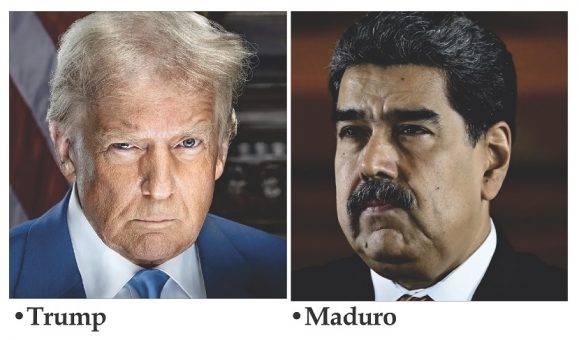

Yesterday was seismically significant as President Donald Trump ordered United States Special Forces nighttime operation to seize Venezuelan president Nicolas Maduro and his wife.
They have been flown to the US to be tried, according to the US attorney general, Pam Bondi, in US courts. Charges had previously been filed against Mr Maduro in the US in 2020. The bombing of Iran last year, the airstrike on Nigeria last Christmas, the abduction of Mr Maduro, and the torrent of threats Mr Trump issued against US traditional allies and foes alike are all indications of the upending of the rules-based global order in favour of a power-based world order. Long after the Peace of Westphalia in the 17th century had established the concept of sovereignty, among other variables, as the foundation of global peace and stability, the world order was nevertheless repeatedly broken at least four times in the past two centuries. Each time the order was broken, war followed. Mr Trump is about rounding up his first year in office; by the time he is through, it is uncertain what would be left of the global order, or how long it would take for the consequences of his disruptions and dictatorship to manifest.
Mr Trump may be picking on small and less powerful nations incapable of retaliating against the US, but by balkanising the world into two camps, pro-US and anti-US, and by first alienating his allies before taking on his enemies, the American president may be setting the stage for his country’s isolation and vulnerability. The US may have the most powerful military in the world at the moment, but until it is truly tested by near equals, no one can say whether the US military is as invincible as Mr Trump has repeatedly boasted. Until Russia took on Ukraine in 2022, few expected that even with external help Kiev could last for as much as it has done, one month shy of four years. Russia has so far failed to expand its sphere of influence, and if peace is finally brokered, it will have gained only a little territory at the cost of over 300,000 men. China is not content to maintain its huge and expanding zone of economic influence. If it makes a bid for Taiwan, there are no indications it would not be a very costly misadventure.
The Saturday morning attack on the Venezuelan capital, Caracas, lasted barely 30 minutes before the country’s leadership was decapitated. No one is sure whether the US would make no other move, as Secretary of State Marco Rubio promised, or whether the ease with which the abduction took place would tempt Mr Trump into something more far-reaching and catastrophic. However, the attack followed months of sabre rattling as the American president baited President Maduro, and weeks of gunboat diplomacy that effectively shut-in an already distressed Venezuela in a crippling economic blockade. Back in 2020, in the Southern District of New York, Mr Maduro had been indicted in a US federal court on charges that included narco-terrorism and possession of weapons against the US. Additional charges might now be included in a fresh indictment. Like Panama’s Manuel Noriega who was also seized exactly 35 years ago during the presidency of George H. Bush, it is clear that no one can save Mr Maduro: he will face the charges, and he will get a guilty verdict, for the US had expended so much resources in abducting him.
But the unlawful arrest and trial of Mr Maduro is the smallest of the world’s headaches. Since the advent of President Trump, and for the past one year, the United Nations (UN) has been shunted aside, forced to reenact the dying throes of the League of Nations, its voice reduced to little more than whispers. And when it manages to speak loudly, it sermonises. It will get worse in the months and years ahead. The US under Mr Trump has forsaken soft power in favour of brute force.
Unopposed, its enemies and friends alike cowering before it, the sole surviving superpower will flaunt its wealth and throw its power in everyone’s face. It may in the short term limit himself to taking on less powerful and non-nuclear countries, but ultimately it will look for formidable opponents. President Trump has no sense of history, nor even studied history, and has paid little attention to the principles that undergird the rules-based order he is dismantling. So his instincts, short attention span, and what a psychologist called his malignant narcissism, will conjure the deadly spasms the world must experience in the years ahead.
But overall, Mr Trump is a historical accident. Men like him have ruled empires, destroyed empires, and reshaped the world in ways neither they nor their successors, nor the rest of the region which they dominated, anticipated. For instance, the Assyrian Empire which peaked between 10th to 7th centuries BCE under rulers like Assurmasirpal II, Tiglath-Pilesar III, Sennacherib, Esarhaddon, and Ashurbanipal may have collapsed as a direct consequence of a 60-year megadrought experienced in the 6th century BCE, but it took only three months for Babylon to overrun it and sack Nineveh, the capital, because the empire had become weakened by a combination of many factors. Take a roll call of powerful empires and kingdoms, and observe the eerie parallel with Mr Trump’s shallow understanding of power, regional and global dynamics, and the internal factors that conduce to or corrode state power. It will be evident that the empires of the Romans, Mongols, Babylonians, Chaldeans, Persians, and the Greeks tell cautionary tales. But it takes a leader schooled in the art and dynamics of power to safeguard an empire. Mr Trump is not adept or schooled. It is a matter of time before the world and circumstances take on the might of the US.
Most condemnations of the abduction of Mr Maduro will be tame, for the prevailing unipolar world cannot withstand Mr Trump’s destructive projection of power. Nigeria was fortunate to get away with a face-saving joint attack on terrorists targets in the Tangaza forests of Sokoto State last Christmas. Had the US decided to go it alone, Nigeria would have been powerless to raise a finger. Even the Nigerian promoters of religious hegemony and ethnic exceptionalism as well as sponsors of terrorism had suddenly become deathly quiet. Had Nigeria united behind its leaders and managed its differences well, no outsider could attack. Had Venezuela united behind its controversial and flawed leader, the US would have thought twice before embarking on the crude and insane colonial exploitation it has embarked upon.
In the end, the ultimate consequence of the demolition of a rules-based global order is the rekindling of global arms race. Small and medium level countries will from now onwards strive to develop weapons capable of projecting power on such a scale that even the big powers would think twice about meddling in their affairs. North Korea did it, and has been left alone. Iran needed brilliant and circumspect leaders to do it, but it made a lot of noise, threatened genocide against Israel, and showed itself to be a regional nuisance. It will need time and perhaps change in leadership and ideology to be able to achieve military self-sufficiency and political latitude. Other ambitious countries will quietly take the lessons of history made possible in real time by the US to rearm. In the end, like every era when the world order was undermined, war will be inevitable.