
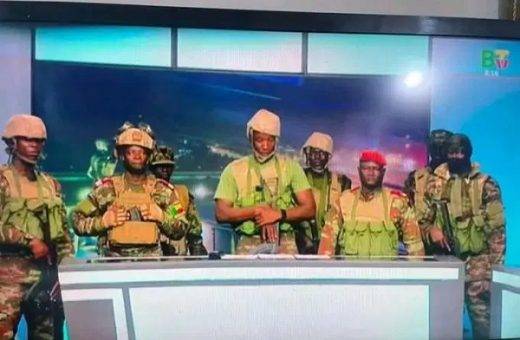

In the last week, there was a failed coup d’état in the Republic of Benin after the success of a coup in Guinea Bissau. The military governments in Mali, Burkina Faso, and Niger are sitting tight at different levels of instability while the military regime in Guinea (Conakry) appears to be on its way out. The regime in Mali, despite its blind walking into a marriage with Russia, is daily challenged by various ethnic fissiparous tendencies in the wretched Sahelian dessert country that appears doomed to instability for the foreseeable future. Our neighbour Niger will eventually come to its senses and come back crawling to Nigeria if we stand on our democratic course. Burkina Faso, as far as I am concerned, is a basket case despite the exaggerated claims of the propagandists hired by its government of manufacturing air planes, going to space and other absurd performances by its president and government.
I know this desert country and when I see how the world is being fooled, I laugh. The success of this propaganda can be seen in the recent inaugural speech of Madame Netumbo Nandi-Ndaitwah, president of Namibia who claimed that her country would follow the glorious example of the president of Burkina Faso!
Eventually, Africa will wake up from the dream world of the paradise of the confederation of Sahelian States. This Burkina Faso is keeping a Hercules’ C130 plane belonging to Nigeria which landed in its territory because of bad weather and issuing inflammatory statement about guarding its air space. The Federal Government of Nigeria should issue a stiff statement saying what happened and demanding the release of its plane using countries like Senegal, Guinea and even Niger as conduits for our diplomatic intervention.
What seems to be happening in the region is a challenge to Nigeria’s security and we must rise quickly to the occasion by cranking up our diplomatic feelers to deal with all these irritants. Our government must use as agents, Nigerians knowledgeable about the affairs of these countries.
I am surprised that we have not worked on bringing back to our embrace the Republique of Niger. This should have been a priority of this government. We must never allow any hostile governments surrounding us. We have ties of consanguinity with our neighbours; we must always exploit this for our benefit. We should always post as heads of missions to these countries, people who can talk to those in power in African languages rather than inherited colonial languages with key players in power politics of these countries. For example, a Yoruba speaker should be sent to Benin, Hausa speaker to Niger, Kanuri speaker to Chad, Fulfulde or Hausa speaker to the Cameroon and an Igbo or Ibibio- Efik speaker to Equatorial Guinea.
I remember General Ike Nwachukwu as foreign minister discussing with the foreign minister of Benin when the two of them found out they could do without English/French interpreters in 1988 when dealing with the issue of toxic wastes dumping in our waters by Italian shippers.
The situation which deteriorates to military coups and putsches in most cases in these West African countries is economic. In the particular cases of Chad and Benin, the two countries from their exit from dependence on France had serious problems of unviability. Chad throughout its history was ruled by the French military. Benin on the other hand provided junior civil servants for the French administration of West Africa (L’Afrique Occidentale Francaise — L’AOF). Of course when the French granted independence to the separate countries, Benin inherited too many civil servants which the economy of the country could not support. The unemployment consequently caused instability in the country. After independence, Benin cities regularly witnessed placards emblazoned on roads saying “Larmee au pouvoir (army takes power). In the past, Nigeria tried to help by joint development of cement production in Onigbolo and sugar production in Save. Unfortunately the ventures failed while the attempt to privatise them did not succeed. The economy of the country depends on trans-shipping of imports bound for Nigeria through the port of Cotonou. This was also unviable because of changing policies in Nigeria on smuggling. Smuggling is such a big deal in the country which exports cocoa grown in Nigeria as its main produce.
The solution to all these economic problems is integration of the West African economy with Ghana, Côte d’Ivoire and Nigeria bearing the economic burdens as Germany seems to do in the European Union albeit with complaints and grumbling.
The recent abortive coup d’état failed because Nigeria answered the call of “safe our souls” by the remnants of the democratic government that was about to be kicked out. But for how long can Nigeria sustain the government of Benin while its own economy is not the best it can be and the current state of ECOWAS makes it difficult for it to do anything for the serious economic problems of Guinea Bissau and Benin?
West Africa will remain in a prostrate and pathetic position until Nigeria takes the challenge of co-prosperity of itself and its immediate neighbours more seriously. In the meantime, Nigeria has to provide a grant or loan secured by Benin-Nigerian production of the oil found in the Benin waters. Nigeria also must press Benin to privatize the sugar production in Save (Sabe) and Cement industry in Onigbolo. If possible, the Dangote group should be encouraged to make a distress bid for the two factories. The political future of Benin should be negotiated because as it stands today, the economy of Benin will continue to be in dire strait and a drag on the economy of Nigeria which currently provides a safety net for Benin’s galloping population and its hopelessly resourced economy.