

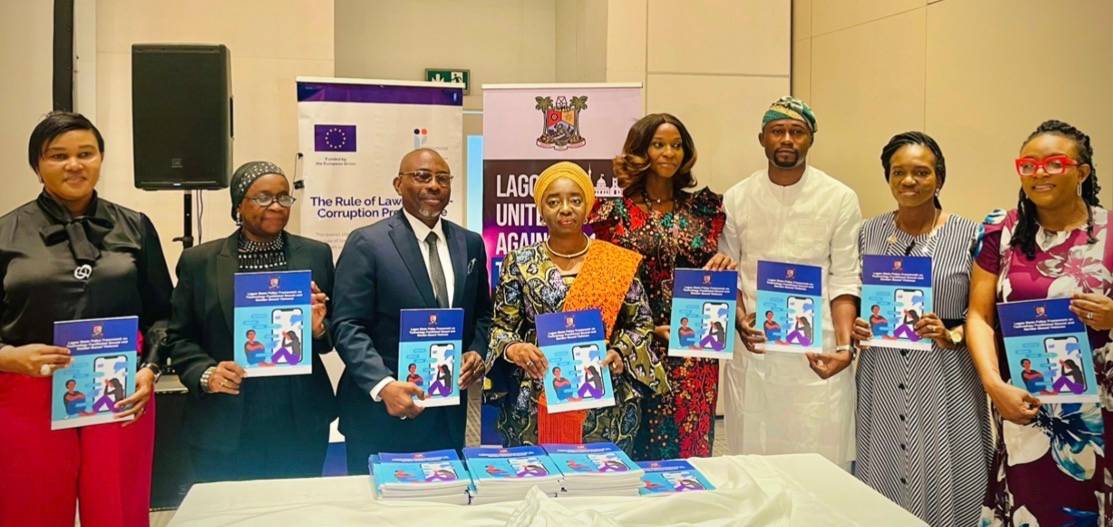
The Lagos government on Wednesday formally unveiled a comprehensive policy framework designed to prevent and respond to technology-facilitated sexual and gender-based violence.
Officials said the new framework reflects Lagos’s evolving efforts to confront digital threats that increasingly shape patterns of abuse, intimidation and exploitation on online platforms.
A technical working group was also inaugurated to coordinate implementation and ensure the policy delivers sustained institutional impact across government and civil society partners.
Speaking at the ceremony, Lagos first lady Ibijoke Sanwo-Olu said digital expansion had introduced “new, complex avenues for abuse which require urgent and structured intervention”.
She explained that social media and other digital tools had enabled wider patterns of exploitation, identity misuse and online manipulation that disproportionately affect vulnerable groups.
Mrs Sanwo-Olu commended the Domestic and Sexual Violence Agency for recognising the urgency of addressing technology-facilitated abuse, describing the phenomenon as “real, evolving and deeply harmful to women, children and marginalised persons”. She said the policy’s unveiling aligned with activities marking the global 16 Days of Activism, during which she visited several facilities directly supporting survivors.
The governor’s wife noted that facilities in Majidun, Igbogbo, Ebutte, Ikorodu, and Alakara highlighted the ongoing challenges faced by survivors seeking justice and protection.
Mrs Sanwo-Olu said the visits reinforced the need for a more coordinated and survivor-centred approach that supports victims in both physical communities and digital environments. She stressed that gender-based violence remained one of the world’s most pervasive human rights violations, requiring collective responsibility and sustained government leadership.
Mrs Sanwo-Olu urged joint action among government agencies, technology companies, civil society groups and individuals to confront technology-enabled abuse. She said the policy framework provided clear guidelines for law enforcement, regulators and digital platforms to prevent online violations and provide timely remedies for survivors.
She encouraged the Technical Working Group to demonstrate passion, urgency and professionalism while driving the policy’s implementation across relevant institutions.
“As mother of Lagos, I reiterate my support for initiatives committed to eliminating SGBV in all its forms,” the governor’s wife said.
She added that Lagos aimed to build a society where survivors can access justice without fear, communities can challenge harmful norms, and digital technologies are deployed responsibly.
Delivering the welcome address, DSVA executive secretary, Titilola Vivour-Adeniyi, described the unveiling as a landmark step in confronting emerging digital threats. She said the policy strengthened Lagos’s capacity to detect, analyse and respond to new patterns of online abuse that increasingly mirror offline violations.
Ms Vivour-Adeniyi highlighted risks such as cyberstalking, online grooming, digital extortion and non-consensual image sharing, describing them as “persistent and damaging forms of online violence”. She said unveiling the policy on Human Rights Day reaffirmed Lagos’s commitment to safeguarding the digital dignity, safety and well-being of all residents.
According to her, the policy establishes unified procedures for preventing, reporting, investigating and responding to technology-facilitated sexual and gender-based violence.
Ms Vivour-Adeniyi added that the framework would deepen public awareness of digital rights, reporting channels, safety practices and available support services across the state.
(NAN)