

Seek ye first the kingdom of a new constitution for Nigeria and every other thing – prosperity, stability, security, electoral rectitude, moral integrity, etc – that have largely eluded the country since independence will be added to her an influential school of thought appears to believe. For instance, the eminent pressure group known as The Patriots, when they paid a courtesy call on President Bola Tinubu at the Presidential Villa, Abuja, in August last year, made the demand for a new constitution the fulcrum of their essentially two-point demand. Led by former Secretary-General of the Commonwealth, Chief Emeka Anyaoku, the group is made up of experienced statesmen and respected elders, including former governors and other ex-public office holders, distinguished professionals and accomplished leaders whose views are no doubt deserving of respect.
Speaking on behalf of The Patriots at the meeting with the President, Chief Anyaoku appealed to him to send an executive bill to the National Assembly to convene a national constituent Assembly with the mandate to produce a draft people’s democratic constitution for the country. The group advocated that the proposed Constituent Assembly should comprise individuals elected on a non-party basis from the 36 states and the Federal Capital Territory. They also proposed that the Constituent Assembly should be supported by seven constitutional lawyers representing the six geopolitical zones and the FCT and that its deliberations “should take into account the 1960/1963 constitutions as well as the recommendations of the 2014 National Conference and indeed of the various national conferences that considered the Nigerian constitutions.”
Continuing, the group advised that “The draft constitution, produced by the constituent Assembly should be put to a national referendum and, if approved, should then be signed by the President as the genuine Nigerian people’s constitution”. Insinuated subtly in this proposal is the belief that the current 1999 Constitution (as amended) is a fake document but The Patriots do not proffer any logical or empirical reasons for arriving at this conclusion. Although President Tinubu did not necessarily disagree with the proposals of his distinguished visitors, he hinted that his major preoccupation for now was to see through his administration’s ongoing economic reforms, after which the suggestions of The Patriots would be reviewed and carefully considered.
However, the group of eminent persons has obviously not given up on its demand for a new constitution as the cure-all panacea for the country’s socio-political and economic maladies. Towards this end, the group plans to meet with the leadership of the National Assembly to further push its agenda for far-reaching constitutional reforms. Speaking at an event marking the 20th memorial anniversary of their founding Chairman, Chief FRA Williams in Lagos, the group’s General Secretary, Mr Olawale Okuniyi, reiterated The Patriot’s commitment to constitutional reforms stressing that their meeting with the National Assembly would focus on amending Sections 8 and 9 of the 1999 Constitution to allow for a referendum to enable Nigerians to directly influence constitutional changes.
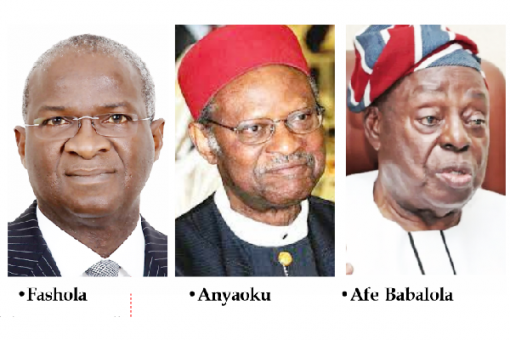
According to Okuniyi, “The 1999 Constitution is fundamentally flawed and structured in a way that benefits only a small elite while enabling corruption. We are calling on President Tinubu to convene a Constituent Assembly where Nigerians can negotiate a new governance framework that works for everyone”. Incidentally, The Patriots have the support of many eminent senior lawyers in their campaign for a new constitution. For instance, when he received a group, the Prestigious Sisters League at the Afe Babalola University, Ado Ekiti, campus last year, the founder of the university and respected Senior lawyer, Chief Afe Babalola, unequivocally threw his weight behind the demand of the Patriots.
In the words of Chief Babalola on that occasion, “I read the publication of The Patriots visiting President Tinubu, and I am in full agreement with them. We need a new constitution. But I do not agree that we should go through any constitutional conference. Recently, you are aware that President Bola Tinubu asked us to go back to the old National Anthem; there was no conference for it before it was passed by the National Assembly and assented by the President. The 1963 constitution was the one made by all of us. By the same token, the parliament should bring back the 1963 constitution and reenact it”. This is an incredible view from a SAN of Chief Babalola ‘s pedigree. He spoke seemingly ex-cathedra and apparently saw no reason to justify through rational arguments his advocacy for a return to the 1963 Constitution under which the First Republic collapsed catastrophically, and the country drifted to a tragic civil war.
Unfortunately, another esteemed SAN, Chief Wole Olanipekun, did no better when he delivered the 32nd and 33rd convocation lecture of the Olabisi Onabanjo University in February last year. Describing the 1999 Constitution as fake, Chief Olanipekun told his audience, including impressionable youths that “We need a constitution with a humane face. I’m a lawyer, but we are deceiving ourselves; our constitution is fake, and I have said this over and over, but then you will ask us, lawyers, ‘If we say the Constitution is fake, why are we practising it?’ Lawyers and judges apply the law as it is, not the law as it ought to be, so we apply the law as we have it now and we have been pleading that we should amend the constitution, let us overhaul it’. But Chief Olanipekun did not believe that he owed the public, given his legal expertise, the benefit of his rigorously articulated position on what he thinks a ‘genuine’ constitution should contain and why he describes the 1999 Constitution as fake.
The casual and rather cavalier manner in which these revered lawyers approach the very critical issue of an appropriate constitution for Nigeria is a far cry from the seriousness with which Obafemi Awolowo undertook the same task. Awolowo seized the opportunity of his incarceration at the Calabar Prisons to undertake extensive research into the constitutions of most countries in the world at the time based on which he formulated rigorous, near-scientific principles to guide the formulation of an appropriate constitution for Nigeria. Among the principles he arrived at in this respect include that (1) If a country is unilingual and uni-national, the constitution must be unitary (2) If a country is bilingual or multilingual, the constitution must be federal, and the constituent states must be organized on a linguistic basis (3) Any experiment with a unitary constitution in a bilingual or multilingual or multinational country must fail, in the long run. He articulated his political ideas on constitution making as well as Socio-economic policy in such books as ‘Thoughts on the Nigerian Constitution’, ‘The People’s Republic’ and ‘Strategy and Tactics of the People’s Republic of Nigeria’.
Chief Anyaoku talks so casually about the present Constitution breeding corruption but perhaps forgets that humongous corruption was a behavioural pattern of our political elite right from the First Republic. Indeed, the corruption of the political class in that period featured prominently in major Kaduna Nzeogwu’s coup speech in 1966 as one of the reasons for the military intervention that sacked the First Republic. In his seminal work on the failure of Nigeria’s First Republic, Professor Larry Diamond wrote that “Each ruling party set about in the early 1950s to use the lever of state power – the control over patronage, coercion and chieftaincy in particular -:to consolidate its political base and to suppress those elements that resisted consolidation…Rank favouritism in the award of loans, contracts, bank credits, positions on public boards and corporations and licenses to trade commodity crops gave rise in each region to a ‘privileged group’ of entrepreneurs who came sudden and fantastic success and who, in return, were expected to contribute substantially to party funds, use their wealth and influence to mobilize support for their parties in their various localities, and maintain unflinching loyalty to party leadership”.
Indeed, the flaws and ills of the 1960/1963 constitution informed the change from the parliamentary to the presidential constitution of the Second Republic and even then the rampant corruption, intemperate politics, blatant election rigging, promiscuous vagrancy of politicians from one party to the other that resulted in the collapse of the First Republic led to the breakdown of democracy once again with the coup of 1983. Another respected Senior Advocate in the person of Mr Babatunde Fashola, former Lagos State governor and Minister of Works, in my view, summarizes the crux of the matter succinctly and poignantly in his book, ‘Nigerian Public Discourse -‘The Interplay of Empirical Evidence and Hyperbole’.
According to Fashola, “My summation is that “Nigerians want a better life, not a better document”. The conviction that the Constitution serves as a universal remedy, a magic bullet with the capacity to address all our tribulations, perhaps warrants a re-evaluation. Proponents of the perspective that our political architecture is the principal barrier to our progress may indeed possess a legitimate argument. However, l advocate that their contentions necessitate less rhetorical flourish and more exactitude”.
Fashola continues, “Interestingly, while an impressive number of commentators and agitators for constitutional change endorse the 1979 Constitution, they disown the 1999 Constitution in many aspects such as to assert that it lied about its source and that it was written by the military. However, they continually forget that the 1976 Constituent Assembly leading to the 1999 Constitution and Justice Niki Tobi’s constitution debating and coordinating committee share one thing in common – they were both inaugurated by Military Heads of state. As I acknowledged earlier, there may be the need to further amend part of the Constitution, and indeed – the amendment was made in 2023, but those who seek those amendments must move away from wholesale condemnation and recommend specific amendments that they seek”. I concur.