

By Segun Ayobolu
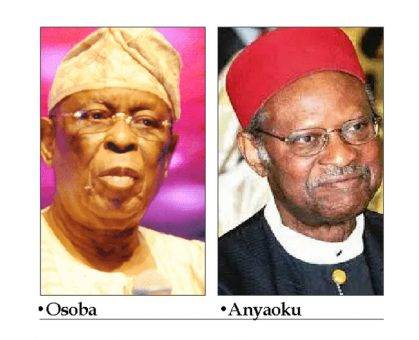
Seek ye first the kingdom of a new constitution and everything else will be added unto you. There are not an insubstantial number of Nigerians who hold this view and blame the 1999 Constitution (as amended) as the root cause of the multidimensional crises confronting the country today. This position was again recently canvassed by a group of eminent elder statesmen known as ‘The Patriots’ during a courtesy call on President Bola Tinubu at the Presidential Villa in Abuja. Led by former Secretary General of the Commonwealth, Chief Emeka Anyaoku, members of the association are widely held in high esteem, their voices weighty and difficult to ignore.
Their main grouse against the 1999 Constitution is that it does not emanate from the people as proclaimed in its preamble that it is the product of ‘We the people’. It is on this largely semantic basis that The Patriots and several other individuals and groups have called for the conceptualization and actualization of a new constitution for the country. They recommend the convocation of a Constituent Assembly to be elected on non-party basis to draw up the constitution which will then be ratified to become law through a national referendum. But how do they expect the legislators to commit political suicide by agreeing with this kind of proposal.
But the current electoral districts across 36 states and 773 local governments which The Patriots want to be the basis for the election into the proposed Constituent Assembly are themselves, ironically, largely creations of military rule. The point here is that we cannot completely extricate ourselves from the influence of our historical trajectory which cannot exclude the periods of military rule and some of its institutional legacies.
What do we say to the contention that the military imposed the 1999 Constitution on the Nigerian people thus insinuating that the document is denuded of legitimacy, perhaps even of legality? This position is historically implausible. Those who canvass such views insinuate that some committee of soldiers simply sat down somewhere and conjured up the 1999 Constitution out of their vivid imagination. Nothing can be further from the truth. In reality, the 1999 Constitution is rooted firmly in the 1979 presidential Constitution.
Given the short timeframe it had set itself to hold new elections and hand over power to an elected government by 1999, the General Abubakar Adussalam regime had no luxury of time to seek to draw up a new constitution. Meanwhile, the 1989 Constitution drawn up under the military President, Ibrahim Babangida regime had its integrity incurably tainted especially with the collapse of that government. What the Abdussalam regime did was to go back to the 1979 Constitution which had guided state, governance and society in Nigeria’s Second Republic (1979-1983). And it is the 1979 Constitution that has been adopted as the 1999 Constitution under which the country is governed today.
But what about the 1979 Constitution? Was it an imposition of the military? True, it was drawn up during the Murtala /Obasanjo military government. Yet, the military government of the time was all too conscious of its deficiencies in the sphere of constitution-making. It thus set up the Constitution Drafting Committee (CDC) made up of 50 members under the Chairmanship of renowned lawyer, Chief Rotimi Williams. Chief Obafemi Awolowo declined to serve on the CDC but those on the Committee constituted some of the best and brightest from the legal profession, academia, administration and business. The main criticism of the committee was that it was made up entirely of men and also had no representatives of students or workers. But this did not detract from the quality of its work.
After the CDC had submitted its report to the Federal government, elections were held on 31 August, 1977, through the then newly reorganized local governments acting as electoral colleges. The election chose members of the Constituent Assembly who debated the principles of the draft constitution and forwarded their recommendations to the Supreme Military Council.
Although the SMC made a number of alterations to the final document, these were not substantial enough to affect the integrity of the final document promulgated into law. In any case, the incoming civilian administration was at liberty to utilize modalities provided for in the same constitution to affect any constitutional Changes it desired after the exit of the military in October 1979. It is my view that lamentations regarding the military sources of the 1999 Constitution are grossly exaggerated and attributing all the challenges we confront to the constitution is unhelpful and unproductive.
We will recall that in the First Republic, the country ran a parliamentary system of government and had a strong federal constitution which enabled the then existing regional governments to enjoy a considerable degree of fiscal autonomy from the centre. And the 1960 presidential constitution was arrived at after a series of negotiating conferences by the nationalist leaders both in the country and in the United Kingdom between 1950 and 1957. But under the much romanticized 1960 constitution, the country witnessed a fierce and unrestrained quest for power by the political elite, massive corruption, blatant rigging of elections, and rabid ethnicity. Within six years, the country had witnessed two bloody coups and ultimately descended into a tragic civil war.
It was these ills associated with the 1960 Constitution that informed our change from the parliamentary to the presidential system of government in the second and now the fourth republic. It was believed, for instance, that since the President would be elected from the whole nation as his constituency, the office would be a powerful symbol and magnet for national unity and cohesion. Unfortunately, the same reasons that led to the collapse of the first republic reared their heads again dooming democratic governance in 1983. There is no guarantee that even if we craft a brand new constitution today, there will be any change in the negative behavior of both the political elite and masses that has over the years bred political decay rather than promote sustainable democratic structure.