
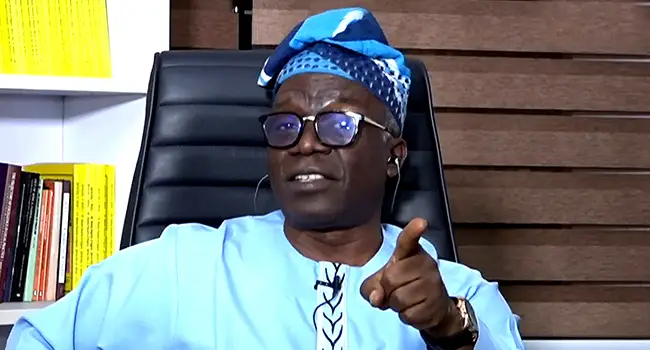

Legal luminary and senior advocate of Nigeria, Femi Falana, has provided valuable legal insights into the proposed National Minimum Wage Act, addressing concerns raised by some state governors and lawyers.
Theliberationnews reports that in a well-spelt-out analysis, Falana explained that it is in line with the principles of federalism for the federal government to prescribe a uniform national minimum wage for workers across the country.
He referenced Item 34 of the Exclusive Legislative List, which empowers the National Assembly to “prescribe a national minimum wage for the Federation or any part thereof.”
The legal juggernaut noted that Nigeria has ratified international conventions that mandate the fixing of minimum wages to protect workers’ welfare and promote social justice. He argued that state legislatures lack the constitutional power to set minimum wages for public service workers within their states.
He pointed out that the National Assembly has previously enacted four National Minimum Wage Acts between 1981 and 2019 to reflect changing living conditions in the country. He stated that the proposed new minimum wage will be an agreement reached by a tripartite committee comprising the government (all tiers), organized private employers, and labor centers, including state governors.
Falana cited relevant court cases affirming that once enacted, the National Minimum Wage Act will be binding on all employers, except those explicitly exempted. He argued that while state governments and private employers can pay above the minimum wage, they cannot pay below the stipulated amount.
Addressing concerns from governors, Falana explained that the aim of the Minimum Wage Act is to bridge the gap between the wages of lowly paid workers and top public officers. He suggested that governors cut down on waste and confront official corruption to fund the new minimum wage, rather than assuming it will lead to a general salary review across all levels.