
By Segun Ayobolu
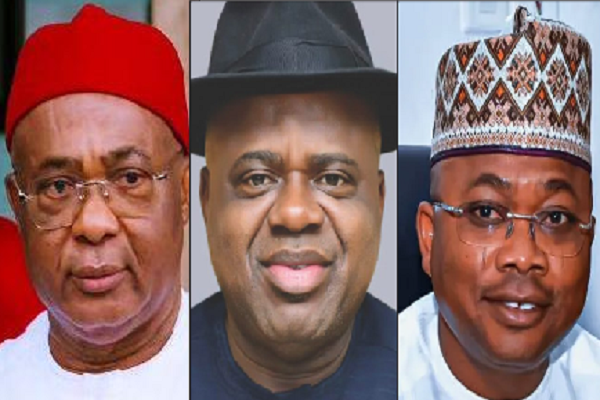
Just as was the case with the 25th February presidential election and the March 18th governorship elections, losers in the off-cycle elections in Bayelsa, Imo, and Kogi states, which held last Saturday, November 11, across party lines have roundly rejected the outcome of the polls accusing the Independent National Electoral Commission (INEC) of brazenly rigging the exercise in collusion with those who emerged winners. It is significant that the parties in control of the governments in the three states emerged victorious in their respective spheres of control indicating that the power of incumbency, though no longer an overwhelming factor in determining electoral loss or victory, remains a critical variable with enormous influence on the outcome of elections.
Equally noteworthy is the fact that just as it was with the general elections held earlier in the year, parties and candidates applauded the INEC and the security agencies where they won while condemning these entities as biased and compromised where they lost. It is thus obvious that the only condition for parties and their candidates to accept and affirm the integrity and credibility of INEC and other stakeholders in the election management process is if they are triumphant.
In congratulating the Bayelsa State governor, Mr Duoye Diri, on his re-election for a second term, a victory which he said was “against all odds” despite the governor’s emphatic win, the PDP presidential candidate in the 2023 polls, Alhaji Atiku Abubakar, was indirectly admitting that the electoral umpire conducted an exercise which reflected the will of the electorate in the state. Yet, the Waziri Adamawa was vehemently critical of the conduct of the elections in Imo and Kogi states where the APC candidates won and his party lost and, once again, chided INEC for allegedly conducting “the worst-ever general election in the country” on February 25. The APC candidate in Bayelsa, Mr Timipre Silva, a former governor of the state, who scored 110,000 votes to Governor Diri’s winning 175,000 votes has rejected the results alleging that the electoral and security agencies manipulated the exercise in favour of the governor.
Even though Atiku continues to blame election rigging and the complicity of an allegedly compromised INEC for his dismal performance in the last presidential election as well as the PDP’s desultory electoral outings post-2015, the veteran presidential contender appears to have put his hands on the most critical reason for the APC’s triumph over the opposition in recent elections despite the ruling party’s less than stellar record of developmental performance in the last eight years. Receiving the executive committee of the Inter-Party Advisory Committee Nigeria, which paid him a courtesy call, he advocated the merger of opposition political parties to present a formidable front against the ruling party in future elections.
Accusing the APC of deliberately trying to foist a one-party dictatorship on the country, he said, “If we don’t come together to challenge what the ruling party is trying to create, our democracy will suffer for it, and the consequences of it will affect generations yet unborn.” Atiku is probably gradually realizing that the PDP and not INEC gifted the APC victory in the February 25 presidential election by fragmenting into PDP, LP, and NNPP while also having the Nyesom Wike-led G5 governors as an opposition within the party going into the election.
The constellation of forces that have unceasingly sought to delegitimize the February 25 presidential election as well as destroy the institutional integrity of INEC as well as the personal credibility of its Chairman, Professor Yakub Mahmoud, have intensified their efforts after last Saturday’s off-cycle polls. A number of Civil Society Organizations (CSOs) addressed news conferences vehemently denouncing the conduct and outcome of the polls, particularly in Imo and Kogi. While they alleged massive rigging of the elections in the two states, these groups did not suggest who they thought were the genuine winners of the elections there.
What is becoming more and more apparent is that many CSOs including election observer groups have become aligned with political parties and pursue partisan agendas in the guise of patriotic altruism. Rufai Oseni, the incurably cynical Arise TV program anchor, this week joined in the generalized condemnation of the polls, excoriating the INEC and asserting with characteristic magisterial ignorance that, after 2015, the conduct of elections in the country has regressed to the utterly despicable elections of the early 2000s. Nothing could be more untrue.
Let’s take the Kogi governorship poll for instance. The major candidates, Ahmed Usman-Ododo of the APC, Murtala Ajaka of the SDP and Dino Melaye of the PDP scored 446,237; 259,052, and 46,362 votes respectively. Could Ododo’s victory be attributed to a massive rigging of the election as alleged by the opposition or are there other factors that can credibly explain the pattern of the voting in the election? In the first place, did APC deserve victory in the poll on the basis of the performance of the outgoing Yahaya Bello administration? I don’t think so.
Bello’s propaganda far outweighed the actual record of achievement of his administration. Against the background of the abundant natural resources of the state, her strategic geographical location, and the immense potential of its population, the Yahaya Bello administration was as lacking in vision and competence as its predecessors. But the election was not necessarily about governmental performance or development as about the political dynamics of its ethnic component parts.
Both Ododo and Ajaka won emphatic victories in their respective ethnic redoubts, the Igbira and Igala in Kogi Central and Kogi East Senatorial districts respectively but Melaye performed desultorily in his native Okun land in Kogi West Senatorial district. Apart from winning massively in Kogi Central Senatorial district, Ododo’s victory was substantial because of his no less impressive performance in Kogi West where he won in Mopa, Ijumu, Kabba-Bunu and Yagba-West Local Government Areas while coming a close second to the ADC candidate, Leke Abejide, in Yagba LGA. The voting pattern in the election can be understood against the historical fact that, relying on its dominant ethnic demography, the Igala ethnic group had maintained monopolistic control of the governorship of Kogi from the creation of the state in 1991 till the emergence of Bello as governor in 2015.
It was the unfortunate death of the late Abubakar Audu, candidate of the APC, shortly before the announcement by the INEC of his victory in the 2015 governorship election that enabled surreptitious elements in the President Muhammadu Buhari administration to mysteriously and controversially manipulate the emergence of Yahaya Bello to inherit Audu’s votes and become the first non-Igala governor of the state in this dispensation. But for these fortuitous circumstances, the Igala would have maintained their unbroken stranglehold on the tenancy of Lugard House.
To win re-election for his second term, Yahaya Bello had to resort to his ruthless ‘ra-ta-ta-ta’ scorched earth electoral tactics to overcome the overwhelming and otherwise insurmountable Igala numerical superiority. Going into the 2023 election, therefore, the fear of Igala ethnic hegemony would appear to be the beginning of wisdom particularly for the Okun people who have not been opportune to produce a governor since the creation of the state.
Substantial numbers of voters in Kogi West in last Saturday’s election were apparently persuaded that it would be much easier for power to pass over from an Igbira to Okun land after Ododo’s tenure than from an Igala man to the zone if Ajaka won. This largely explains the dynamics of the Kogi election even if the figures recorded by the APC in Kogi Central appear extraordinary and may yet spur the opposition to seek their judicial interrogation.
The election in Imo State was held under the shadow of the crisis between the Imo State government and the President of the Nigerian Labour Congress (NLC), Comrade Joe Ajaero, a few days to the polls. Comrade Joe Ajaero, was in the state to lead workers in a protest against alleged unpaid salary arrears of over 20 months by the Senator Hope Uzodinma administration when he was rough handled and beaten up by those he claimed were thugs sponsored by the Imo State government. The state governor denied vehemently that any salary arrears were being owed pointing out that his administration was even paying a 13th month salary as incentive to workers.
Curiously, the Imo State Chapter of the NLC has till date not controverted Uzodinma thereby lending a degree of credence to suggestions that Ajaero’s actions were actuated by partisan considerations both as an indigene of the state and a fervent supporter of the Labour Party at national and state levels.
If indeed Uzodinma was owing 20 months’ salaries, the election offered the not inconsiderable number of workers in the essentially civil service state an opportunity to vote overwhelmingly against the APC in the state. To the contrary, Uzodinma scored a landslide of over 540,000 votes to Sam Anyanwu of the PDP’s 71,500 votes and Nneji Achonu of the LP’s 64,000 votes. Large numbers of Imo State workers trooped to government house, Owerri, to celebrate Uzodinma’s victory even as they refrained from participating in a nationwide strike called by the NLC to protest the brutalization of Ajaero in the state. However, the PDP and LP candidates have given INEC a 7-day ultimatum to cancel the election alleging that it was characterized by over voting, hijacking of electoral materials to private homes and other irregularities.
But are the performances of the PDP and LP in the Imo election any surprise? The answer is most certainly no. After Peter Obi’s impressive run in the February 25 presidential election, a performance fueled largely by his personal appeal to his admirers, the LP had fizzled out by the March 18 governorship elections in which it won only one state, Abia, and the trend has only continued in last Saturday’s off-cycle elections in which it did not win any of the three states in contention.
It is unlikely that Sam Anyanwu, candidate of the PDP in Imo, enjoyed the support of Honourable Emeka Ihedioha, the immediate past governor of the state whose election in 2019 was truncated by the Supreme Court which declared Uzodinma as the true winner of the election. Had Ihedioha been fielded as the candidate or carried along to enthusiastically support Anyanwu, the PDP would most certainly have offered the APC a far stiffer contest in Imo.
In contrast, Uzodinma enjoyed the endorsement of a former governor of the state, Senator Rochas Okorocha, while his pledge to ensure a rotation of power to Owerri Zone after his tenure must have been an attractive deal to a not insubstantial number of voters from that zone. It is instructive that Uzodinma won in all 27 LGAs of the state and the Imo State Council of Elders has since visited and congratulated him on his victory. While the LP and PDP candidates are calling for a cancellation of the election in the state, neither has claimed that he was triumphant in the exercise.
A common feature of the elections in the three states was the voter apathy that has been characteristic of our elections in recent times. One factor responsible for this is the increased use of technology that has helped to clean up the voters register and virtually eliminated the incidence of multiple voting that was witnessed in most elections before 2015. Again, the persistent and deliberate attempts to destroy the credibility of the INEC and the electoral process by desperate election losers have eroded the trust of large numbers of people in the system and they thus do not bother to vote.
The dominance of this negative and cynical narrative by such dishonest and anarchic voices must begin to be effectively countered while the National Assembly must continue to introduce new innovations into the Electoral Act to enhance further transparency and credibility in the conduct of elections and rebuild public trust in electoral institutions and processes. Furthermore, political parties, pressure groups and patriotic CSOs must intensify their efforts to educate, enlighten, and mobilize the citizenry to participate actively in the choice of those who govern them at all levels.
Culled from The Nation