

President Tinubu’s withdrawal of their police security men does not seem to go down well with them. But will the order stand this time?
Last Sunday, President Bola Ahmed Tinubu ordered the withdrawal of police officers currently providing security for Very Important Persons (VIPs) in the country, to boost the number of personnel, as well as enable them concentrate on their core police duties.
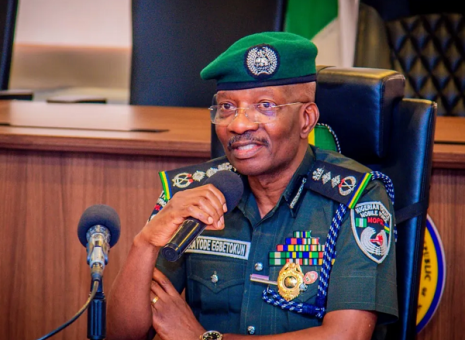
The directive was issued at the security meeting the president held with the Chief of Army Staff, Lt General Waidi Shaibu; the Chief of Air Staff, Air Marshal Sunday Kelvin Aneke; the Inspector-General of Police, Kayode Egbetokun; and the Director-General of the Department of State Services (DSS), Tosin Adeola Ajayi, in Abuja.
Henceforth, VIPs who want police protection will now request well-armed personnel from the Nigeria Security and Civil Defence Corps (NSCDC).
Before the ink with which the presidential spokesman, Bayo Onanuga, wrote his press release on the matter dried up, reports say some of the affected VIPs had been inundating police headquarters with calls seeking more clarifications over the development and expressing fears, based on the prevailing security situation in the country.
The major concern of these VIPs is whether the NSCDC has the capacity to protect them, considering their training and requirements. “He (a VIP) told us that it will be like engaging Boys Scouts to protect them as the mobile policemen they normally engage are more agile and battle-ready to confront any situation.”
Another VIP told Vanguard: “The practice of providing police escorts to high ranking officers and VIP’s has become a major feature of the security landscape in Nigeria, but it must be noted that as the country grapples with growing security concerns, the use of police personnel for VIP protection has raised significant questions about its broader implications on public safety and the overall effectiveness of the police force.”
This VIP would even seem more considerate, considering the attempt he made to strike a balance between public safety and individual safety. So, rather than the blanket ban or withdrawal that could lead to increase in the prevailing fears of insecurity, he called for rationalisation of the exercise.
“The justification behind this practice often rests on the high-profile nature of individuals involved, the perceived threat to their safety, and the desire to project power and influence.
”While these measures are meant to offer security for influential figures, the broader implication is that they come at a high cost to the public, both in terms of the security resources diverted and the moral perception of a system that favours the few over the many,” he said.
Fair argument, if you ask me.
But, we should have expected the big people affected by the directive to react the way some of them did. Nigeria’s big men do not want to lose any privilege. After all, this is not the first time that such order for the withdrawal of policemen serving VIPs would be made. In the last 20 years or so, there has not been an inspector-general of police that did not issue such directive.
As far back as 2003, the then IGP, Mustafa Adebayo Balogun initiated one of the earliest major attempts to withdraw police orderlies from judicial officers and politicians nationwide, essentially to prevent abuse of the police officers.
Ogbonnaya Onovo, who succeeded Balogun, in August 2009 issued a sweeping order mandating all police personnel serving as private orderlies to return to their bases. This directive extended to former heads of state, ministers, legislators, and governors. Onovo gave a seven-day deadline for the order to be complied with. He said he was disturbed by the degradation of police professionalism caused by officers performing menial tasks such as carrying handbags or opening doors for VIPs. As at that time, there were 100,000 such policemen attached to the VIPs.
Then Hafiz Ringim, who succeeded Onovo. He reinforced the withdrawal policy by cautioning officers guarding unauthorised individuals to return to their commands or face arrest and prosecution. To underscore his seriousness on the issue, he established a special monitoring unit to ensure adherence to the directive, signalling a more rigorous enforcement approach.
Then Mohammed Abubakar, Solomon Arase, Ibrahim Idris, Mohammed Adamu, Usman Alkali Baba, and Kayode Egbetokun, the incumbent Inspector-General of Police who had also repeated the same ritual. That it had to take President Tinubu to personally make the order this time around means that he also appreciated the need for such an order to come from the seat of power.
The thing is; in all the cases, the big people have always complained and their police security men restored.
So, I saw the silence-enough-to-be heard protest coming. I knew that the big men would kick against the presidential order even before the ink used to pen the press release on it dried up. Nigeria’s big men do not want to lose any privilege, no matter how obnoxious. And they have a surfeit of them. Otherwise, how do you explain that in a country of over 220 million citizens being served by about 370,000 policemen, more than a third of the number was allocated to VIPs?
Are such people fair to Nigerians? Do they have two heads? And are the other Nigerians who had to be deprived so the VIPs could breathe not entitled to police protection? Is it not the same one life that the VIPs have that the ordinary Nigerians too have?
Although some would make the point that it is not all about numbers; but numbers also matter. Freeing a whopping 100,000 policemen to complement those on the field should definitely make some impact on the terrible security situation in the country. The United States, for instance, protects its 341 million population with about 750,000-strong law enforcement officers. This is an average of one policeman to about 455 persons.
Nigeria’s population is about 232.6 million and it is being served by about 270,000 policemen (less the 100,000 others assigned as security to VIPs). This is a ratio of about 1:859 persons.
With this, it is clear that Nigeria is disadvantaged and underserved in virtually every policing index unlike the U.S. that has the advantage of technology to leverage in terms of internal security. So, if we are able to free about 100,000 policemen to join the 270,000 that are presently doing strictly policing, the ratio would increase to 1: 600. Other things being equal, this should reflect in effectiveness and efficiency.
The fact of the matter is that, in Nigeria, virtually everything under the sun is a status symbol. I remember when the global system for mobile (GSM) communication phones came into the country in 2001, you would see some of our big men trying to pause one call for another in the open, to show off the number of telephones they owned, courtesy of GSM. Some of them even engaged personal assistants essentially for the purpose of carrying the phones for them. GSM telephones then were status symbols.
When we see policemen guiding many of our VIPs, we know it is not only about security; it is also a status symbol. It is something to let the community know that one has arrived, or that levels have changed. That is not all. Many at times, some of these policemen help their new ‘masters’ fight personal battles, that is when they are not turned to errand boys by not only ‘oga at the top’, but ,madam at the bottom,, and the kids as well.
And they do these errand boy jobs even better and gladly than the professionals because of the extra bucks that such jobs fetch them. Obviously, their miserable take-home pay cannot take them home.
For Nigeria, this is not the best of times to over-pamper a select few at the expense of the generality of the people. The country is at war with terrorists and we need all hands on deck to win the war.
So, am I now saying that some Nigerians do not deserve extra protection even by the very nature of their public assignments? NO! For most rules, there are exceptions. We cannot say, for example, that our judges should be left to their own devices. There are other categories of public officials who require police protection; they should be accorded the privilege. Others may, as the president rightly suggested, look toward the NSCDC for cover.
But, the government should work out, on a sustainable basis, the number of policemen to recruit annually to reduce the manpower shortage in the force. The then President Olusegun Obasanjo had in 2000 ordered the police force to begin an annual recruitment of some 40,000 men for four years to bridge the gap. I do not know if this was followed throughout his eight years in office, and even subsequently. This cannot be the spirit in a country with serious security situation like ours. The recruitment and training should be regular and sustained until such a time when we know that we already have enough or close to enough.
The fact is: we have been too lackadaisical about security. That explains why we could have abandoned the police force for so long. Now that we are facing the stark reality of that neglect, the very people who should have done something about the situation are the ones crying for special protection; a thing that had always blinded them to the reality on ground. What I am saying is that our big men, particularly those who are in position to make a difference to our lives should not continue to live in the illusion that all is well when that is far from being correct. When they are given police protection, they cannot understand when the hoi polloi say there is insecurity in the land. I learnt many politicians of northern extraction cannot go to their towns and villages due to insecurity. When they also have a feel of what the ordinary people see and feel daily on insecurity, they would realise the mistake they have made over the decades by leaving the country under-policed. And not only under-policed, but under-paid, poorly kitted, ill-trained, ill-accommodated and ill-motivated. All the ‘ills’ are present in the Nigeria Police Force! We must be prepared to address them if we are to sleep with our two eyes closed.
It is ungodly and inhuman for a country that is battling terrorism, mass abductions and violent crimes to reserve 100,000 policemen to protect probably less than 250,000 Nigerians while 270,000 others are protecting the majority 230 million. It is absolutely absurd.
What, in my view, the president can do is try to give a three-month period within which to allow for the training of the NSCDC personnel that would take over VIP protection from the police. Henceforth, VIP protection should be a permanent feature of their training.
Then the salaries of all the security personnel must be reviewed, as well as their condition of service, to make their job attractive and enhance their performance.
This would appear the first time that such directive on police withdrawal from VIPs would be coming from an incumbent president. That being the case, it is expected that there should be a difference in implementation this time around. Normally, when a president speaks, it is like an oracle has spoken and I believe President Tinubu understands this.
Meanwhile, where is State Police in all of these?