

Is Nigeria’s democracy in danger, and President Bola Tinubu transmogrifying into a one-man dictatorship? That is the new swansong of some elements of the opposition, with Mr Peter Obi of the embattled African Democratic Congress (ADC) even, rather comically, characterising the incumbent ruling APC administration as being worse than late General Sani Abacha’s brutal dictatorship. Of course, Peter Obi does not surprise. He is often given to hasty generalisations, muddled thinking and superficiality in analysis. But the articulate and eloquent Bashorun Dele Momodu, also of the ADC, surprisingly echoed this view in a recent interview on national television.
No one knows better than the veteran journalist and publisher turned politician that the Abacha regime was perhaps the most vicious and murderous dictatorship in Nigeria’s history. Dele Momodu was a victim of the regime’s oppressive and asphyxiating rule. But to even remotely compare Nigeria’s contemporary political dispensation with the worst form of military praetorianism is grossly inaccurate and exaggerated.
In the interview in question, Bashorun Momodu claimed that the ruling APC is controlling and manipulating key institutions of the state, including the electoral umpire, the security and anti-graft agencies, as well as the judiciary, to destabilise, denigrate and destroy the opposition. Thus, Nigeria is being turned into a one-party and one-man dictatorship. It is understandable for leading opposition politicians to suspect the hands of the ruling party in the inexplicable crises in which the leading opposition parties – the PDP, Labour Party (LP) and now ADC – have been embroiled.
But it is not enough to levy these grave allegations. They must be backed with concrete evidence to be credible. It would appear that the magnetic attraction of the ruling party for opposition governors, legislators and members is less due to the dictatorial aspirations and manipulations of an all- powerful President Tinubu and more a function of the political vagrancy that had been ingrained in Nigeria’s political culture since the first Republic. There is always the tendency for opposition elements to gravitate towards parties in control of power and resources, both at the centre and in the states.
This tendency predated the ascendancy to power of the Tinubu administration. It was characteristic, for instance, of the 16-year rule at the centre of the PDP, which, after the 2007 elections, controlled at least 31 of the 36 states in the country. A former National Chairman of the PDP, Dr Okwesilieze Nwodo, boasted openly that the PDP would be in power for no less than 60 years. It was not an illegitimate aspiration in a democracy and, as far as I can recall, did not elicit cries of attempts to impose a one-party or one-man dictatorship on the country.
Ever before the emergence of Tinubu as President of Nigeria, that office had often been described as one of the most powerful political positions in the world. Its influence thus has nothing to do with the allegedly inordinate ambitions of the incumbent. The office of the President was no less powerful under former Presidents Olusegun Obasanjo, Umaru Yar’Adua, Goodluck Jonathan or Muhammadu Buhari. One of the most vivid manifestations of the power of the Nigerian presidency was the routing of the defunct Alliance for Democracy (AD) in five of the six states the party controlled in the Southwest in the farcical 2003 governorship elections of dubious credibility.
Incidentally, former Vice President Atiku Abubakar, the moving spirit behind the hostile takeover of the ADC by the anti-Tinubu coalition, has openly claimed credit for being the mastermind behind the PDP’s electoral abracadabra, particularly in the Southwest in 2003. At the end of the political Tsunami of that year, President Tinubu, then governor of Lagos State, remained the only governor standing on the platform of the AD while the party sank into an interminable crisis alleged to be fuelled by the ruling PDP. Its National Chairman, Alhaji Abdulkadir Ahmed, became a Special Adviser in the President Obasanjo administration, and the AD sank gradually into oblivion.
In the same vein, the then major opposition party, the All Nigeria People’s Party (ANPP), descended into a protracted intra-party crisis, its National Chairman, Alhaji Mahmud Waziri, became an appointee of the Obasanjo administration, and the party lost its political and electoral viability. Nigeria became a one-party dominant state under the hegemony of the PDP behemoth. But there were no cries of deliberate attempts to deform Nigeria’s democracy into a one-party tyranny. Rather, Tinubu and other opposition elements explored and utilized opportunities in the democratic space – a free media, basic human rights, opportunities for Judicial redress etc – to organize, mobilize and plan, culminating in the historic 2015 dislodging of the PDP from power at the centre.
Even as leading opposition elements shout themselves hoarse about the alleged imminent death of democracy in Nigeria at the hands of a supposedly omnipotent and omnipresent Tinubu dictatorship, it is gratifying that they are effectively utilising the opportunities of Nigeria’s democratic structures and processes to mobilise, vibrantly express their grievances and pursue countervailing actions. Democracy is alive and well in Nigeria after all. For example, the contending factions of the ADC held separate public demonstrations during the week, seeking to influence public opinion and put pressure on the Independent National Electoral Commission (INEC) to accede to their respective opposing demands.
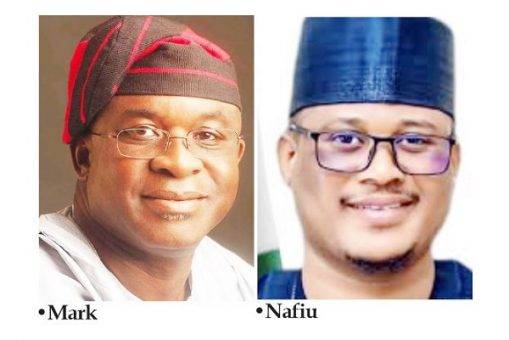
This implies the continued existence and vibrancy of such basic freedoms of speech, thought, movement and association that are alien to an Abacha-type dictatorship alleged to have resurrected in Nigeria. Indeed, Nigeria’s media remains virile, active with opposition parties and politicians, and even enjoying an edge in media dominance. The depth of the crisis plaguing the ADC is illustrated by the action of at least 25 states’ Chairmen of the party who converged in Abuja to denounce both the David Mark and Nafiu Gombe tendencies in the party and to attempt to forge a third force to chart a way forward for the party.
It is obvious that these elected members of the National Executive Council (NEC) of the party were not carried along in the decision by some members of the National Working Party (NWC) to vacate their positions and hand the party over to its new, invading, powerful members.
The bleeding wounds of the ADC are largely self-inflicted, and the ruling APC cannot be blamed for taking advantage of opportunities to strengthen its position and brighten its chances in the next polls. It is unlikely that the ADC would behave any differently were the odds in its favour. Why did we have the emergence and consolidation of a viable opposition that ultimately was able to dislodge the PDP from power in 2015? Was it due to the benevolence of the erstwhile ruling party? Most certainly no, as we have shown above. It was more because of the steadfastness, resilience and willingness of key members of the opposition to sacrifice personal interest for the achievement of a common purpose of winning control of power at the centre.
It is this kind of spirit that factional members of both the PDP and APC, led by Alhaji Tanimu Turaki and Governor Seyi Makinde on one hand and Senator David Mark and Alhaji Atiku Abubakar on the other, demonstrated when they held exploratory collaborative talks in Abuja during the week. The seeming strengths and triumphs of the ruling party are due more to the divisiveness of the opposition, the selfish pursuit of selfish personal ambition by its leading elements to the detriment of collective group purpose, than the strategic genius of the APC.
After weeks of unproductive grandstanding, arrogant but impotent threats and whinings about oppressive inclinations and hegemonic aspirations of the ruling APC; the latter’s alleged capture of critical state institutions, the David Mark-led tendency of the ADC has done the more rational thing of exploring current democratic possibilities to seek Judicial redress and regain its control of the party. It remains a mystery why, instead of complying with the earlier court order that the David Mark group should come before it to show reason why Nafiu Bala Gombe ‘s request to be recognised as National Chairman of the APC should not be granted, the former proceeded on appeal to the higher court, questioning the lower court’s jurisdiction.
The David Mark group this week did the needful by returning to the Federal High Court to resolve the party’s contending leadership claims and seeking an accelerated hearing of the case as ordered by the Court of Appeal. On the contentious issue of what constitutes a return to the “status quo ante bellum”, the appellant’s lawyer, Sulaiman Usman (SAN), contended that it refers to “the last lawful, uncontested state of affairs before the institution of the suit” and stressing that “As at September 2, 2025, when this action was instituted, the 2nd defendant, (Senator David Mark), was the recognized National Chairman of the 1st defendant. The said leadership structure had already been constituted.”
Unfortunately, the David Mark-led ADC allowed so much time to elapse before instituting this case despite its being able to muster strong points in its favour. As the ultimate triumph in the court of the Mrs Nenadi Usman faction of the Labour Party (LP), which had Mr Peter Obi in its camp before he left for the ADC, shows, justice can still be obtained in our courts, and there is no cause for the opposition to seek to erode the legitimacy of critical national institutions for partisan political ends.
The ruling party does not have a responsibility to spoon-feed the opposition or help nurture it to vibrancy. Nobody did the APC any such favour when it constituted the opposition. Rather, it pulled itself up by its bootstraps and fought its way to its current ascendancy. But the opposition must take solace in the fact that the PDP was once as hegemonic as the APC is today, but still lost power in 2015. If it was achieved before, the feat can be replicated even if the opposition’s sights must now realistically be focused beyond 2027 to 2031. Meanwhile, the opposition must face the challenge of organizing and getting itself in shape rather than whine unproductively about an imaginary Tinubu dictatorship.