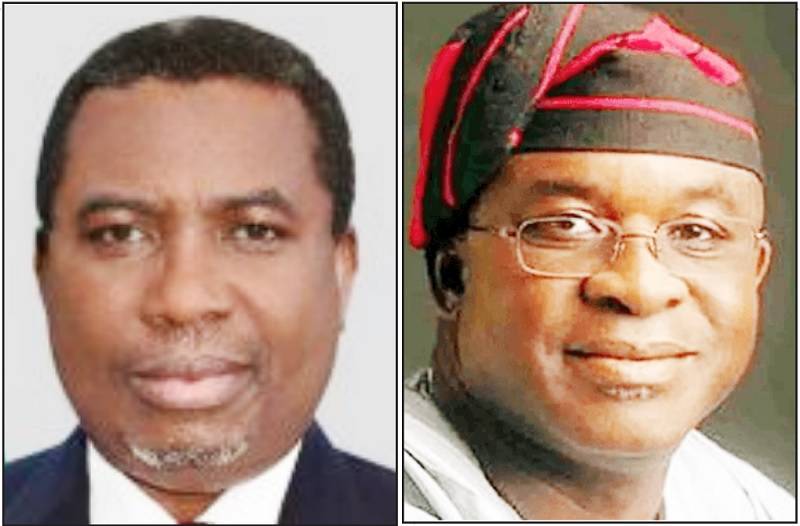



Nigeria may be heading for perilous times, not from economic threats, but from baleful political rhetoric. Last Thursday, responding to the Independent National Electoral Commission’s delisting of the caretaker executive committee of the opposition coalition African Democratic Congress (ADC), factional party chairman David Mark not only threatened doomsday if the delisting was not reversed, he also declared the party’s loss of confidence in the electoral body and its chairman and commissioners. His rhetoric was characteristically fierce and apocalyptic, if somewhat ironic. As a military officer, he possessed a fiercely antidemocratic inclination, and infamously advocated the annulment of the 1993 presidential poll won by the late MKO Abiola. Yet he rose to the senate presidency never needing to show any evidence he had become a repentant democrat or became amenable to democratic principles.
Since leaving the senate, he has still not shown any inclination towards democracy, and has neither spoken up for, nor openly and persuasively advocated, democracy. Exhumed from retirement last year by the former vice president Atiku Abubakar-led coalition group, and thrust upon the sensibility of the nation one more agonising time, his political methods have predictably revolved around either getting his way or destroying the bone of contention. For him, always, there is no middle ground. This was why instead of laying his party’s argument before the public regarding last week’s INEC intervention, he simply dictated what seemed like an ultimatum to the nation and hoped for, or incited, an uprising on behalf of the ADC around which he argued favourable public opinion had coalesced. In short, he spoke daggers and used them.
The bones of contention were, however, engagingly simple. Firstly, Sen. Mark insisted that before the Atiku-led group took over the ADC on July 29, 2025, all former party executives led by Ralph Nwosu collectively resigned and emplaced a new executive group. He described the process and listed the dates. However, still in contention before the courts was the claim by the only surviving national vice chairman of the party, a certain Nafiu Bello Gombe, that he was not among those who resigned. So far, no one has produced in court or elsewhere his alleged letter of resignation. INEC acknowledged that since the controversial resignation issue was still before the courts, it was premature to have listed, and invariably approved, the Sen. Mark-led executives. By withdrawing its recognition of the Mark-led Exco, in obedience to the March 12, 2026 Court of Appeal ruling that ordered a return to status quo ante bellum, a second conundrum was immediately triggered.
Secondly, both feuding groups proceeded to interpret what the appellate court meant by a return to status quo ante bellum. The Sen. Mark-led group insisted the status quo ante bellum started counting from when their group was emplaced. They cited dates and witnesses, among whom, they pointed out, were INEC observers. Mr Gombe insisted that the status quo could only make meaning when it is counted from the position before his September 2, 2025 suit, arguing that the ADC constitution empowered him to assume the leadership of the party in the absence or resignation of Mr Nwosu. After all, his tenure was yet to expire when he was booted out. Neither the Mark group nor the Gombe group had sought for a court interpretation of what that status quo meant or precisely what position pre-September 2 indicated: before the inauguration of the Mark Exco or after in order not to render the trial court’s proceedings an academic exercise.
Instead, they both helped themselves to their individual interpretations. INEC, however, simply cut the Gordian knot by issuing its own interpretation of the contentious order. It is possible the electoral body got the interpretation wrong; but for the ADC leaders to insinuate collusion, conspiracy, and antidemocratic moves by both INEC and President Tinubu appears far-fetched and a deliberate act of incitement. The ADC could easily have returned to court to get the matter resolved; for delay in this matter may not necessarily amount to denial.
Mr Gombe is convinced he cannot lose the case because he did not resign with the rest of the Nwosu-led executives, and ADC leaders have not been able to present any resignation letter, forged or real, before the courts. But he could issue no threats, perhaps because he had no crowd of supporters behind him. Sen. Mark, on the other hand, is backed by powerful forces, and has made sweeping statements, issued threats and ultimatums, appealed to the international community for solidarity and intervention, incited uprising, and conjured doomsday. As far as he was concerned, he could smell APC’s mischief. But a cursory consideration of the judicial facts suggests that INEC was probably righter than the ADC in taking the precautionary steps it took to preserve the integrity of the case until the trial court delivers judgement.
Any other position would have, as the electoral body argued, foisted a fait accompli on the court or rendered the eventual judgement or even the proceedings nugatory. The ADC should have approached the matter more maturely, more responsibly given the fragility of the Nigerian democratic experience, and more futuristically in order to preserve and stabilise the polity.
Indeed, it could theoretically still win the argument, win the case, and convince the public that it has so much more to offer than the impression its desperation for high office gives.
For now, however, it is clear that the ADC leaders are neither interested in promoting and nurturing national institutions, and are desperate to win office because after the next election cycle, should they lose either in the polls or by default, their geese would be cooked.
Worse, by their incendiary statements and reckless attributions, they don’t appear to mind fracturing the country should their ambitions be legitimately foiled.